

Cracking the Code: Can Australia Sustain More Homegrown Unicorns?
Guest blog by Kumar Abhishek, Aurangzeb Badini, Rafael Letizio and Raja Muhammad Irfan Sadiq
In 2008, a Melbourne-based startup called 99designs set out to transform how businesses access graphic design. The platform connected companies with a global network of designers, quickly gaining traction and becoming one of Australia’s most recognized early tech startups. It had strong founders, global demand, and a scalable digital product; ingredients typically associated with high-growth technology firms. Yet despite its early promise, the company ultimately exited through acquisition by a U.S.-based firm in 2020. While the deal represented a successful outcome for founders and investors, it also reflects a broader pattern: many Australian startups create innovative products but struggle to scale independently into global technology giants from within the domestic ecosystem.
This pattern raises an important question about the structure of Australia’s innovation economy. The country has built many of the ingredients required for a thriving technology sector. In 2024–25, Australia invested $14.4 billion in research and innovation, and the tech sector raised $4 billion in venture capital across 414 deals in 2024. Universities produce world-class research, founder talent continues to grow, and policymakers are increasingly focused on strengthening the technology ecosystem. On paper, these indicators suggest a healthy innovation environment.
Yet the critical issue is not whether Australia has strengths—it clearly does. The real question is whether the broader system surrounding startups is designed to convert those strengths into durable commercial outcomes at scale. Our research assessed the competitiveness of the Australian tech ecosystem in a global context, examining how the conditions that surround technology companies shape their ability to capture value from the innovation they produce.
This means looking beyond individual companies and asking deeper system-level questions. How does growth capital flow through the ecosystem? Do procurement systems allow startups to test and scale their technologies domestically? Are regulatory frameworks flexible enough for fast-growing technology firms? And are public support programs designed to help companies move from early innovation to global market leadership?
Importantly, this research is not about assigning blame to any single actor. Founders, investors, procurement teams, and policymakers are each responding rationally to the incentives and constraints they face. The goal of this work is to understand what those conditions actually look like, from the perspective of the people closest to them, and how they shape the journey of Australian startups attempting to scale globally.
Because ultimately, the challenge is not just about creating innovation in Australia. It is about ensuring that Australia captures the economic value of the innovation it produces, through high-value jobs, productivity gains, and long-term economic growth.
That was the problem our team set out to explore during our PDIA journey. Initially unfamiliar with the topic, we began by formulating hypotheses, reviewing reports, and engaging with stakeholders who could challenge or validate our assumptions. The iterative nature of the process quickly proved essential. Each round of discussion and evidence gathering reshaped our understanding of the problem, often forcing us to reconsider earlier conclusions. From the first version of our analysis to its final form, our list of potential root causes changed significantly as new insights emerged.
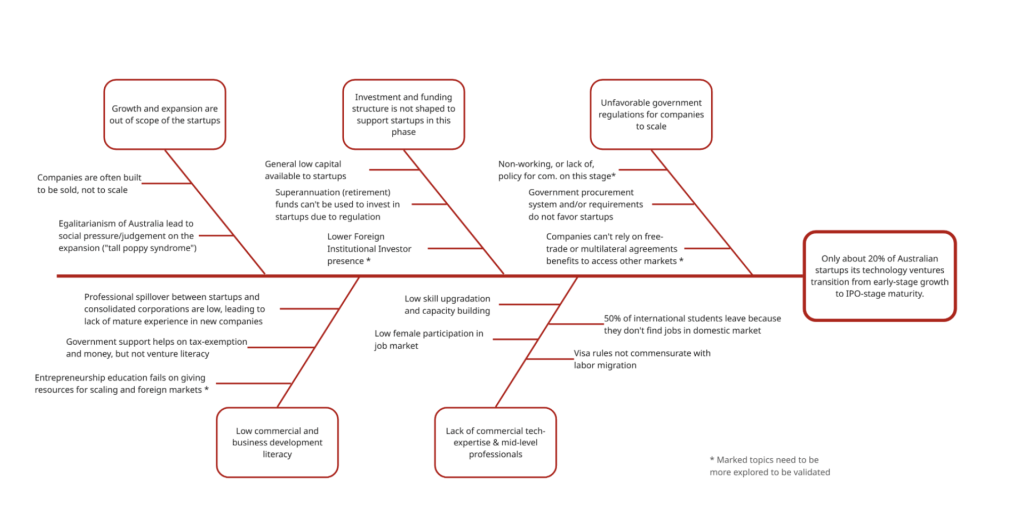
Problems and root causes, organized as a fishbone diagram during initial problem exploration.
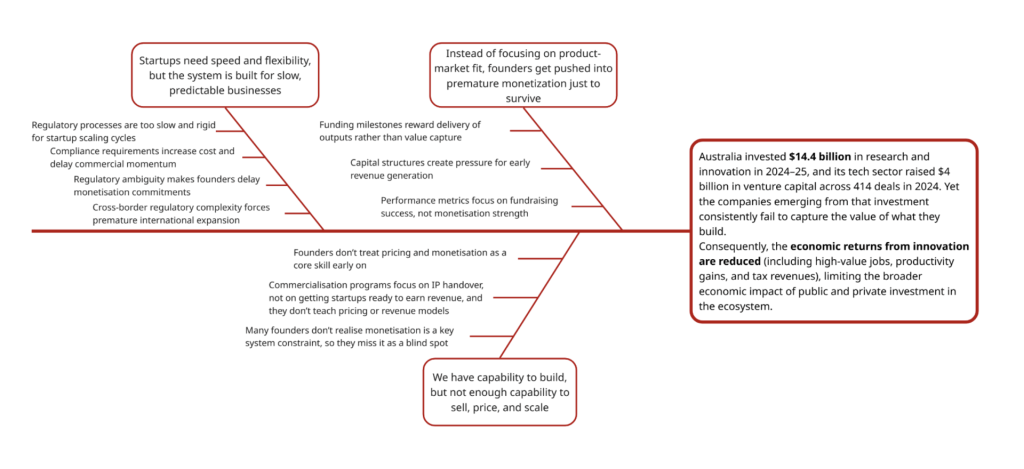
Final problem-causes structure, post extensive stakeholder consultations and feedbacks.
One of the most valuable tools in this process was the fishbone diagram, which helped us systematically unpack the causes behind the initial problem narrative. Rather than treating startup scaling as a single challenge, the diagram pushed us to explore multiple dimensions of the ecosystem, from investor incentives and commercialization capabilities to regulatory and procurement structures. The diagram evolved from a broad set of hypotheses into a more structured diagnosis of how ecosystem signals shape the way startups pursue growth and monetization.
Throughout this process, the role of our authorizer, Jorida Zeneli, was essential. Acting as both a discussion partner and a bridge to the ecosystem, she helped us refine our questions and identify areas where deeper investigation was needed. More importantly, the authorizer role gave the project a sense of real-world relevance: our work was not only an academic exercise, but part of a broader effort to understand challenges facing the Australian startup ecosystem.
To complement our desk research, we actively engaged with stakeholders across different sectors. Our goal was to gather perspectives from people directly involved in the innovation ecosystem, and we talked to people ranging from founders and marketing professionals to public sector actors. These conversations helped surface new hypotheses. For example, a discussion with Captain Russell Barton pointed us toward procurement systems as a potential constraint on startups’ ability to capture value, leading us to explore how contracting structures may influence pricing and monetization decisions.
As stakeholder engagement within the Australian ecosystem proved more challenging than initially expected, we adapted our approach. In addition to conducting structured interviews, we developed an online survey targeted at founders at different stages of company growth. While interviews provided richer qualitative insights into individual experiences, the survey allowed us to collect more structured responses across a wider group of entrepreneurs.
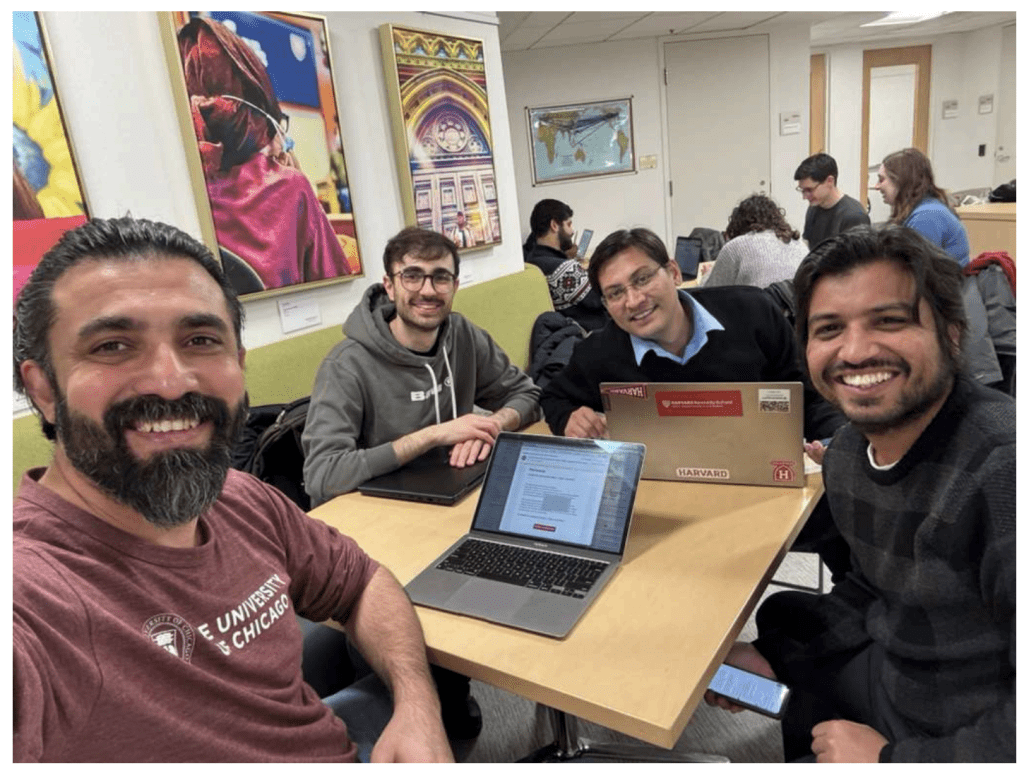
Working in a small team under tight timelines highlighted how important communication and commitment are for collaborative problem solving. Even more importantly, how important the team is in providing space for discussion, exchange of ideas, and to brainstorm and validate together hypotheses and approaches.
As our diagnosis became more structured, we applied the PDIA Triple-A framework (Authority, Acceptance, and Ability) to evaluate where there was space for action. Rather than assuming that the most visible problems were also the most actionable, this exercise forced us to consider whether the actors involved actually had the incentives, and capacity to address them. In several areas of the ecosystem, including government regulations and venture capital behavior, our team quickly realized that neither we nor our authorizers had the authority to drive direct change. This pushed us to think more carefully about where intervention could realistically occur.
Through this process, we concluded that building authority around the problem itself was an important first step. Many of the issues we identified appeared to be widely experienced but not always clearly articulated at the ecosystem level. As a result, our proposed entry points focused beyond prescribing immediate policy change, acting also on strengthening the ecosystem’s ability to recognize and address these barriers. Initiatives such as developing a commercialization early warning insolvency framework or producing an ecosystem pain-points report aim to build shared understanding and legitimacy around the issue, creating a foundation from which more structural reforms could emerge.
One of the most lasting impacts of this experience is how it reshaped the way we approach complex policy and organizational challenges. In many professional environments, there is strong pressure to quickly propose solutions or strategic plans. This project highlighted the importance of slowing down that impulse and investing time in understanding the system surrounding the problem. Conversations with stakeholders, evidence from reports, and internal discussions often revealed aspects of the ecosystem that were not visible at the beginning, reinforcing the value of structured exploration before committing to specific interventions.
The process also showed that progress on complex challenges often comes from small, practical steps rather than large, comprehensive reforms. Many of the ideas we developed were not sweeping policy solutions, but targeted actions designed to build understanding, legitimacy, and collaboration within the ecosystem. This approach does not remove uncertainty, but it provides a way to move forward despite it, focusing on testing ideas, learning from feedback, and gradually expanding the scope of action.
Perhaps the most valuable takeaway from this experience is that complex problems rarely reveal themselves fully at the beginning. And that’s where the PDIA approach proves especially valuable. Rather than starting with predefined solutions, the process emphasizes gradual problem construction, experimentation, and continuous learning. As happened in our journey, we hope that future students, practitioners, and policymakers allow themselves to dive deeply into the problems they are working on, one small iteration at a time.
This is a blog series written by students at the Harvard Kennedy School who completed “PDIA in Action: Development Through Facilitated Emergence” (MLD 103) in March 2026. These are their learning journey stories.