
Bridging Education and Economic Growth in the United States
Guest blog by Kenneth Balcarcel, LEG ’25
I can’t believe it—10 weeks have flown by! When I enrolled in Harvard’s Leading Economic Growth Program, it wasn’t just a professional decision; it was a personal milestone. The curriculum, the chance to learn from world-class professors, and the depth of Harvard’s knowledge were all reasons I signed up.
My focus has always been education as a tool for inclusion and economic growth. This program promised to give me new frameworks and reshape old ones—and it delivered.
Early on, we explored opportunities in growing industries. Living in Chicago, I know the U.S. is the land of opportunity, but creating new industries here is challenging. What struck me was learning how industries evolve within cities—this ‘molecular’ approach to decision-making expanded my understanding.
Here’s why this matters: economic growth often comes from adapting existing structures rather than starting from scratch. Think of it like this: we don’t need to reinvent the wheel—but we do need to evolve its components. A tractor needs different wheels than an F1 car. The same principle applies to problem-solving. This program gave me the visuals and frameworks to realize that while others may have solved similar problems, I don’t need to copy their solutions—I need to adapt them to my context and goals.
My work focuses on adult education, teaching English as an additional language and helping adults earn their high school diplomas. One major challenge we face is communication barriers—many of our students don’t speak English.
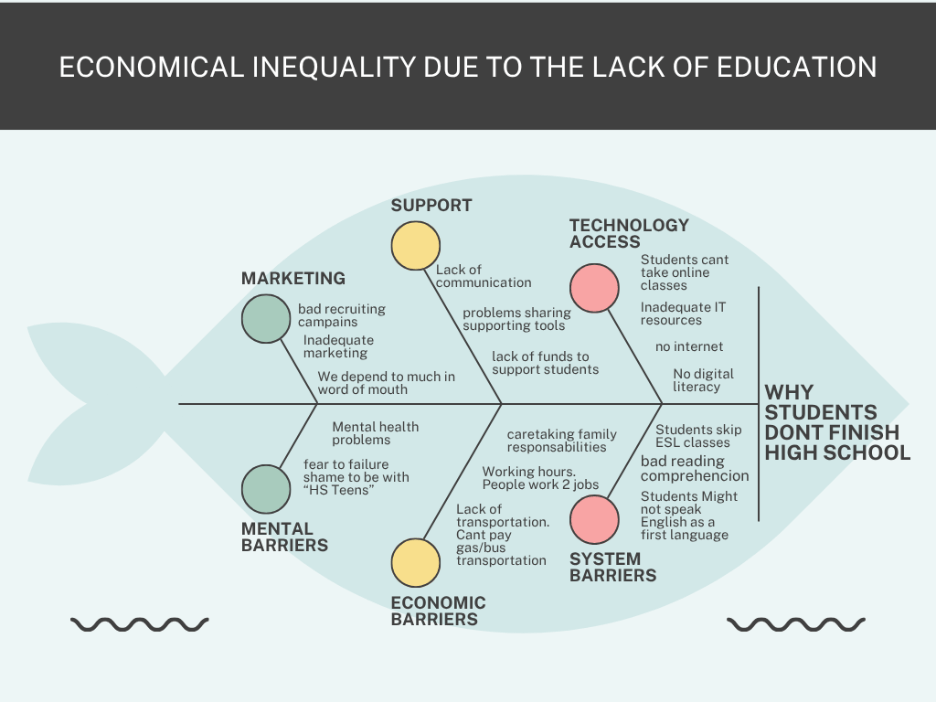
During one session, we learned about the Fishbone Problem-Solving Method, which helps break down complex issues into manageable parts. Using this approach, I connected with other organizations and discovered ‘language access kiosks’—tools that provide multilingual cards, translation technology, and essential information.
Inspired, I reached out to companies that provide translation devices—and secured some for free! We’re now launching a pilot program to see how these devices can support our EAL students. This happened within just 10 weeks of starting the program.
This proves a key point: structured problem-solving and collaboration unlock resources you didn’t know existed. By focusing on one problem at a time, we can move toward systemic solutions.
Another ‘bone’ we’re tackling is student transportation. We’re exploring partnerships with local entities to secure affordable transportation and even create policies to reduce costs. Why? Because research shows that transportation barriers are one of the top reasons adults drop out of education programs. Solving this could dramatically improve retention and outcomes.
One comment from Professor Hausmann really resonated with me:
“We didn’t get out of the Stone Age because we ran out of stones. We got out because we needed to evolve.”
We still use stones today—but in new ways. That mix of old and new technologies is essential. Things don’t stay the same forever; they change, and we must evolve with them. This lesson applies not only to work but to life.
The Problem-Driven Iterative Adaptation (PDIA) approach is already producing results—and I’ve only just finished the program! I’m excited to continue collaborating with other organizations, shaping policies, and solving problems.
I’m also eager to take another program and keep learning from this incredible community of professors and peers.
This is a blog series written by the alumni of the Leading Economic Growth Executive Education Program at the Harvard Kennedy School. 63 Participants successfully completed this 10-week online course in December 2025. These are their learning journey stories.