
Beyond the Plan: Learning to Address Emerging Technology Risk Across the Financial Industry
Guest blog by Kristina Angelova, IPP ’26
I came to Harvard Kennedy School’s Implementing Public Policy programme hoping to become better at addressing a difficult professional challenge. I expected new tools and stronger analytical frameworks. What I had not expected was how much I would need to reconsider my own role.
I had been asking: What would a better solution look like? Over the following months, another question became just as important: How do I help people discover and develop that solution together?
A different question about technology risk
My implementation challenge concerned how financial institutions identify, escalate and respond to emerging technology risks, including artificial intelligence, cyber risk and digital assets. I approached it as a financial-industry challenge with international relevance, not one confined to a city, country or institution. I wanted to explore how governance, decision-making and cross-functional learning could adapt, recognising that each institution’s response must fit its context.
Initially, my instinct was to focus on better governance arrangements. Through Problem Driven Iterative Adaptation (PDIA), I began examining what might prevent those arrangements from working in practice. Who sees a risk first? How does that understanding travel between functions? Where might responsibility become unclear? Are we even describing the same problem?
Revisiting my fishbone diagram helped me consider possible connections between ownership, information, incentives, capability and learning. The branches were not findings to defend; they were hypotheses to explore. I stopped expecting the diagram to prove that I understood the problem and began using it to see what I still needed to understand.
An industry-wide challenge still needs a specific starting point. Mine became smaller: one coordination barrier, one risk pathway and a few relevant people. A smaller beginning did not mean a smaller purpose.
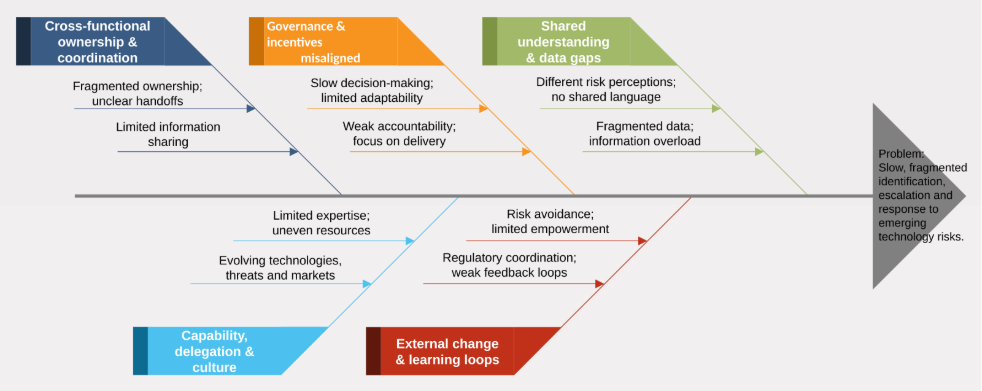
My evolving fishbone diagram: possible causes to investigate, not findings about a particular institution.
Learning to recognise progress honestly
The regular check-ins brought me back to four questions: What did I do? What did I learn? What am I struggling with? What is next? Those questions made me look beyond the document I had produced and consider what had actually changed.
My initiative remains a work in progress. The clearest gains so far are a more focused problem statement, an evolving fishbone, a cumulative learning-and-leads log, and a better understanding of the engagement needed next. These are meaningful gains, but they are not yet evidence of improved risk management in practice.
That distinction has become important to me. A stronger diagnosis is not a tested solution. Identifying a stakeholder is not securing their commitment. Encouragement is not the same as permission to act.
The authority, acceptance and ability analysis helped me think more carefully about where a practical opening might exist. Instead of seeking a broad mandate, I began shaping smaller requests with clearer boundaries and a defined report-back. I also learned to recognise the value of relationships that bring knowledge, challenge and new connections. Our peer discussions showed that support can grow, but it can also recede; authorization needs continuing attention.
A classroom that practised what it taught
The week on the Harvard Kennedy School campus brought the learning to life. Meeting our faculty, teaching team and cohort in person, working through exercises and continuing conversations over lunch made the programme feel like a shared endeavour. I felt fortunate to be in that room, learning from people who gave so generously of their experience.
Matt Andrews, Senior Lecturer in International Development at Harvard’s Kennedy School of Government, brought remarkable knowledge, warmth and a genuine love of teaching to the classroom. His examples and personal experiences made difficult implementation questions tangible. His emphasis on choosing work we genuinely care about stayed with me. I understood it as a reminder that we care for what we love, and that a clear purpose helps us keep going when progress is slow. His questions brought me back to what I had learned and what I would do next.
Salimah Samji (Executive Director, Building State Capability) made participation central to the learning. Her practical exercises, thoughtful questions and respectful encouragement created room for us to test ideas and learn from one another. I particularly appreciated the coordination and mutual respect between our two lead educators: they demonstrated the collaborative leadership we were discussing.
Elizabeth Linos, Professor of Public Policy and Management, sharpened my attention to how engagement is designed. I took away the need to make a request clear, practical and manageable for the person receiving it.
Robert Wilkinson (Senior Lecturer in Public Policy and Leadership) encouraged me to examine my assumptions, the messages I send and the space I create for others through his 4Ps framework-perception, projection, people and process. His Shackleton discussion stayed with me as a lesson in adapting the route while protecting what matters.
Santiago Creuheras, our teaching fellow and mentor, provided thoughtful feedback and encouragement throughout the assignments. He recognised the learning while consistently asking what more could turn preparation into engagement. I am grateful, too, to the programme team whose care and organisation made space for this experience.
The Change Makers – and the person I need to become
At the start of the programme, we were told: “Your group is your gift.” I understand that much better now. Our peer group, the Change Makers, brought together people from different countries and fields, yet we recognised familiar struggles: competing priorities, uncertain authority and changing plans. The gift was not that someone always had the answer. It was having people willing to listen, challenge my assumptions and help me see a way forward. We were learning with one another, not simply alongside one another.
The group also gave me somewhere to explore a question relevant to sensitive professional environments: how can people learn together while respecting confidentiality? The discussion reinforced that trust and shared purpose matter, but neither replaces appropriate information-sharing boundaries.
Some of my hardest learning was about myself. In class, I described the difficulty of letting others take ownership when I feel responsible for quality. The delegation model offered a middle ground: map the work together, provide support, check in and expand autonomy as capability grows. I can take responsibility without taking every task back. I also recognised that thorough preparation can become a way of postponing the conversation that would improve the work.
The self-care sessions added something I had not expected from an implementation course. I began questioning the idea that rest must be earned after everything is finished. I want to protect the attention, patience and energy this work requires, not only the time on my calendar.
What I will carry forward
I will carry this approach into future challenges, adapting it to each context rather than treating it as a universal formula. I will continue using the fishbone as an invitation to inquiry rather than a finished explanation. My next step is a bounded conversation about one part of the challenge, within agreed information-sharing arrangements, followed by a small action and a check-in. I want each lesson to influence what happens next.
I will also continue communicating progress through evidence: what changed in my understanding, who contributed, what remains uncertain and what support is needed. I do not need to apply PDIA to every routine task. I need to recognise when a challenge calls for learning rather than pretending that the answer is already known.
To fellow PDIA practitioners, my advice is to hold your purpose firmly and your preferred solution lightly. Ask whose knowledge is missing. Make the first step small enough to take and meaningful enough to learn from. Let others help shape it. Celebrate progress without overstating it, and give yourself the same patience you would offer a colleague.
I look forward to being part of the IPP alumni community and staying connected with Harvard Kennedy School faculty, my cohort and the wider alumni network. I hope we will continue exchanging ideas on complex challenges, questioning how policies are developed and implemented, and learning from one another’s experience. I would be glad to contribute my own perspective, offer support and keep learning long after the assignments end.
I came to IPP wanting to become better at solving a problem. I leave with better questions, a community to keep learning with, and a clearer purpose: to build the work with people, not simply prepare it for them.
This is a blog series written by the alumni of the Implementing Public Policy Executive Education Program at the Harvard Kennedy School. 33 Participants successfully completed this 5-month hybrid program in September 2026. These are their learning journey stories.