
The Implementation Paradox
Guest blog by Amber Power, IPP ’26
In Wyoming, the least populated state in the US, we have spent the past three years working with municipal teams through Assessment to Action (A2A). A2A is a locally-led problem solving process based on the principles of Problem-Driven Iterative Adaption (PDIA). Though there are distinct differences, the fundamentals remain the same: teams move away from jumping to solutions and focus on uncovering the root problem, break it down into causes, identify places to begin, and take small steps to both better understand and, ultimately, find plausible solutions.
In theory, it is simple. In practice, it is not. This is the implementation paradox.
The initial implementation challenge is straightforward: Wyoming’s community leaders and officials struggle to implement the changes necessary to strengthen and grow their local economies. The challenge seems almost too basic but it is where we need to begin.
Wyoming communities are small, rural, geographically dispersed, and operate within a fiscal and governmental system that spur more complex problems. Most have limited capacity and capability. Regardless of size, staff, or budget, these communities face the complexities of lagging housing, workforce, infrastructure, and economic stability. The same problems with which larger communities struggle to understand with far more resources. Most of our communities quite literally do not know where to start.
Three years ago, we began the Assessment to Action (A2A) experiment. We primarily focused on municipal teams, though we did work with a few industry teams. While we see real and valuable action, with almost 85% of these teams continuing work almost one year later, another question emerged, “What happens when the problem is bigger than the municipal teams trying to solve them?” That question led us to experiment with a regional approach. Would shared problems foster sharing resources and capacity to better address complex problems?”
The Implementation Paradox: the Balancing Act
The more we practice PDIA, the more I realize how paradoxical it is. The real world trumps theory every single time, but we have to start with the theory. The tension between the methodology and the implementation is the process.
PDIA is a balancing act:
- Structure and flexibility. We need enough structure to keep us moving without either falling into old habits or stopping altogether, but with enough flexibility to iterate when the unexpected inevitably happens or our assumptions are proven false.
- Constant and change. The process is constant; at times it is the only thing that is. We must remain steadfast enough to stay the course, but we must be willing to change how we think about and approach anything/everything.
- Urgency and patience. Without urgency, it is difficult to create momentum, to facilitate action, but the process is often much slower than we’d like it to be. We cannot enact true and lasting change without people. It takes time to build relationships, trust, and authorization.
The Regional Experiment
Sweetwater County, Wyoming cannot access the power it needs to expand industry or grow new industry. Local industry cannot meet current demand for products without significantly increasing access to electricity. Growth opportunities have dwindled as interested manufacturing companies realize there is not enough excess on the current electrical grid to support the need.
Trona companies who previously wouldn’t sit at the same table, now are willing to have conversations about how the problem impacts their sustainability and growth opportunities.
Local businesses, realtors, city and county officials joined forces to initially build their own energy co-op, but, after months of learning, are now focused on championing a change in the state’s electrical utility policy.
After seven months of examining the problem, the one-county team grew to a four-county region tackling the real economic issues stemming from lack of power generation and accessibility. Now the movement is going statewide as they gather support for policy change. Reworking the regulatory and statutory policies for energy providers to ensure that industry has what they need to grow or attract new industries. The Wyoming Energy Alliance and other energy industry experts joined the conversation, as have many legislators. The momentum, team and ultimately authority is expanding to create policy change at the state level and to solve the decades-long problem plaguing communities and industries across the state.
We are seeing similar patterns in other areas.
In Platte County, three communities, each represented by people who didn’t know each other, committed to work together to tackle shared housing, infrastructure, and leadership development constraints reaching across the arbitrary boundaries drawn on the county map. The other two communities soon joined the team, as well as elected officials, city and county staff, economic development board members, non-profits, and two state legislators.
This past week, communities in Niobrara County, the poorest and least populated in Wyoming, began similar work. And other communities are noticing. We are in the beginning stages of creating a regional effort including three counties most heavily reliant on coal extraction. Four towns in three northwestern counties are organically beginning to work together to tackle housing constraints.
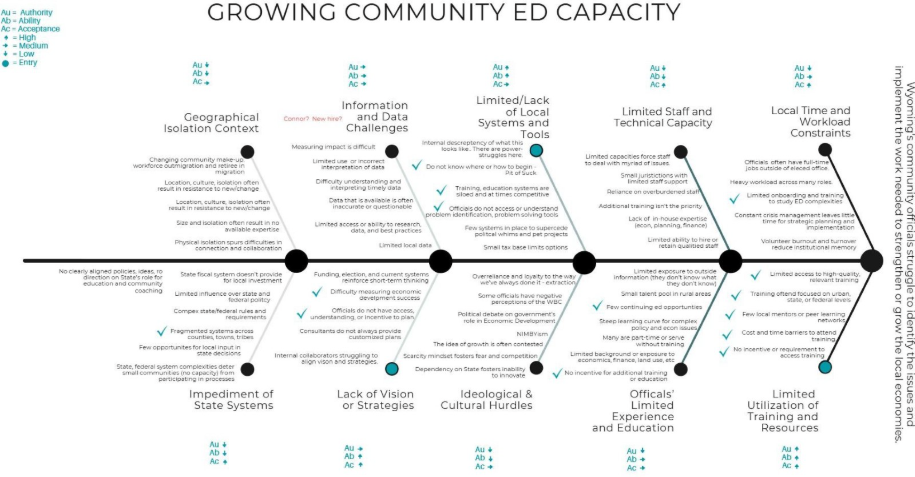
We can tell communities that they need to work together. We can draw boundaries on a map. We can create committees, draw fishbones, and explain why regional collaboration is important. This does not work. But a shared problem does. We still have a lot of work to do, but we’ve started the regional conversation and our state is taking notice.
Economic Foundations
Working with local teams highlighted another important constraint: local decision-makers, whether they be elected officials or economic development leaders, have varying degrees of economic development knowledge and capabilities.
We are currently developing the Economic Foundations Institute (EFI) with the primary goal of providing foundational economic development education and training to local leaders. We began with a pilot “Introduction to Economic Development” training, introducing basic economic development concepts. We are not intent on creating experts, but hope that officials and decision-makers will know enough to ask better questions and make more informed decisions. The initial session introduced in a local leadership organization was the highest rated of nine training sessions in the program. Though this is only one test, it does indicate that economic development training is valuable and interesting to audiences.
We are also creating a “Before you Vote” training for local, county, and state officials, with the simple goal of ensuring that elected officials understand how their local economic and fiscal systems, the role of different levels of government, and how state-wide policies impact the local communities. We expect that we will have a record number of freshman officials serving in offices across the state, many of whom have not been exposed to economic development ideals or fiscal policy.
EFI’s focus is creating access to economic development training. We are now advocating for funding to scholarship these officials, economic development boards and directors, and those adjacent to Beginning Economic Development Courses through the International Economic Development Council (IEDC).
Our theory? Again, better educated decision makers will lead to better, more effective policy decisions.
We believe that EFI will help us create a stronger, more competent economic development environment where A2A can help communities build capacity to address their complex problems locally, regionally, and state-wide.
Change is Personal…If You Do It Right
Throughout this course, we’ve learned about the “Ps”. I’d describe my take-aways in similar terms: Passion. People. Process. Permission. Patience.
- Passion gets people to the table.
- People make the change possible. People bring technical expertise, but more importantly, people are relationships, credibility, trust, momentum, celebration, and authority.
Process encourages us to start. It may alleviate a little risk. We may not know the entirety of the route, but we know we can begin with just a few steps. Just as important, it provides a consistent rhythm or cadence when we are tired or discouraged. We know the process and we can keep going. Permission. Authorization is obviously fundamental in the process. Without it, we cannot enact change. But sometimes we need to give ourselves permission to try, to ask the questions, to look at a problem in a different light, and to take the first step.
- Patience. The process moves at varying speeds and with varying short-term results, requiring more patience than we think we’ll need. This is especially challenging for action-oriented, independent, headstrong “doers”.
The PDIA process is truly transformational. Not only has it provided valuable insight in addressing complexities in the State’s economic environment, but I’ve learned more about myself in the past five months than almost any other time in my life. I’ve addressed difficult questions, tested my personal assumptions, and grew as both a person and as a leader.
Advice
If I could offer one piece of advice to PDIA practitioners, it would be: Start with the ideal. Learn the tools. Deconstruct the process. Identify your entry points. Slowly build authority while growing results. Learn and iterate.
Then expect reality to interfere. When it does, take a moment and ask yourself, “what did reality just teach me?” Progress isn’t measured by a finished product or a policy victory. It is measured by what we continue to learn, how we respond, and who we bring with us. It is the commitment to taking the next best step.
This is a blog series written by the alumni of the Implementing Public Policy Executive Education Program at the Harvard Kennedy School. 33 Participants successfully completed this 5-month hybrid program in September 2026. These are their learning journey stories.