
Aligning Polytechnic Education with Labor Market Needs in the Dominican Republic
Guest blog by Sharlyn Rodríguez, IPP ’26
I began the Implementing Public Policy program with a challenge that has shaped much of my professional work: the supply of graduates from Dominican polytechnic schools is not sufficiently aligned with the talent needs of local productive sectors. I knew the system well and had experience building bridges between education and employers. That experience was valuable, but it also made it easy to believe that I already understood the problem and should move quickly toward a solution.
PDIA taught me to slow down—not to become less ambitious, but to become more disciplined about learning. My most important shift was from asking, “What solution can we implement?” to asking, “What is really keeping this problem in place, and what can we learn by acting?”
The challenge beneath the challenge
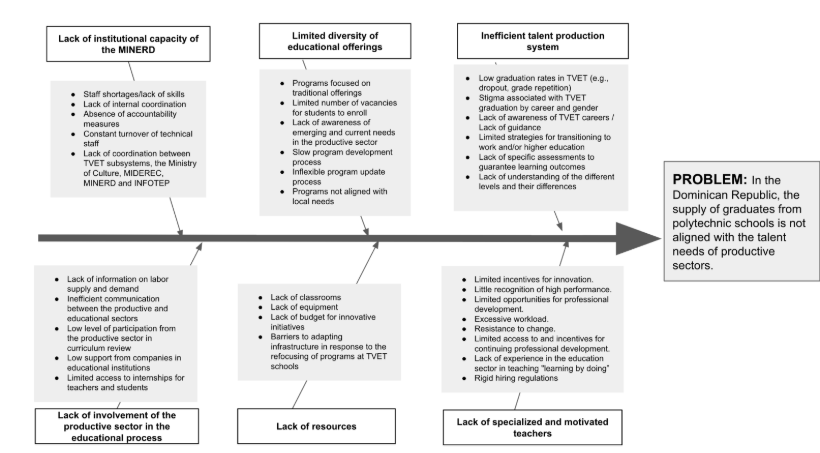
My initial hypothesis focused on a shortage of teachers with the technical and practical skills required by expanding polytechnic schools. A fishbone analysis helped me break the broad problem into possible causes: teacher capacity, infrastructure and equipment, curriculum relevance, relationships with employers, student mobility, and the transition from graduation to employment. The diagram was useful, but the conversations it generated were even more valuable. Each person I engaged saw a different part of the system.
Feedback from an ex-coworker and expert on the subject led me to give greater attention to teachers’ ability to develop practical competencies rather than transmit theory alone. A visit to a Polytechnic School where I spoke with their principal, showed me that strong employer engagement was already happening in parts of the system. This positive deviation challenged the assumption that schools and companies were uniformly disconnected. It also reminded me that useful ideas may already exist locally; the task is to understand why they work and what conditions would allow them to travel.
When I was unable to meet immediately with decision makers the Ministry of Education, I first experienced the delay as a setback. PDIA helped me treat it as information. Institutional calendars, competing priorities, and access to authorizers are not external inconveniences; they are part of the implementation environment. I continued gathering evidence and learned that the Ministry was preparing another cycle of a teacher internship program first implemented under my leadership at another NGO. This clarified that Instituto 512, my current place of work, should not duplicate an existing initiative. Our contribution would need to be complementary and institutionally legitimate.
The hypothesis changed
The most important turning point came through engagement with other authorizers within the Ministry of education. I learned that the Ministry had addressed the immediate teacher shortage through a special hiring mechanism. The original constraint I had prioritized was no longer the same. The expansion of polytechnic education was being limited more directly by the time required to prepare infrastructure, the ability of students to reach specialized training opportunities, and the strength of the pathway from school to employment.
This did not mean my initial analysis had been useless. It meant it had done its job: it gave us hypotheses that could be tested and revised. The problem became richer and more actionable. Possible entry points now include exploring mobile workshops, understanding whether the public-school transportation system can reduce mobility barriers, speaking with employers and graduates about the transition into work, and testing a small intervention with one or two schools before designing something larger.
Progress is also better questions
We did not finish the program with a large, fully designed solution—and I now see that as a sign of progress rather than failure. We refined the problem, corrected a central assumption, identified positive deviations, expanded the group of people from whom we learn, and developed feasible points of entry for experimentation.
I also learned that implementation success has both functional and legitimacy dimensions. A technically sound idea is not enough. It must fit institutional priorities, earn support, and strengthen the capacity of the people who will carry it forward. This became personal in my relationship with the executive director at Instituto 512, my authorizer. By taking action, demonstrating commitment, communicating progress, and producing useful results, I gradually earned greater trust and more space to act. Authorization grows through action.
From plan and control to learning and adaptation
Before this course, I often relied on highly detailed schedules. Planning gave me clarity and a sense of control. I still value planning, but I now understand its limits in complex problems. A plan-and-control approach can unintentionally punish mistakes because every deviation is treated as failure. The plan begins to look like the result, when the real result should be learning what works and improving the lives of the people affected by the problem.
When following the plan becomes more important than solving the problem, creativity narrows. People become cautious about trying something different, and teams lose the time needed for experimentation, connection, and reflection. I recognized this tendency in myself. My tightly planned schedules did not leave enough space for people to think together, test assumptions, learn from mistakes, or celebrate small wins. PDIA has changed how I want to lead: plans will guide action, but evidence will guide adaptation.
How I will use PDIA
In future challenges, I will begin by constructing the problem with the people who experience, authorize, and implement it. I will use tools such as the fishbone diagram to decompose the challenge, but I will treat every branch as a hypothesis rather than a conclusion. I will look deliberately for positive deviations, keep a learning log, and use short iterations to connect action with reflection.
I will also assess entry points not only by importance, but by feasibility, acceptance, and the authority and capabilities available to act. Instead of waiting for permission to design a perfect, large-scale response, I will seek small, responsible actions that generate evidence, build relationships, and expand authorization. In my current work, that means validating the revised problem with operational actors, exploring infrastructure and mobility alternatives, understanding the employment pathway, and defining a limited experiment with one or two schools.
A final reflection for fellow practitioners
Is simple: do not become more committed to your first explanation than to the problem itself. Go and speak with the people who see the system from different positions. Treat delays, disagreement, and failed attempts as data. Look for places where the problem is less severe and ask what makes those cases different. Start with the authority you have, take a useful step, communicate what you learn, and let action build the trust required for the next step.
PDIA is hard because it asks us to exchange the comfort of certainty for the discipline of learning. It is worthwhile because complex public problems rarely yield to a single expert, institution, or plan. They move when people engage with purpose, act, reflect, adapt, and keep going. I leave the program not with a perfect solution, but with something more durable: a better way to learn my way toward one or many.
This is a blog series written by the alumni of the Implementing Public Policy Executive Education Program at the Harvard Kennedy School. 33 Participants successfully completed this 5-month hybrid program in September 2026. These are their learning journey stories.