
Preparing Students for an AI-Driven Labor Market in Kazakhstan: From Policy Ambition to Institutional Capability
Guest blog by Assel Aryn, IPP ’26
When I joined Harvard Kennedy School’s Implementing Public Policy (IPP) program, I brought a challenge that was closely connected to my work: how can universities in Kazakhstan better prepare students for a rapidly changing AI-driven labor market?
As Vice-Rector for Academic Development at Almaty Management University (AlmaU), I have spent many years leading academic reforms. I am familiar with developing strategies, redesigning programs, and making institutional decisions.
I initially approached this challenge in much the same way: identify the problem, prepare a plan, engage stakeholders, and move toward implementation. However, the IPP journey challenged some of my assumptions about how change actually happens.
My most important realization was that complex problems cannot be solved through planning and control alone. They require continuous learning, experimentation, and adaptation.
Understanding the problem behind the problem
Kazakhstan has ambitious goals for integrating AI into higher education. However, introducing new policies, AI-related courses, or digital technologies does not automatically mean that students are developing the competencies they will need in the future.
My initial problem statement was: Students in Kazakhstan’s higher education system are not sufficiently prepared for a rapidly changing AI-driven labor market.
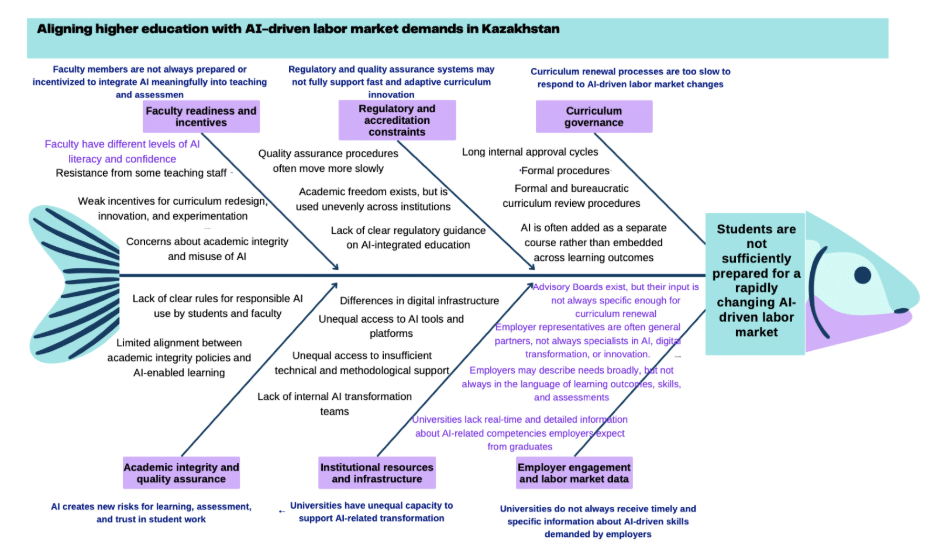
Using the PDIA fishbone diagram, I explored the possible causes: curriculum governance, faculty readiness, employer engagement, institutional resources, academic integrity, and regulatory constraints.
As I worked through iterations, my understanding became more specific.
I realized that the deeper challenge was not simply a lack of AI-related curriculum content. It was the limited institutional capability to translate changing labor market needs into learning outcomes, teaching, assessment, and faculty development.
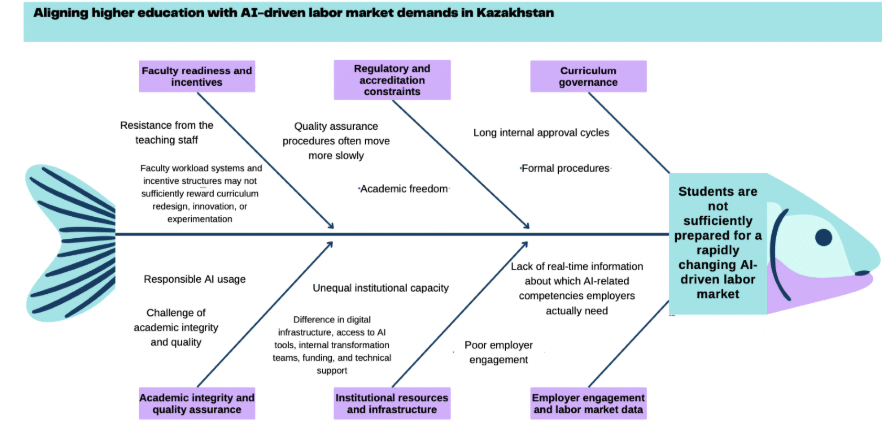
My evolving fishbone diagram
Moving from diagnosis to action
I decided to start with an existing mechanism at AlmaU: employer Advisory Boards.
My first assumption was that employers would naturally be interested in contributing to AI-related curriculum development. However, I discovered that interest in the topic did not always translate into active participation or concrete recommendations.
Instead of trying to implement a university-wide reform immediately, I narrowed the scope to one pilot: the Finance program within the School of Digital Technologies and Economics.
Together with our Career Center, we identified partner companies and invited representatives with experience in digital transformation, innovation, and AI. We prepared targeted questions and a survey to understand what competencies employers expect from graduates.
The Advisory Board meeting was initially delayed because of the summer vacation period. Eventually, we held it and received valuable recommendations.
I analyzed the discussion and survey responses and presented the findings to the pilot school. Together with the team, we developed a revised draft curricula for Finance at both bachelor’s and master’s levels.
In parallel, I worked with HR to develop a plan for strengthening faculty members’ digital and AI skills.
These are important steps, but they are not the end of the reform. We still need to implement the proposed changes and understand their impact on teaching and student competencies.
Five key lessons from my IPP journey
1. A policy is not the same as real change
In my experience, many reforms are implemented mainly to demonstrate formal compliance. Universities can approve new programs, introduce courses, and submit reports without necessarily changing what students learn.
The course helped me distinguish between producing policy outputs and building real institutional capability.
For my project, success is not simply having AI-related courses in the curriculum. It is developing the university’s ability to continuously adapt its programs as technologies and labor market needs change.
2. Do not jump to solutions before understanding the problem
As a senior university leader, I am responsible for making decisions and finding solutions quickly. PDIA taught me to spend more time diagnosing the problem, questioning my assumptions, and identifying realistic entry points.
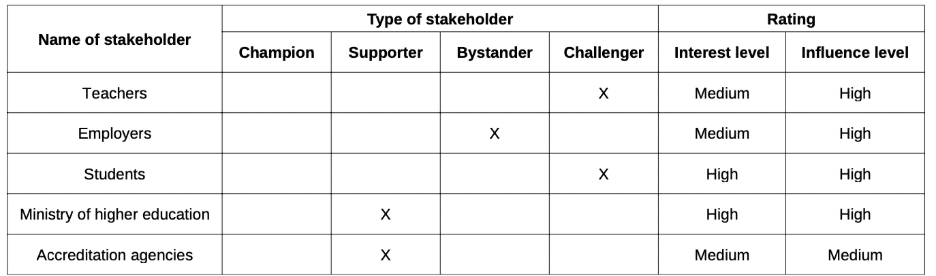
The fishbone diagram and AAA analysis helped me understand where there was enough authority, acceptance, and ability to act.
Instead of beginning a large-scale reform, I started with one academic program and an existing Advisory Board. This made the challenge more manageable and created an opportunity to learn from practice.
3. Stakeholder engagement must lead to practical action
One of my biggest surprises was that even interested stakeholders could not always provide concrete recommendations. I learned that the quality of engagement depends on how we organize it. Simply inviting employers to a meeting is not enough. We need to ask focused questions, create a comfortable environment for discussion, and make it easy for people to contribute. Our Advisory Board meeting and survey helped us collect more useful input. But the real challenge was translating that input into curriculum decisions. This is where working closely with faculty and program leaders became essential.
4. Formal authority is important, but implementation requires relationships
As Vice-Rector, I already have formal authority over academic programs, faculty, and academic policy. However, the project required cooperation with units that do not report to me directly, including HR and the Career Center, as well as external employers.
I learned that authority alone does not guarantee ownership. Real implementation requires communication, trust, delegation, and the ability to bring people together around a shared problem. Through iterations, I was able to expand support beyond my academic team and involve colleagues from different parts of the university.
5. Learning and small wins are real progress
Before IPP, I was more focused on major outcomes and completed projects. This course helped me recognize the value of smaller steps: a new relationship, a useful conversation, a better understanding of the problem, or an idea that did not work as expected.
I also realized that I had rarely protected enough time for reflection. Now I want to make learning an explicit part of my implementation roadmaps. After each iteration, I plan to stop, review what happened, and adapt the next step. I no longer see reflection as time away from implementation. It is part of the implementation itself.
What comes next?
My immediate priority is to move from draft curriculum plans to implementation, while supporting faculty in developing the skills they need to teach and assess AI-related competencies.
I also see an opportunity to take this learning beyond AlmaU. Recently, I contributed a case about our university to a collection of essays: Universities After AI: Voices from the Global Frontier https://iaup.org/wp-content/uploads/2026/06/Universities-After-AI.pdf
In October, we are planning a meeting of the Rector’s Club: Central Asia+, which brings together universities from Central Asia. The meeting will focus on AI integration in higher education, and I plan to present the intermediate results of my project. I hope this will create opportunities for feedback, new partnerships, and possibly testing some of our approaches in other universities.
A final thought for fellow PDIA practitioners
If I could share one piece of advice with fellow practitioners, it would be this: do not wait for a perfect plan or immediate support from everyone. Start with a problem that matters. Find a small space where you can act. Engage people, listen carefully, and learn from what happens. And remember that a reform is not successful simply because it has been approved. Real success begins when people and institutions develop the capability to make change happen – and to keep adapting long after the original project is finished. I started IPP thinking about how to implement an AI-related education reform. I am finishing the program with a different understanding of my role as a leader.
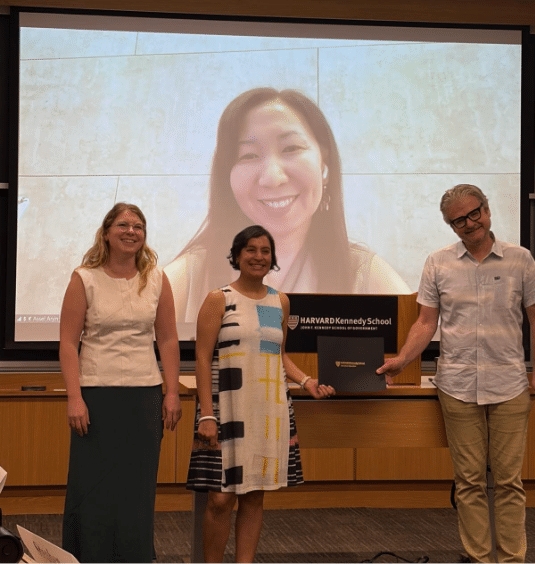
This is a blog series written by the alumni of the Implementing Public Policy Executive Education Program at the Harvard Kennedy School. 33 Participants successfully completed this 5-month hybrid program in September 2026. These are their learning journey stories.