

De-risking Private Capital Investment in Addressing Energy Access Gaps in Rural Communities in Ethiopia
Guest blog by Stephen Kansuk, IPP ’26
With over 15 years of development work focused on Africa, I have been confronted with complex development challenges, especially those related to public policy implementation. While the organization I work for is arguably one of the leading international development organizations, equipped with excellent tools to address complex development challenges across Africa, we are still frequently confronted with systemic implementation challenges. These challenges can often be frustrating.
For this reason, I enrolled in the Harvard Kennedy School Executive Education Program on Implementing Public Policy (IPP) to better understand what the real challenge might be and the available tools to deconstruct this challenge.
At the beginning of the course, I thought Matt Andrews, the course director, would simply provide ideas and solutions to my implementation challenge. Instead, he repeatedly emphasized that “policy work is about people, not just about ideas or analysis.” Initially, I thought there was nothing particularly new about this statement. After all, my organization exists to improve the lives of the people we serve across Africa. However, as the course progressed, I realized that I had misunderstood what he meant. The Problem-Driven Iterative Adaptation (PDIA) process fundamentally transformed the way I think about public policy implementation.
One of the most important lessons I learned is that how we construct or deconstruct a policy problem largely determines the results we achieve. During the course, I worked on the implementation challenge: “Limited private capital investment in rural electrification is contributing to persistently low electrification rates in rural communities in Ethiopia.”
A key lesson from the program was the importance of asking the right questions. For example, instead of simply stating, “We need to provide electricity to all rural communities in Ethiopia,” the PDIA approach challenged me to ask why this matters and to whom. Through the fishbone analysis and related PDIA tools, I learned to apply the “Five Whys” technique to explore the deeper causes of the problem.
Asking these questions helped me break down the problem into its underlying causes and identify strategic entry points for action. However, among all the lessons from the course, iteration was perhaps the most significant for me. In my normal line of work, resource constraints often limit opportunities for repeated testing, learning, and adaptation with multiple stakeholders. As a result, there is always a risk of addressing symptoms rather than the real causes of a problem. The PDIA approach demonstrated the importance of continuous learning and adaptation throughout implementation. The fishbone diagram was central to uncovering the root causes of my implementation challenge. It pushed me beyond the energy sector and encouraged me to consider both supply-side and demand-side factors, as well as influences from other sectors.
I revised the fishbone diagram several times with colleagues from both Harvard Kennedy School and my workplace before arriving at the final version as show below.
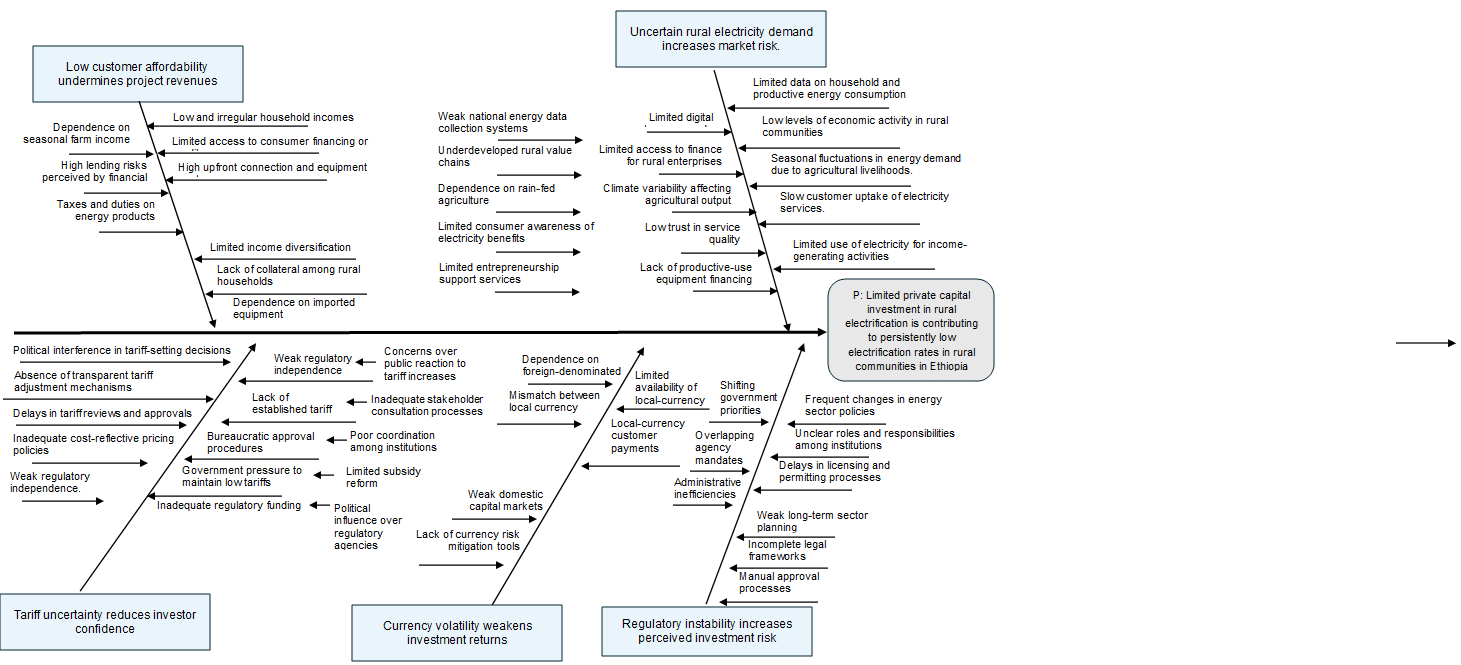
At first glance, the fishbone diagram was overwhelming. Before learning about PDIA, I never imagined that the causes of limited private capital investment in rural electrification could be so extensive and interconnected. Looking at the diagram, I almost concluded that the challenge was impossible to solve. However, Matt often reminded us that recognizing small wins and identifying entry points are critical in addressing complex problems. This insight leads to another important lesson I learned during the IPP program- Leads, Learning, and the Importance of Small Wins. In a busy and resource-constrained donor environment, there is often little incentive to report small wins. Authorizers and donors typically focus on final outcomes and major achievements rather than incremental progress. However, after engaging in discussions with peers and the course instructors, my perspective changed significantly. I now appreciate that in complex public policy challenges, meaningful results often take time to emerge. Progress is frequently achieved through a series of small steps rather than through a single breakthrough. Recognizing and learning from these small wins can help sustain momentum and build confidence among stakeholders.
The course also reinforced the importance of stakeholder engagement. If the implementation challenge is complex, then the stakeholder environment is equally complex. Effective stakeholder engagement cannot be treated as a one-time activity. It requires continuous assessment, adaptation, and reflection. Throughout the course, I learned to repeatedly ask: “Why does this matter, and to whom?
Through the PDIA process, I made important progress in identifying key authorizers and stakeholders both within and outside my organization who will be critical to advancing my implementation challenge. I have already begun engaging some of these external stakeholders to build relationships, understand their interests, and explore areas of collaboration. These early conversations have broadened my support base and helped identify potential opportunities for future action once formal authorization is secured.
Perhaps more importantly, the process helped me recognize that solving the challenge does not require addressing every issue identified in the fishbone diagram simultaneously. Instead, progress can be achieved by identifying feasible entry points, testing solutions, learning from results, and adapting accordingly.
The PDIA approach has fundamentally changed how I think about problem-solving. Today, I spend much more time understanding the problem itself before attempting to identify solutions. I believe these practices will help reduce the likelihood of addressing the wrong problem and improve the effectiveness of implementation efforts.
With the lessons learned from this course, I hope to gradually build support for incorporating PDIA principles into my organization’s project design and implementation processes.
This approach can strengthen authorization for addressing my implementation challenge while also promoting a more adaptive, learning-oriented, and problem-driven culture within the organization. I believe PDIA has significant potential to improve how development programs are designed and implemented, particularly in contexts characterized by complexity and uncertainty.
If I were to offer words of wisdom to fellow PDIA practitioners around the world, they would be these: Your team is your gift. Make use of that gift. Engage team members genuinely and with humility. Recognize and celebrate small wins. Be willing to learn continuously and adapt your approach. Most importantly, remember to care for yourself while addressing complex development challenges. Effective leadership requires personal well-being as much as professional commitment.
As part of my effort to care for myself, I have started taking my golf lessons more seriously.

This course has been a truly transformative learning experience and was worth every moment invested. It was never merely a theoretical academic exercise; rather, it provided practical tools and approaches directly relevant to public policy leadership and implementation.
The PDIA framework has changed the way I understand complex problems, engage stakeholders, and pursue implementation. Most importantly, it has shown me that meaningful progress often begins not with having the right answer, but with asking the right questions.
This is a blog series written by the alumni of the Implementing Public Policy Executive Education Program at the Harvard Kennedy School. 33 Participants successfully completed this 5-month hybrid program in September 2026. These are their learning journey stories.