
Untangling the Arts Ecosystem in Providence: Strengthening the “Creative Capital”
Guest blog by Sattam Alqadadi, Asyifa Isvari, Sunny Jiang, and Sumbul Siddiqui
Our team examined how to strengthen the arts and culture ecosystem in Providence, Rhode Island. Although Providence calls itself the “Creative Capital,” arts and culture are not fully integrated into the city’s economic development and infrastructure strategies. As a result, the sector remains under-supported and underutilized, limiting its potential to contribute to economic growth, civic identity, and community engagement. Providence is also at a pivotal moment: the upcoming 2026 FIFA World Cup presents an opportunity for the city to showcase and invest in its arts and cultural sector, potentially catalyzing greater visibility, collaboration, and support.
Over 7 weeks, our team, working with our authorizer Joe Wilson Jr., Director of Department of Art, Culture and Tourism, City of Providence, made significant progress in defining the problem facing the arts and culture sector in Providence, deconstructing its elements and prioritizing them based on feasibility, and identifying entry points to address the problem.
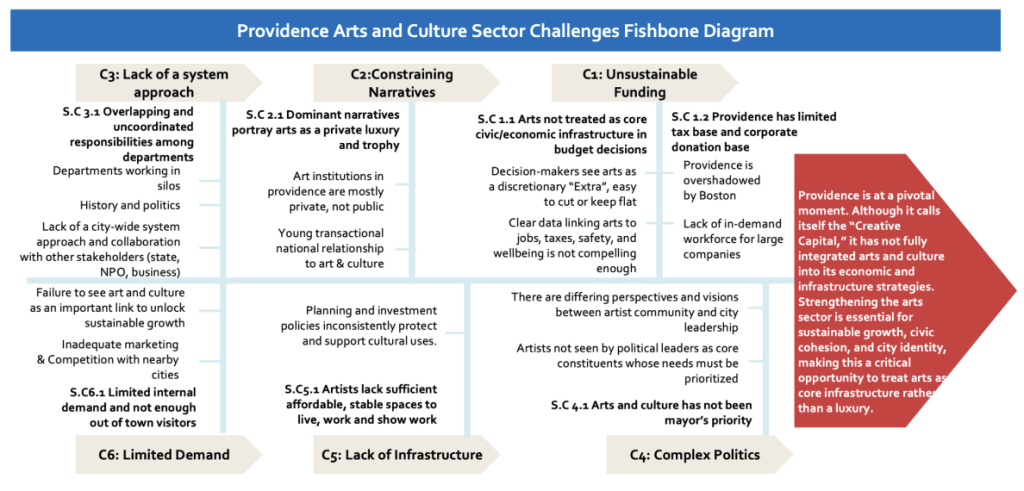
Using PDIA tools such as the fishbone diagram and AAA (Authority, Acceptance, Ability) analysis, we learned that the challenge facing Providence’s arts sector is systemic rather than simply a funding issue. The fishbone diagram helped us unpack the problem and identify multiple contributing factors shaping the ecosystem. Building on this analysis, the AAA framework helped us assess where meaningful change was most feasible, highlighting potential entry points.
Through this process, we learned that the problem is that Providence’s arts and culture sector is vibrant but under-supported and underutilized, resulting in missed opportunities for sustainable economic growth, equity, community engagement, and well-being.
The problem is multilayered, with several dimensions affecting it, including financial, political, social, and structural elements. While different stakeholders cited various causes from their perspective, our team has identified six main causes for this problem: unsustainable funding, constraining narratives, lack of a system approach, complex politics, lack of infrastructure, and limited demand.
The AAA analysis was conducted to prioritize the most feasible causes for action, which were: limited demand, unsustainable funding, and lack of a system approach. We selected several entry points to address these causes by focusing on improving marketing and positioning of the sector, generating non-governmental revenue/funding, and coordinating a city-wide approach to support the sector.
Our team believes that starting with these entry points can create the most impact in the short-term, but longer-term impact requires addressing all the other causes comprehensively.
Key Learnings from the PDIA Process
PDIA taught us the value of first understanding the problem in depth before proposing solutions. By constructing the problem, deconstructing it into its key elements, and prioritizing those based on feasibility, we developed a more comprehensive framework to navigate complex challenges in Providence’s arts and culture sector. This approach has strengthened our problem-solving skills and provided a roadmap for tackling multi-dimensional issues in future policy work.
A critical element of this process was engaging stakeholders. Through over 15 interviews and a perception survey, we captured diverse perspectives that helped us refine the problem, uncover root causes, and identify realistic entry points for change. In this context, authorization emerged as a dynamic and essential factor—we need permission and legitimacy to test ideas or pilot initiatives. This reinforced the importance of starting small, demonstrating early successes, and gradually building broader support to expand impact.
As Rafiki told Timon in The Lion King, “Look beyond what you see.” Fully understanding a problem and identifying effective solutions requires not just research but deep engagement with stakeholders across the spectrum. This 360-degree view allowed us to uncover hidden opportunities and design interventions that are both realistic and impactful.
Iteration was central to our progress. We refined our problem statement, fishbone diagram, AAA analysis, and proposed ideas multiple times. Each iteration revealed new insights, corrected assumptions, and allowed us to adjust our strategies. This process showed us that complex problems rarely have linear solutions; meaningful progress comes from repeatedly testing ideas, learning, and adapting.
Building a strong internal team is just as important as external engagement. Our team learned that shared objectives, open communication, mutually agreed norms, and respect are crucial for collaboration. Kindness, flexibility, and willingness to adapt to different perspectives helped us work seamlessly through challenges and maintain momentum. Psychological safety, which grew from the relaxed moments we shared between serious conversations, created a foundation that allowed us to comfortably share ideas, disagree, and build on one another’s thinking.
Challenges and How We Addressed Them
Connecting with diverse stakeholders was difficult. To overcome this, we leveraged our personal networks, conducted a literature review, collected data, and studied case examples from other cities. These efforts allowed us to engage a wide range of perspectives, which was essential for understanding the nuances of Providence’s arts and culture ecosystem.
Figuring out the core problem was another major challenge. The issue was ambiguous and multifaceted, with multiple interacting causes. We addressed this by combining individual reflection with team brainstorming sessions, and then testing our assumptions with our authorizer and interviewees. This iterative process helped us clarify the problem, refine our analysis, and identify actionable entry points.
Progress and Next Steps
During this process, we iterated multiple times on our analysis—refining our problem statement three times, revising our fishbone diagram three times, conducting three rounds of AAA analysis, and revisiting our proposed ideas twice. This iterative approach helped us deepen our understanding of the challenge facing Providence’s arts and culture sector.
One of our key insights is that the situation presents both a challenge and an opportunity. On one hand, limited public art, insufficient wraparound infrastructure for artists and organizations, and limited public demand have constrained the sector’s growth and visibility. On the other hand, there is growing momentum and several emerging initiatives that Providence can build upon. With the right coordination and support, the city has a real opportunity to strengthen its arts ecosystem and more fully realize its identity as the “Creative Capital.”
PDIA provides a powerful framework for tackling complex policy challenges. Its strength lies in being problem-driven rather than solution-driven: it encourages us to carefully construct, deconstruct, and iterate on the problem before jumping to any prescription. This deliberate approach ensures that our solutions are grounded in a deep understanding of the system and its dynamics.
Equally important is PDIA’s cycle of small steps, learning, and iteration. By taking incremental actions, reflecting on what works, and adapting as we go, we can gradually build confidence, authority, and momentum—even when the path forward is uncertain.
Looking ahead, this approach will change the way we tackle problems. Rather than seeking quick fixes or assuming a single solution will work, we will focus on understanding the nuances of each context, iterating thoughtfully, and engaging stakeholders throughout the process.
As a Chinese proverb reminds us, “Feel the rocks when crossing the river.” This captures the essence of PDIA: testing the ground carefully, learning from each step, and moving forward deliberately rather than leaping blindly.
This is a blog series written by students at the Harvard Kennedy School who completed “PDIA in Action: Development Through Facilitated Emergence” (MLD 103) in March 2026. These are their learning journey stories.