
Phosphate Decarbonization as a Catalyst for Growth in Morocco
Guest blog by Soumaya Benzennou, LEG ’25
When I began this course, I thought my challenge was technical: how can a hard-to-abate sector like phosphates decarbonize? But over the ten weeks, something shifted. The more we learned about growth, complexity and inclusion, the more I realized that my real challenge was not about emissions. It was about people, incentives, institutions, capabilities, and the possibility of turning a climate constraint into a growth engine for Morocco and for Africa.
The first surprise came from the idea that growth is not just growth. The Brookings Metro Monitor pushed me to see that real development must advance growth, prosperity and inclusion all at once. I started looking at OCP not just as an industrial giant, but as a system capable of lifting entire regions through better jobs, upgraded capabilities and new opportunities. For the first time, decarbonization stopped being an environmental obligation and became an economic strategy.
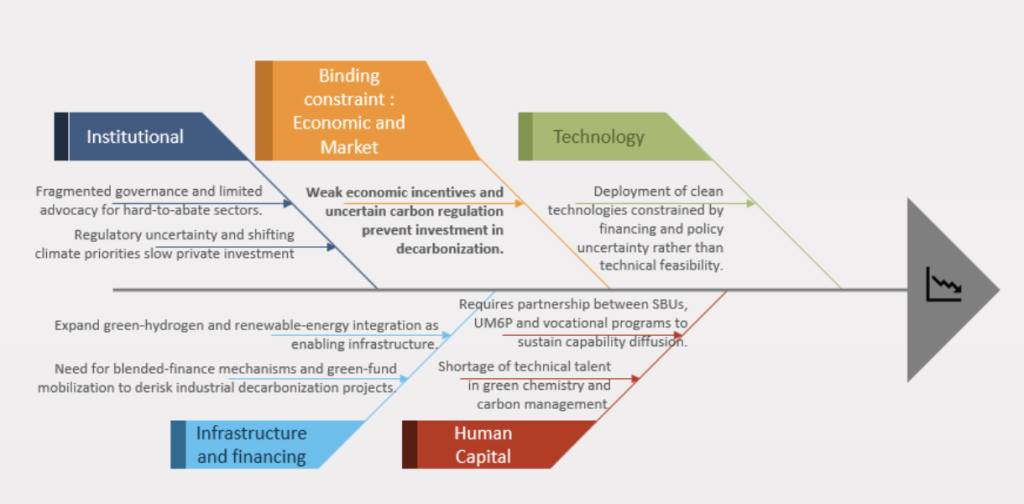
As I worked through the fishbone, PDIA changed my way of thinking. I learned that problems are not what we initially think they are; they are what they do to the system. And suddenly, everything became clearer. The biggest obstacle to green transformation in my challenge was not engineering—it was the misalignment of incentives, the uncertainty of international regulations, the absence of strong market signals for green fertilizers, and the financial barriers that keep African farmers from adopting sustainable inputs. In parallel, the inclusion readings—especially the Chiapas case and Hausmann’s idea of exclusion traps—helped me see that the farmers who cannot access green fertilizers are not “late adopters,” but individuals structurally disconnected from the networks where productivity and opportunity live.
Throughout the course, I felt myself moving from a mindset of “designing the right plan” to “building the right learning process.” PDIA taught me that progress comes not from big decisions but from crawling the design space: experimenting, learning, adjusting, and letting capabilities grow over time. I stopped thinking in terms of “the” solution and started seeing a landscape of possibilities—existing practices we can recombine, latent practices we can activate, positive deviants we can learn from, and global best practices we must adapt, not copy. This shift alone has been transformative for me.
Along the way, my working group played an unexpectedly important role. Week after week, the discussions were stimulating, generous, and full of creative ideas. Hearing how others applied PDIA to their own countries and sectors pushed me to see my challenge differently. Their questions opened new angles, their reflections sharpened my own, and the energy in the group made the learning journey richer and far more enjoyable. It reminded me that capability grows through interaction, not isolation.
As the weeks went on, my growth challenge evolved. It became less about achieving technical decarbonization and more about orchestrating a green transition that is economically viable, institutionally grounded and socially inclusive. I realized that OCP is not just a chemical company; it is an ecosystem. And ecosystems grow through coordination, learning and the strategic shaping of incentives. My biggest insight was that decarbonization only becomes growth when it creates new capabilities, new connections, and new opportunities for the many—not the few.
What I will carry with me into my work is the idea that change is built through repeated cycles of action and reflection. I now see the value of quick experiments, iterative learning, and “good enough” first steps. I understand that in a world of regulatory uncertainty (RFNBO, CBAM, SBTi changes…), the best strategy is not to wait for clarity, but to build options and flexibility. And I see that inclusion is not a moral add-on—it is the foundation of a legitimate and durable growth path. For me, the green transition is now inseparable from the idea of an inclusive transition.
Working through the assignments, talking with my group, reflecting on the readings, I started to see my role differently. I am not just trying to reduce CO₂. I am contributing to designing the future of an industry, a region, maybe even a development model. And this is why the final question of the course—what remains unresolved—feels so important. I still wonder how we can build stronger coordination across institutions, how we can design policies that create real incentives for green adoption, and how we can ensure that Africa’s farmers are not left behind in a global green transition. I also hope the next course will explore how to design social contracts that support green industrialization, especially in emerging economies.
What I gained from this course is not only knowledge—it is clarity, confidence and a new way of seeing. I now look at my growth challenge not as a technical problem to solve, but as a strategic opportunity to build something bigger: a green, competitive and inclusive industrial transformation. And for the first time, I truly believe that Morocco—and OCP—can lead the way.
This is a blog series written by the alumni of the Leading Economic Growth Executive Education Program at the Harvard Kennedy School. 63 Participants successfully completed this 10-week online course in December 2025. These are their learning journey stories.