

Low Economic Engagement of Youth in Agribusiness Opportunities in Kutubu, Papua New Guinea
Guest blog by Elsie Mongoru, Alexander Tanabi, Dorcas Mileng, Emmanuel Kokiva, Evenezer Tanda, David William, Nancy Ilambi
In the heart of Papua New Guinea lies Kutubu rural local government area in Nipa Kutubu District of Southern Highlands Province. The population is estimated to be 24,155 with a youth population of around 7,229 of which 43% are female. From the Kutubu Local Level Youth Development Council (KLLYDC) baseline data, 12% are out-of-school youths who have never attended school or have completed elementary school only. The targeted population of out-of-school youth aged 16-35 in Kutubu face limited employment opportunities. Over 12 weeks, PNG Themis explored the complex issue of minimal youth participation in agribusiness as part of our PDIA course, addressing the challenges of economic engagement for those who have moved away from traditional education. Together, we uncovered new perspectives, faced hurdles, and built bonds that have strengthened our resolve to make a lasting impact.
The team comprised of Department of Community Development and Religion (DfCDR), National Youth Development Authority, KLLYDC, Santos Foundation and Santos Business Unit. Our primary authorizer is the Secretary for DfCDR.
Here’s a look back at the journey, the lessons learned, and our plans for the future.
Key Learnings from the PDIA Course
We realised that a state or organisation can have policies and legislations in place, but the capability to implement these policies and legislations is key to public policy reforms. A reasonable policy is one thing; actually implementing it successfully is another. With collective engagement by individuals of committed people forming a team to tackle the problem that matters, changes things. As Professor Andrews stated:
“If whether a policy, program or project produces the desired outcomes hinges on how well it is implemented, then the real determinant of performance is not the three Ps but capability for implementation”.
The 12-week PDIA training program showed us an effective method of problem-solving; avoid hasty solutions by delving into root causes using the fishbone diagram to map out contributing factors to understanding the broader system and its relationships. Through our weekly assignments, we learned how to break down a complex problem, and analyse its root causes which was key to clearly visualizing how intertwined the factors were, providing a roadmap for targeted action steps, and recognizing the need to engage with diverse actors. The concept of “crawling the design space” is also an important tool to identify different ideas to be used to addressing the various causes and sub causes through the Triple A Analysis.
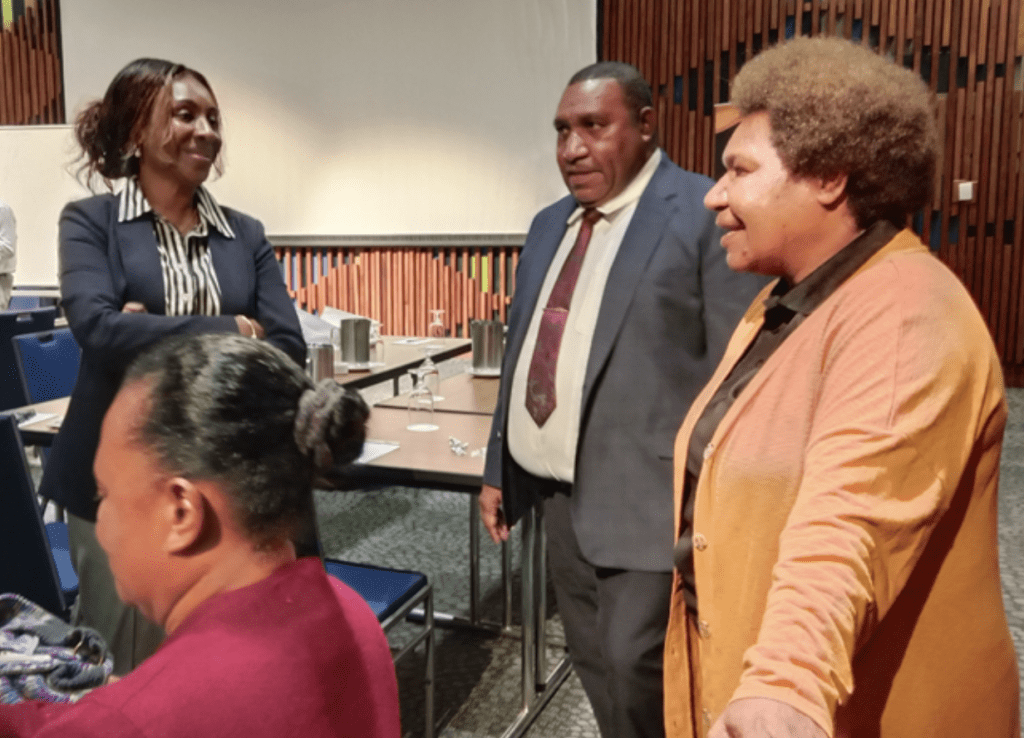
PNG Themis primary authorizer (second from right), Secretary Jerry Ubase from the DfCDR
Also, an impactful insight was the value of “small wins,” which encouraged us to prioritize incremental progress instead of awaiting major solutions. By celebrating these smaller achievements, we found motivation to persist in our efforts and recognized that these strategic steps are essential for driving sustainable change. In addition, weekly reflections were essential to our growth as they revealed subtle insights that were easy to miss when moving quickly. We also learned that “if at first you don’t succeed, try and try again”.
Problem Focus: Agribusiness opportunities for youths in Kutubu
The youth of Kutubu LLG, similar to other rural youths in the country, are disengaged and are involved in activities that are not conducive to human capital development. Team Themis chose Kutubu LLG because it already has a formal youth network structure to mobilize and engage the local youths, and has in place a local youth plan. There is also a number of agricultural projects piloted and in the process of implementation in the district.
Kutubu’s communal land ownership offers potential for agribusiness, but out-of-school youths currently lack involvement in opportunities provided by partners like Santos Ltd and the Fresh Produce Development Agency. This dependency on family support limits their economic independence, reducing their ability to contribute to both their local economy and household wellbeing.
Over the past 12 weeks, our problem statement was amended more than 5 times as a result of research findings and further inquiring with organisations and professionals within the youth and agricultural spaces. We finally ended with this problem statement; ‘Minimum participation in agribusiness by out-of-school youth aged 16-35 in Kutubu Local Level Government in Nipa-Kutubu District’. This problem is complex, arising from social and cultural norms that hinder certain groups from engaging in farming, along with a lack of ambition, high business costs, negative perceptions of agribusiness, and limited access to finance for startups. Addressing these barriers is crucial, as agribusiness presents a vital opportunity for economic empowerment and community resilience for the youth in Kutubu.
Empowering youth through agribusiness can foster self-reliance, discipline, and reduce law and order issues, while helping retain young people in rural areas. This approach strengthens the local economy and leverages youth energy for community development.
Problems and Insights Gained
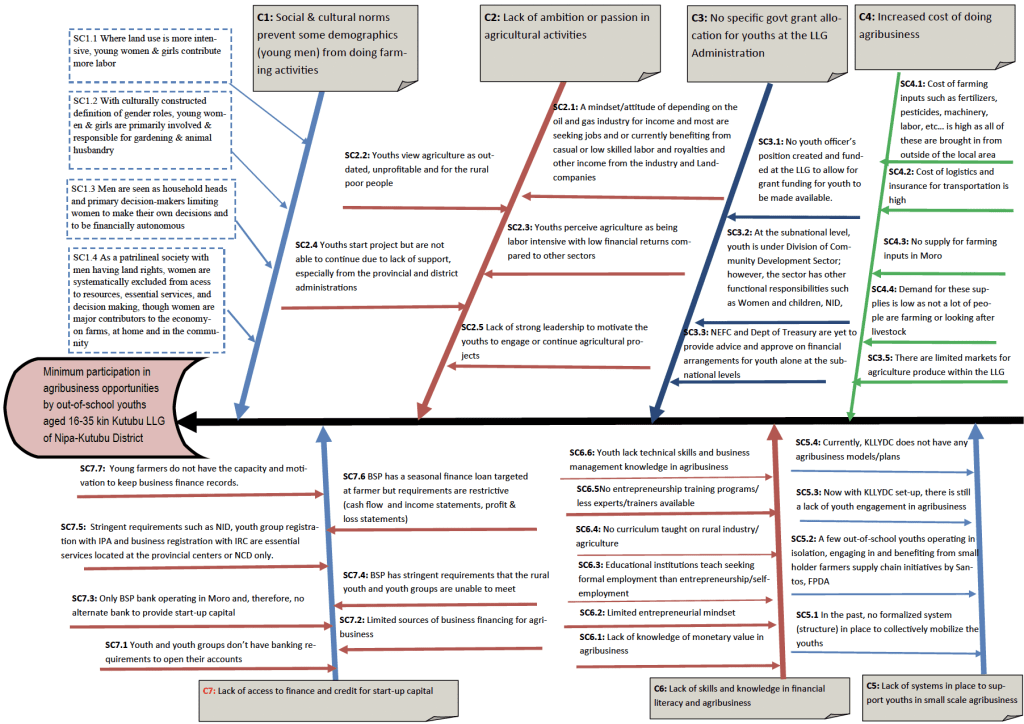
PNG Themis Fishbone Diagram
This problem is very closely related to a lot of what we do on a day-to-day basis-improve access to economic opportunities for women and youth. Going through the PDIA process has highlighted the need to conduct ongoing consultation with youth, leaders and government bodies to understand challenges and issues and identifying ways forward.
Throughout the course, we made significant strides. The fishbone diagram became a living document, constantly refined as we uncovered new insights and engaged with various actors. Our most substantial progress was in identifying key leverage points within the system that we could influence, such as increasing awareness around agribusiness as a viable career path and seeking partnerships to enhance skills training.
One key insight was recognizing that agribusiness challenges in Kutubu stems from multiple, interconnected issues needing simultaneous focus. For instance, improved market access alone isn’t enough; young people also need skills and resources. Realizing that shifting youth attitudes requires community-wide effort, we engaged local leaders to influence perceptions. Through our iteration assignments, we also identified small steps to strengthen existing networks and attract more support from government and private sectors.
All the approaches learned in the course are important and one should not be neglected. The strength of one tool strengthens the other tool so they should all be employed in working towards solving complex problems.
Here, our team member, Alexander, gives his feedback:
PDIA has fundamentally changed my approach to tackling challenges. Before this course, I leaned towards linear problem-solving methods, assuming that understanding a problem would lead to an easy fix. Now, I know that complex problems require constant adaptation and feedback loops. Moving forward, I’m more prepared to address problems iteratively—testing, learning, and adjusting as I go. I see myself engaging stakeholders more actively and using real-time feedback to pivot when needed. This approach will help me stay focused on achievable outcomes without feeling overwhelmed by the scope of an issue.
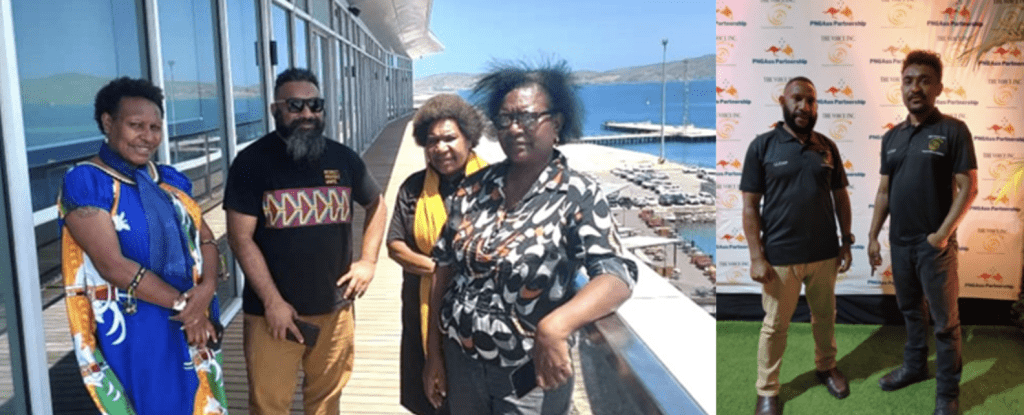
(L-R) Elsie from Santos Business Unit, Alexander-Santos Foundation, Dorcas & Nancy from NYDA, David from KLLYDC and Emmanuel from NYDA
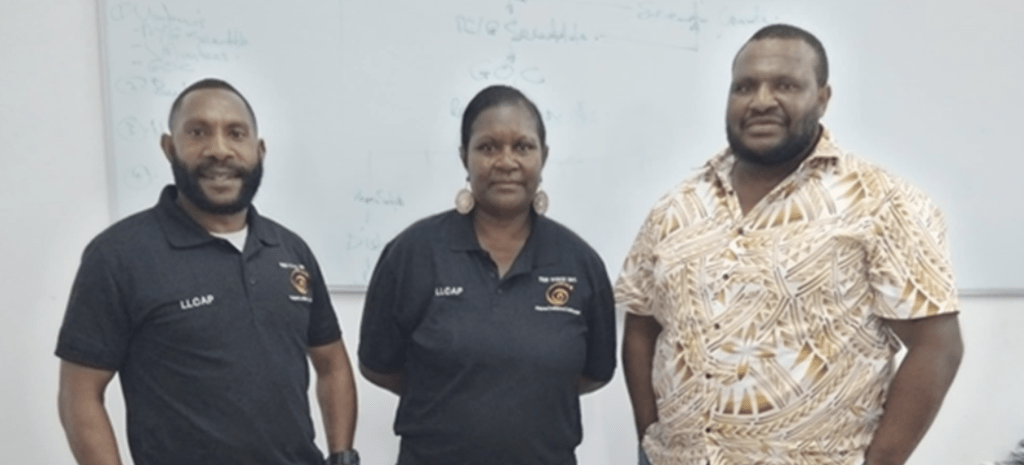
Standing far right is Evenezer from Department of Religion & Community Development
Our goal is to address root causes, explore solutions, and implement practical steps to engage Kutubu’s youth in sustainable agribusiness. In the coming years, we envision empowered young individuals with skills and knowledge, reduced law and order issues, increased employment, self-reliance, improved living standards, and a thriving local economy.
Applying PDIA Lessons in our Work
Our key role is to work with young people and create opportunities for them, and this course has highlighted the importance of an iterative, participative process. We plan to include regular reflection points in our projects to assess what works and what doesn’t, recognizing that kindness, motivation, and positive energy are just as crucial as resources and authority in achieving results.
Words of Wisdom for PDIA Practitioners Worldwide
For anyone new to PDIA or starting a similar journey, our advice is to embrace the iterative process and stay flexible. Small steps build up to big wins, keeping the team motivated and the project progressing. When challenges arise, remember that every problem has multiple solutions, and sometimes unexpected paths bring the greatest breakthroughs. Stay committed—change is a marathon, not a sprint—and value collaboration, as the friendships and professional bonds you form will strengthen your resolve and enrich your outcomes.
Reflecting on our journey, we’re deeply grateful for the experiences and friendships built during this course, which have helped us develop practical solutions and forge a network of support and inspiration. Together, we’re committed to fostering a future where Kutubu’s youth have the opportunities, resources, and motivation to succeed in agribusiness and beyond.
This blog was written by participants who completed a 12-week PDIA for PNG online action learning program from August – November 2024. 31 participants successfully completed this program.