

Publications
BSC faculty, fellows, and affiliates regularly publish research in a wide range of academic and policy venues. These include books, book chapters, working papers, articles, cases, and reports. In addition, we have hundreds of blog posts that you can read.
-
 Featured Book
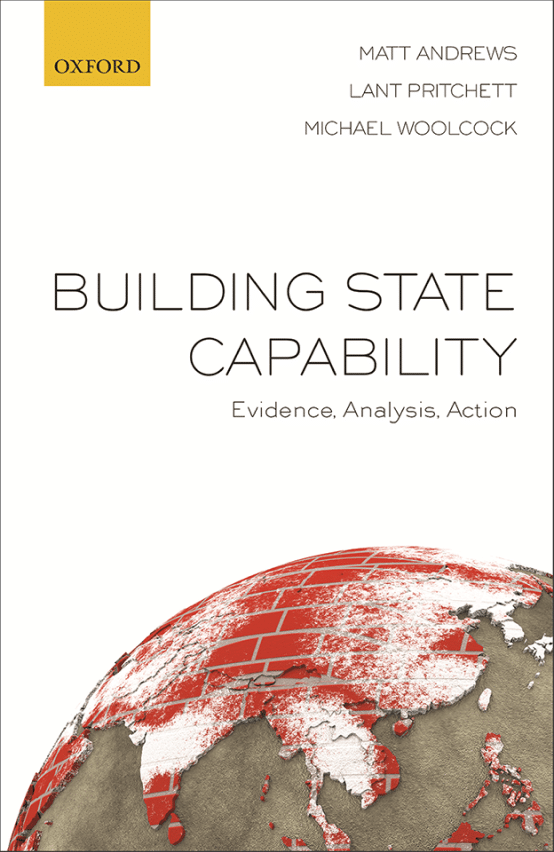
Building State Capability: Evidence, Analysis, Action
This book provides evidence of the capability shortfalls that currently exist in many countries, identifies capability traps that hold many governments back, and describes a process that can be used to escape these traps called PDIA (Problem Driven Iterative Adaptation).

Featured Publications
-

Tackling Learning Poverty in Sierra Leone’s Education System through the Lens of the PDIA
Guest blog by Irina Bilyalova, Orlando Carvajal, Vaiba Flomo, and Sonali Verma We were four students brought together by a shared interest in solving real-world problems. Three from the Harvard Kennedy School and one from the Harvard T.H. Chan School of Public Health. One of us was from the United States; three of us were…
-

Case: Using PDIA to Transform Waste Management in Amman
In early 2022, the Greater Amman Municipality (GAM) faced a growing waste crisis. Given its population of 4.5 million people generating approximately 3,000 tons of solid municipal waste daily, half of Jordan’s total, the city’s rapid growth had significantly outpaced its waste management infrastructure. In response to this challenge, a remarkable two-year transformation using Problem-Driven…
-

Can Outsiders Help Build State Capability? Lessons from Ted Lasso
Gaps between potential and performance are common in states across the globe. This paper argues that these gaps represent differences in state capability, and compares Ted Lasso to how outside actors can impact that capability.

All Publications
SEARCH
Topic
Format
Publication Year
-
Building State Capability: Evidence, Analysis, Action
This book provides evidence of the capability shortfalls that currently exist in many countries, identifies capability traps that hold many governments back, and describes a process that can be used to escape these traps called PDIA (Problem Driven Iterative Adaptation).
-
Doing Iterative and Adaptive Work
This paper builds off of an earlier work in the series, “Doing Problem Driven Work.” This piece goes deeper into how to implement PDIA and address common challenges in international development.
-
Managing Your Authorizing Environment in a PDIA Process
This piece is the fourth in the PDIA series, and it addresses the complex challenge of authority. In this working paper, ideas for adopting the PDIA strategy are provided and elaborate on.
-
Scaling PDIA Solutions through Broad Agency, and Your Role
Scaling solutions can be a complicated task. This paper focuses on broad solutions to fit contextually appropriate situations in policy work.
-
The Big Stuck in State Capability for Policy Implementation
In this working paper, historically developing countries are divided by their strength of state capability. Potential solutions are provided for nations that seem to be stuck in a rut of weak capability.
-
Doing Problem Driven Work
Problem driven work is imperative for policy change. This working paper provides an entry point for PDIA technique.
-
The Challenge of Building (Real) State Capability
“Best practice” solutions sometimes work, but not in all contexts. Development organizations often fall into traps of inaction, and this paper introduces a new approach to building state capability.
-
Building capability by delivering results: Putting Problem-Driven Iterative Adaptation (PDIA) principles into practice
International agencies help countries with both logistical problems, like schooling and medical care, and more broader complex issues, like controlling inflation. That being said, we still have a long way to go. This book chapter offers new ideas to complicated international problems.
-
Can one retell a Mozambican reform story through PDIA?
Public sector reforms in developing countries fail frequently because decision makers ignore the context in which they are placed. Here, PDIA is used to retell the story of a reform that has been limited.
-
Explaining Positive Deviance in Public Sector Reforms in Development
PDIA and SLDC are explored in this working paper, and they are used to analyze data emerging from Princeton’s Innovations for Successful Society.