

Publications
BSC faculty, fellows, and affiliates regularly publish research in a wide range of academic and policy venues. These include books, book chapters, working papers, articles, cases, and reports. In addition, we have hundreds of blog posts that you can read.
-
 Featured Book
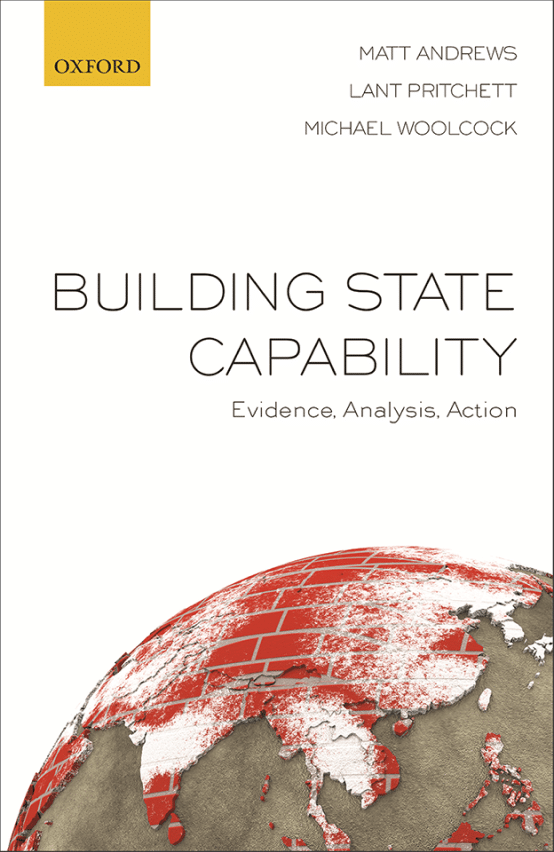
Building State Capability: Evidence, Analysis, Action
This book provides evidence of the capability shortfalls that currently exist in many countries, identifies capability traps that hold many governments back, and describes a process that can be used to escape these traps called PDIA (Problem Driven Iterative Adaptation).

Featured Publications
-

Tackling Learning Poverty in Sierra Leone’s Education System through the Lens of the PDIA
Guest blog by Irina Bilyalova, Orlando Carvajal, Vaiba Flomo, and Sonali Verma We were four students brought together by a shared interest in solving real-world problems. Three from the Harvard Kennedy School and one from the Harvard T.H. Chan School of Public Health. One of us was from the United States; three of us were…
-

Case: Using PDIA to Transform Waste Management in Amman
In early 2022, the Greater Amman Municipality (GAM) faced a growing waste crisis. Given its population of 4.5 million people generating approximately 3,000 tons of solid municipal waste daily, half of Jordan’s total, the city’s rapid growth had significantly outpaced its waste management infrastructure. In response to this challenge, a remarkable two-year transformation using Problem-Driven…
-

Can Outsiders Help Build State Capability? Lessons from Ted Lasso
Gaps between potential and performance are common in states across the globe. This paper argues that these gaps represent differences in state capability, and compares Ted Lasso to how outside actors can impact that capability.

All Publications
SEARCH
Topic
Format
Publication Year
-
Process and Implementation Evaluations: A Primer
Authors investigate six different types of process and implementation evaluations and highlight their strengths and weaknesses to better comprehend successful interventions.
-
Let’s Take the Con Out of Randomized Control Trials in Development: The Puzzles and Paradoxes of External Validity, Empirically Illustrated
Using student learning data from countries across the globe, this paper proves that policy decisions are more successful when they draw on all available research, not just the small set of rigorous studies.
-
Reasons for Using Mixed Methods in the Evaluation of Complex Projects
Evaluating development projects is crucial for assessing their effectiveness and planning for the future. Using mixed method approaches to evaluate the success of projects is especially important.
-
Using case studies to explore the external validity of ‘complex’ development interventions
An analytical framework is provided for assessing the external validity of complex development interventions. It argues for deploying case studies to better identify the conditions under which diverse outcomes are observed, focusing in particular on the salience of contextual idiosyncrasies, implementation capabilities and trajectories of change.
-
It’s All About MeE: Using Structured Experiential Learning (‘e’) to Crawl the Design Space
This paper proposes “structured experiential learning” where agencies use design variations, turning evaluation into a tool for learning and innovation.
-
Can Governance Indicators Make Sense? Towards a New Approach to Sector-Specific Measures of Governance
Governance indicators are biased in the eyes of contemporary critics. The authors of this piece argue for more appropriate standards.
-
The Good Governance Agenda: Beyond Indicators without Theory
How do we define good governance? This article argues that work on the good governance agenda suggests a one-best-way model, ostensibly a developed country government, which isn’t easily replicated.