

The New Global Goals Spell the End of Kinky Development
written by Lant Pritchett
I think the SDGs are both worthless and yet worth it. My perhaps perverse view is that the SDGs are terrific because they will have no impact. The choices for a post-2015 UN development agenda were: (a) a “more of the same” extension of the MDG approach, (b) nothing, and (c) something like the SDGs. While one can debate whether the SDGs are slightly better than nothing or slightly worse than nothing, my argument is that even if the SDGs are worth nothing they are still far better than the MDGs.
The feature that many like about the MDGs, their focus, made them worse than nothing because they were focused on an agenda that was too narrow, too biased, and too kinky to be a global development agenda and this focus distorted development action and assistance.
MDGs too narrow and biased
Table 1 comparing the MDGs with priorities named by developing-country citizens shows the MDG domains were too narrow (excluding entire high-priority domains like energy and transport infrastructure, social protection, or good governance), had too narrow agenda even within those domains it named (schooling without learning, just a few diseases), and were biased toward rich-country and global hyper-elite concerns.
Table 1: The MDGs were narrow and biased compared to the expressed priorities of developing countries in the UN’s own “My World” survey
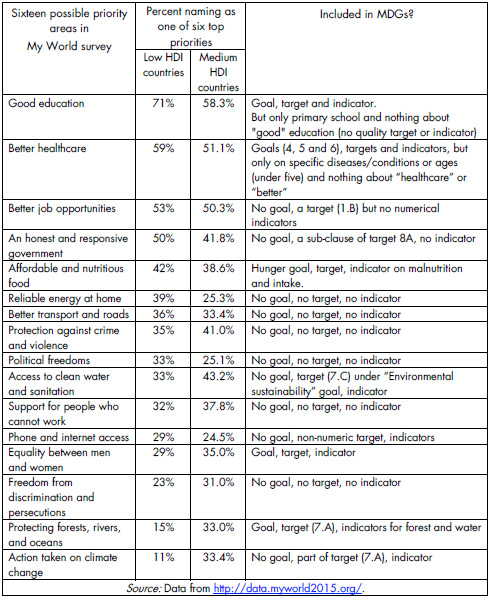
In connection with the preparation of the SDGs, the UN ran “My World,” a global survey that allowed people online (and with some other outreach to cell and paper surveys) to choose 6 of 16 possible issues as “most important for you and your family.” The process was obviously not representative and was potentially biased in a number of ways, but, unlike the MDGs, it allowed over 5.7 million people from low- and medium-HDI (human development indicator) countries to participate. Moreover, as part of a UN process, one would think the biases would be pro-MDG.
A comparison of these survey rankings (again, such as they are) against the official MDG goals, targets, and indicators shows just how narrow and biased the MDGs were. “Good education” is the most commonly named priority. While there is an MDG for education it lists only primary school completion, doesn’t happen to mention that education be “good,” or include anything about secondary or tertiary education.
“Better healthcare” is number 1, and health gets three goals but they are focused on specific ages, diseases, and conditions and never mention either “healthcare” or “better” for most disease conditions (see below).
The survey lists neither “economic growth” or “poverty” as possible priorities but “better job opportunities” is the number 3 named priority but, strangely, is subsumed in the MDGs as a target under the goal “Eradicate extreme poverty and hunger” without a numeric goal or target.
An honest and responsive government is the number 4 priority and merits only a vague mention in the MDGs.
Priorities 5, 6, 7, and 9 (among low-HDI country respondents) are infrastructure related — energy, transport, clean water and sanitation, and phone and internet access. Energy and transport are completely absent from the MDGs and water and sanitation are subsumed under “environmental sustainability” (as opposed to being important in their own right) and, more strangely still, phone and internet without a target bur have indicators under “global partnership for development.” As Leo (2013) shows representative survey results suggest that infrastructure is a large priority in Africa and Latin America.
The only target for goal 3 of promoting gender equality and empowering women was equalizing enrollments in primary and secondary school — nothing about sexual violence and domestic violence, nothing about property rights, nothing about discrimination.
The MDGs were too narrow a definition of development, with entire domains important to developing countries’ citizens like energy, transport, good governance and political freedoms, crime and violence, and social protection left out entirely. Even within the domains with an MDG like education, health and gender these were interpreted far too narrowly.
Too kinky
Kinky development is “defining development down” by setting a low bar for a goal and then claiming that reaching this arbitrary low bar is a priority. I call this “kinky” because a targeted project/program/intervention/policy that pushes everybody just up to a low bar level would produce a “kink” in the distribution of well-being at low bar level.
Table 2 shows the MDG targets were such low bar goals they were near being accomplished in the largest developing countries by the time MDGs started.
Table 2: The status of the MDGs before they started in most of the 20 largest developing countries—the targets were already mostly met because they were narrow and kinky
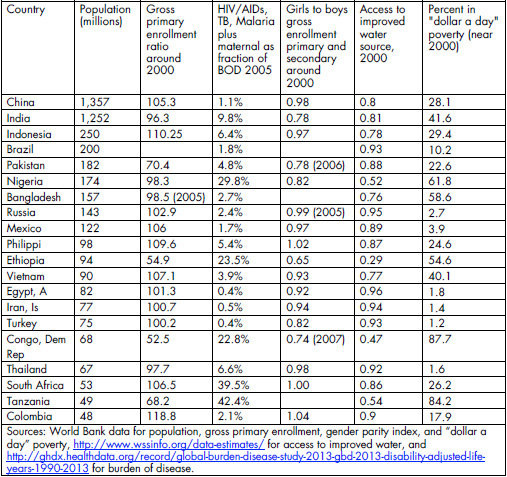
The top 20 most populous developing countries in Table 1 have 4.6 billion of the roughly 6 billion people in the developing world. Table 1 shows where these countries were on the MDGs roughly when (or just after) they started (as best data allows).
This table illustrates that the problem with the MDGs is not that they are not worthy goals but that the goals were too low to constitute a development agenda as they affected too few people.
Take access to an improved water source where the goal was to halve the proportion of people without access to safe water. In Pakistan in 2000, 88 percent of people were already using an improved source in 2000. This means improvements in water that benefitted only 6 percent of the people would be sufficient to meet the target. But only 28 percent of people in Pakistan in 2000 used water piped into their premise, which is a goal for nearly everyone and widely considered part of development but not included in the low-bar MDG. Too low bar.
Take gender. The target is just about equality of enrollment in primary and secondary school. In 10 of 17 countries with data this was already over 90 percent in 2000. But in Colombia where girls are more likely to be in primary and secondary school than boys, the DHS survey reports 44 percent of ever-married women have suffered from domestic violence by their spouse partner. The goal for “promoting gender equality and empowering women” is achieved without any mention of domestic violence? Too low bar.
Take education. All countries have many goals for education but the MDG had the narrow and low-bar goal just completing primary schooling — nothing about learning in primary school (or elsewhere), nothing about secondary, nothing about school to work transitions and training, nothing about higher education, nothing about research and knowledge creation — just completing primary school. As table 2 shows only 4 of these 20 countries had gross primary enrollment rates below 95 percent before the MDG started. Too low bar.
Take health. Besides the goal on infant mortality, the MDGs named HIV, tuberculosis, and malaria (Goal 6) and maternal health (Goal 5). These are obviously important and priority areas. But how narrow are these goals as a portion of (non-child) health? For this we only have data for 2005 but these diseases were less than 10 percent of all burden of disease in all but five countries and less than 5 percent in 11 countries. Three goals for health and nothing about access to health care? Too low bar.
What is the problem with development goals that are narrow, biased and kinky?
First, there is no line. A fundamental principle of Marshall’s Principles was that “nature doesn’t jump” and that is right: there is no non-linear jump in human well-being as these arbitrary low-bar thresholds are crossed. Nothing special happens to a child’s knowledge or capabilities at the end of primary school. Those more than 2 standard deviations below a norm of weight for age the WHO defines as “malnourished” but no one imagines that there is a dramatic difference between those at 2.1 and 1.9. There is no line at the poverty line — no one has ever held an “I am over $1.25 a day” party. Focusing on low-bar goals explicitly dismisses peoples’ legitimate aspirations for good education, better healthcare, higher incomes, better infrastructure as not “priority” without any rationale or justification for a cut off at a low bar.
The second problem is the MDG agenda is too narrow, biased, and kinky to be the development agenda of a democratically elected government. Democratic governments need the median voter and hence nearly all democracies have an agenda aimed at not just “the poor” but their broad middle class. This cannot be the MDGs. Take Indonesia, which made a democratic transition in 1999. The MDG on education could be part of, but not the main focus of its education agenda as primary completion was already at 95 percent. HIV, tuberculosis, malaria, and maternal mortality could be part of its health agenda — but that covered only 6.4 percent of its burden of disease. Access to improved water could be part of its infrastructure agenda, but 78 percent were already there. Equalizing enrollment could be part of a gender agenda, but rates were nearly equal already. By 2000 “dollar a day” poverty was already down to 29.4 percent (after spiking during the crisis) so that could not be their economic agenda — even though 67.1 percent were under the “two dollar a day” standard. As seen in Table 2 only for the very poorest of African countries could the MDGs broadly appeal as an agenda for the median voter.
Third, there is a fundamental contradiction between narrow, biased, kinky MDGs and the Paris Declaration that aid should be based on partner-country priorities. You cannot dictate both process and outcome: “countries should set their own priorities and these priorities should be the MDGs.” In nearly all developing countries, governments were increasingly saying to representatives of development assistance agencies: “Do you want to talk about our national agenda or the MDGs?” If one wants to maintain support for development assistance it has to have the support of the developing countries.
If a “mess” of “senseless, dreamy, garbled” “higgledy-piggledy” SDGs with “no priorities” are the price to pay to get rid of the focused but narrow, biased, and kinky MDGs and onto explicit goals, widely shared among citizens of developing countries, for economic growth (8.1) and higher poverty lines (1.2), learning in education goals (4.1), addressing systemic service delivery issues in healthcare and financing, access to energy (7.1) and expressing high-bar ideals rather than defining development down to low-bar goals then I am all for it — even if I don’t expect great things.
A new era for development – the future or already reality?
Guest blog by Arnaldo Pellini
Michael Woolcock, the Lead Social Development Specialist at the World Bank, gave the keynote speech at the International Conference on Best Development Practices and Policies organized by the State Ministry of National Development Planning (BAPPENAS) on August, 19-20 in Jakarta. He is one of the leading voices in the debate around new ways for approaching development problems and designing development interventions that are more flexible and context specific. He is the co-author of a well-known paper that presents an alternative approach, the Problem Driven Iterative Adaptation.
Here are some of the key insights I took from Michael Woolcock on a new era for development:
- We are entering a new era of development which we can be called Development 2.0. Development 1.0 was concerned with technocratic reforms required to provide access to basic services such as education and health. Most countries (certainly middle income countries) have achieved that and have the infrastructures in place: policies, schools, health centers, textbooks, etc. Development 2.0 is about the state capability to make those systems work, providing good quality public services to citizens. For example, schools have been built, teachers are trained, national policies on salary and curricula are in place. So, why is it that some schools perform well and other do not perform well? Those are the questions that we need to research and answer in Development 2.0.
- Development 2.0 is about multiple (and localized) solutions to development problems. A traditional approach in development is to find smart or best practices and scale them up through nation-wide policies. That approach has had mixed results. Development 2.0 is more about mapping out where public services work well and why as well as where service do not work well and why. Smart practice can still emerge but they can be interpreted to provide a variety of policy responses. This will require moving from the technocratic evidence and knowledge central to Development 1.0, to a more multidisciplinary approach to research and multiple types of evidence that can inform policy decisions aimed at improving service delivery.
- Multiple sources of evidence help to deal with diversity of development problems. The new evidence generated by various types of research methods and various types of knowledge (eg, community knowledge) will produce maps of variations in service quality and delivery, which can suggest the need for multiple solutions or interventions and to draw as much as possible on local knowledge, initiatives, and various forms of capital (eg budget, social capital, human capital, etc.).
- Development 2.0 is an era where variation and uncertainty have to be accepted and embraced. It is an era where one-size-fits-all solutions will struggle to succeed and where context specific, technically sound and politically feasible solutions can have a greater chance of success.
- We, development practitioners and researchers have to learn to become more modest about the extent of what we can learn and, especially, what we can suggest. We can map where bureaucracies struggle and contribute with ideas that can help segments or units of the bureaucracy to provide the services that citizen expect from them. We should avoid the temptation to suggest the solution having mapped with our work only small bits of complex political and institutional realities.
At the end of the meeting I remembered the review written by Malcolm Gladwell about the biography of Albert O. Hirschman, The Gift of Doubt: ‘The economist Albert O. Hirschman […] was a “planner,” the kind of economist who conceives of grand infrastructure projects and bold schemes. But his eye was drawn to the many ways in which plans did not turn out the way they were supposed to—to unintended consequences and perverse outcomes and the puzzling fact that the shortest line between two points is often a dead end. He understood the power of failure and had the gift of doubt.’
Development 2.0 is already here. It seems to me that we should all make use of the same gift of doubt if we are to contribute to progress and innovation in building state capabilities.
Busting Myths about Governance and Development
David Booth highlighted 5 myths about governance and development in a blog earlier this year. Two of his points are particularly relevant for PDIA.
- Myth 2: Governance-improvement is a good entry-point for developmental reform. In our experience, constructing local problems is the entry point to begin the search for solutions that ultimately drive change. We believe in solving problems and not selling solutions.
- Myth 5: African regimes can’t do problem-driven, adaptive development. That’s just not true. We have experimented with PDIA in Mozambique; the World Bank has tried PDIA in Sierra Leone, Cameroon, Burundi; AGI has used it in Rwanda and DFID has used it in Nigeria.
You can find the entire blog here.
Getting Best Fit in Development Projects is like buying a new suit
written by Matt Andrews
I often hear talk of moving from best practice to best fit in development. When I ask what people mean by this I seldom get the same answer. But the basic idea is that multiple solutions are considered instead of a one-best-way solution. I like the idea in concept and have written on it as a way of ensuring that we get past the tyranny of one-best-way. But I don’t think having multiple solutions to choose from is enough.
Getting Best fit is not simply about looking at a variety of options and deciding which one works best in the place one is working. This is because it is really hard to know what led to and informed the ideas being considered, and it is hard to know what the contextual realities are in the place where one is doing the fitting. So: One may think that an idea from South Africa will work in Botswana, because there are contextual similarities, but one does not know if the South African idea depends on very localized political or capacity issues that are not present in Botswana.
The only way one truly does best fit is by trying stuff out and learning what works, hopefully why, and then adapting. Try the South African example in Botswana, ask where it is working and why, and then chisel the idea into a shape that fits Botswana better — simultaneously building some new capacities in Botswana to make the fit work.
It is not, therefore, about getting best fit in some conceptual manner, but about ‘fitting’ in practice. Kind of like being a tailor to someone looking for a new suit. How might it work? Let’s think of buying a new suit….
- Identify the general type of suite that interests you…
- Choose a variety of potential suites off-the-shelf
- Try them on…with the tailor advising on their fit…
- Learn what kinds of cuts and styles work best for your look (you may be surprised and find your assumptions were incorrect)
- Decide on the style and cut and color you want (and other characteristics)
- See what you can take off-the-shelf (you may have the entire suite, or a jacket, or a jacket with sleeves that need shortening, etc.)
- Get the tailor to make alterations you need… as many as required
- try it on again
- make more alterations
- pay that tailor and leave, to impress the world with your best fitted suit!
How do money, ideas and, reforms come together to produce better development outcomes?
Despite the considerable time, money, and effort that aid agencies, international organizations, and NGOs expend producing analysis and advice to inform or influence policymakers in developing countries, there is a remarkable lack of understanding about which of these instruments are most and least effective at spurring and sustaining reforms – and why.
In an attempt to answer these questions, AidData gathered firsthand experiences and insights from 6,750 policymakers and practitioners in 126 low-and middle-income countries. Through their analysis, they identify overall trends, attributes of influential assessments, and both intended and unintended effects of such assessments. These are summarized in their Marketplace of Ideas for Policy Change report.
Here’s an excerpt from the conclusion:
“The Minister’s adviser would probably tell her that, of the wide variety of assessments at her disposal, the policy analysis and advice contained in the assessments of large, global international organizations have proven to be particularly valuable to other reformers. He might also warn the Minister not to rely on the analysis and advice provided by assessment suppliers who lack an in-country presence. These suppliers may not be able to provide the contextual insights needed for the effective design of specific reform features. Additionally, after explaining that external performance assessments are generally associated with more successful reform efforts when they source their data from the governments they assess, the adviser would probably suggest that the Minister pay particularly close attention to assessments that draw upon the data that the government is already producing.
The Minister and her adviser would eventually confront the issue of whether to use country-specific performance assessments or cross-country benchmarking assessments. The adviser would likely explain that each type of assessment has its own advantages and disadvantages. Country-specific assessments contain in-depth diagnostic and advisory content, which may resonate with local stakeholders because they are more attuned to local needs and realities. These assessments tend to be more popular with policymakers across the developing world; however, they can also leave host government officials with a false sense of confidence in the analysis and advice they provide, thus bypassing critical internal processes of introspection, deliberation, and iterative problem solving.
Cross-country benchmarking assessments, on the other hand, are less attractive at first blush because they lack nuance and context specificity. However, when decision-makers confront complex issues of corruption, informality, and institutional dysfunction, they can provide greater policy flexibility and maneuverability than country-specific assessments, enabling the government to experiment with different reform strategies and iteratively adapt in pursuit of better, de facto outcomes.
Noting the Minister’s interest in Greek mythology, the adviser might remind her of the many perils Odysseus faced on his journey home from Troy and counsel the Minister to avoid steering her country into the “capability trap” that has ensnared other well-intentioned, would-be reformers. He would encourage her to focus on simple, solvable problems before undertaking more complex reforms. To underscore his point, he might even slip a copy of a short article by Lant Pritchett, Michael Woolcock, and Matt Andrews into the Minister’s read file, which describes the capability trap as a dynamic that enables [policymakers] to document instances of apparent reform and thus assure a continued flow of development resources to their country or sector, despite the fact that the reforms themselves may be generating few actual improvements in performance.”
Read the full report for more.
PDIA in Indonesia: The new frontline service delivery policy
How does the government of Indonesia make its presence felt by all 250 million citizens across the sprawling archipelago?
While decentralization provides district governments the authority to address local needs, effective execution of these functions relies heavily on the capacity of the local governments to analyze service gaps and drive more coordinated efforts to address them, as well as the capacity of communities to voice their needs, provide feedback and be part of the solution.
To address this, the Medium-Term National Development Plan 2015-19 includes a new policy to improve basic services for the poor and vulnerable. The approach focuses on enhancing interactions at the front line between government, service providers and citizens, as well as their collective ability to diagnose and solve service delivery bottlenecks at the community level.
A multidisciplinary team from 8 sectors conducted a series of field visits between September 2014 and January 2015, with a mission to identify local innovation and best practices for improving services for the poor and vulnerable. Using a PDIA approach, they engaged with a broad set of stakeholders, had enriching interactions, and were able to view the same problem from different angles. Vignettes from their field visits are captured in Catalyzing local innovation to improve services for Indonesia’s Poor. Some of the lessons they learned include:
- Focus on fostering experimentation and learning at the local level , rather than fixating on sluggish reforms at the central level.
- One size does not fit all. Instead of prescribing a set menu of interventions to improve service delivery, the approach should be to create a supportive policy and institutional environment that fosters innovation.
- The locus of innovation also matters. The closer the innovation occurs to the community, the more potential for catalytic change.
- Diffusion can happen organically but knowledge sharing and creating communities of practice can help the expansion of innovative ideas.
Watch Anna Winoto from the National Development Planning Ministry in Indonesia discuss the frontline service delivery policy at the Doing Development Differently Philippines workshop. The challenge in this work is to facilitate district governments to innovate, which requires multi-disciplinary district teams who can solve problems together, access flexible financing, leadership and change management, and diagnostic tools to allow for rapid feedback.
https://www.youtube.com/watch?v=mfMrK-70YqY
Getting real about development; It is hard
Written by Matt Andrews
I’m reminded so regularly that development is about change. If it’s done well it is about change that sticks, and even more about countries becoming adaptive (able to change continuously at the right pace and in the right way).
This requires learning and building a specific type of DNA in people, organizations, and countries. And this learning is hard. Often because learning is perceived as failure, and failure is feared.
The truth is that most key development breakthroughs happen out of the lessons of things gone wrong, but in the moment of going wrong it is hard to see how valuable the failure is; it seems like all is falling apart and critics come out of every window and door they can.
Keeping one’s head in these moments is crucial, and is required to let people see failure as learning and to see that learning itself is the key to success.
I wonder how often public policy schools teach students about these moments and how to manage yourself in the face of the turmoil these moments involve. I think this may be one of the most important lessons to learn if you want to work in development and not spend all the time writing safe reports no one uses or consult from a distance, or do stuff without bringing local folks along to learn how to do it themselves.
Making the case for case studies in development practice
Written by Michael Woolcock
The frequency and sophistication with which case studies are deployed by social scientists has greatly expanded in recent years. The goal now is not merely to document or describe, but to diagnose, explain, interpret, and inform a basis for action. Professional schools across the disciplines – from medicine and engineering to business and public policy – now routinely use ‘the case method’ not only to teach but to generate practical knowledge.
World Bank staff have been active contributors to and beneficiaries of these trends, especially as the role of institutions and governance has gained prominence in efforts to enhance development effectiveness. When complex places, processes, people and projects come together, they inherently yield a diverse range of outcomes. Mapping this variation with survey data and then explaining how it varies using targeted case studies can yield uniquely instructive insights for development policy and practice.
This twin approach forms the empirical foundations of a forthcoming report on public service delivery in the Middle East and North Africa region, and will be a central component of the new Global Delivery Initiative (which will focus on explaining and improving the quality of implementation systems).
Rather than seeking universal ‘best practice’ responses as a basis for policy advice, analysts use case studies to learn from ‘natural’ (or sometime overtly experimental) sources of intra-country variation. Everyone can agree in the abstract that context and high quality institutions matter for development, and that one size doesn’t fit all, but these truisms aren’t much help when trying to provide specific advice in response to a specific problem in a specific place, such as stemming urban violence in Rio de Janeiro or promoting more effective antenatal services for women in Cairo. Case studies are emerging as a useful strategy for eliciting not just uplifting success stories, but as unique data collection tools that can guide policy and practice by helping domestic actors adjust in real time as they seek solutions to emerging problems.
The recently completed ‘Institutions Taking Root’ (ITR) study is an exemplary instance of this new approach to discerning what works, and how success happens, in development. In places that initially seemed unlikely venues for successful development, the ITR team began from the premise that someone, somewhere, somehow had probably figured out how to make real gains where others had not.
In contexts ranging from rural electrification in Lao PDR to basic and secondary education in The Gambia, researchers sought out islands of success in seas of seeming failure, defining success as positive outcomes which were measurable, legitimate and durable (i.e., robust despite exogenous shocks or changes in political leadership). An institution was considered to have achieved results if it exhibited sustained, measurable improvements in key agency outputs and outcomes, doing so across prevailing social cleavages (e.g., rural-urban, between ethnic groups, etc.).
Having identified such outcomes, researchers sought to test hypotheses examining the institution’s interaction with its context, and the organization’s inner workings. This procedure was followed in each of the case studies to guide and standardize data collection, thereby making systematic comparison of the cases possible. Interviews and focus groups were conducted both outside-in (focusing on external stakeholders and constituents first before moving onto officials) and bottom-up (beginning with frontline service providers before moving to agency management and political leaders) to ensure that typically less dominant viewpoints were represented.
One memorable example from the ITR describes the ministry of public works in Lao. Most such ministries, especially in poor countries, have strong imperatives to focus on building new roads rather than maintaining existing ones: new roads look impressive, provide officials with elaborate opening ceremonies and flattering media coverage, and most have an immediately large economic impact.
Fixing old roads, by contrast, is boring, time-consuming and devoid of political pay-off, no matter how necessary. But in Lao, the minister of public works had managed to shape a broad public consensus on the moral, economic and political importance of keeping roads in good repair. Deploying a memorable slogan, he travelled the country reminding villagers and elites alike that “Making children is easy and fun; raising children is hard and costly!” In this way, he argued, roads were like people: they should be cared for if they are to make a lasting contribution to Lao society. No matter their level of education, everyone in Lao understood the minister’s analogy; his unique but explicit leadership on this issue enabled him to secure political credit for an important issue that is usually overlooked.
Is this then “the answer” for raising the profile of road maintenance in developing countries everywhere? Readers will doubtless have their own views, but I think it is an answer, demonstrating how a particular team of people found a way to solve a tough but widespread problem. As such, it can hopefully be a source of inspiration and ideas for others elsewhere seeking to find their own solutions.
This post previously appeared on the World Bank blog.
Rising to the challenge: Supporting PDIA in Nigeria
The importance of thinking and working politically in programs concerned with governance and institutional reform is widely recognized – but shifting from thinking politically to working politically is proving a major challenge. The State Accountability and Voice Initiative (SAVI), a governance reform program in Nigeria, supports local partners and stakeholders not through the usual accountable grants, but through mentoring, capacity building, relationship brokering and seed funding. This approach is making headway in enabling local partners and stakeholders to think and work in politically savvy ways around locally agreed problems – and its success is demonstrated in tangible examples of more responsive state governance in all the states where the program works.
The SAVI program in Nigeria, a DFID-funded Empowerment and Accountability program operating in ten states, is included as a case study, among others, in ODI’s new report Adapting Development.
How do you keep 100 students awake on a Friday afternoon? Fast feedback and iterative adaptation seem to work
Guest blog written by Duncan Green
There’s a character in a Moliere play who is surprised and delighted to learn that he has been speaking prose all his life without knowing it. I thought of him a couple of weeks into my new role as a part-time Professor in Practice in LSE’s International Development Department, when I realized I had been using ‘iterative adaptation’ to work out how best to keep 100+ Masters students awake and engaged for two hours last thing on a Friday afternoon.
The module is called ‘Research Themes in International Development’, a pretty vague topic which appears to be designed to allow lecturers to bang on about their research interests. I kicked off with a discussion on the nature and dilemmas of international NGOs, as I’m just writing a paper on that, then moved on to introduce some of the big themes of a forthcoming book on ‘How Change Happens’.
As an NGO type, I am committed to all things participatory, so ended lecture one getting the students to vote for their preferred guest speakers (no I’m not publishing the results). In order to find out how the lectures were going, I also introduced a weekly feedback form on the LSE intranet (thanks to LSE’s Lucy Pickles for sorting that out), and asked students to fill it in at the end of the session. The only incentive I could think of was to promise a satirical video (example below) if they stayed long enough to fill it in before rushing out the door – it seemed to work. The students were asked to rank presentation and content separately on a scale from ‘awful’ to ‘brilliant’, and then offer suggestions for improvements.
It’s anonymous, and not rigorous of course (self-selecting sample, disgruntled students likely to drop out in subsequent weeks etc), but it has been incredibly useful, especially the open-ended box for suggestions, which have been crammed full with useful content. The first week’s comments broadly asked for more participation, so week two included lots of breakout group discussions. The feedback then said, ‘we like the discussion, but all the unpacking after the groups where you ask what people were talking about eats up time, and anyway, we couldn’t hear half of it’, and asked for more rigour, so week three had more references to the literature, and 3 short discussion groups with minimal feedback – it felt odd, but seemed to work.
At this point, the penny dropped – I was putting into practice some of the messages of my week two lecture on how to work in complex systems, namely fast feedback loops that enable you to experiment, fail, tweak and try again in a repeat cycle until something reasonably successful emerges through trial and error. One example of failing faster – I tried out LSE’s online polling system, but found it was too slow (getting everyone to go online on their mobiles and then vote on a series of multiple choice questions) but also not as energising as getting people to vote analogue style (i.e. raising their hands). The important thing is getting weekly feedback and responding to it, rather than waiting til the end of term (by which time it will be too late).
The form is not the only feedback system of course. As any teacher knows, talking to a roomful of people inevitably involves pretty intense realtime feedback too – you feel the energy rise and fall, see people glazing over or getting interested etc. What’s interesting is being able to triangulate between what I thought was happening in the room/students’ heads, and what they subsequently said. Broad agreement, but the feedback suggested their engagement was reassuringly consistent (see bar chart on content), whereas my perceptions seem to amplify it all into big peaks and troughs – what I thought was a disastrous second half of lecture two appears to have just been a bit below par for a small number of students.
The feedback also helps crystallize half-formed thoughts of your own. For example, several complained about the disruption of students leaving in the middle of the lecture, something I also had found rather unnerving. So I suggested that if people did need to leave early (it’s last thing on Friday after all), they should do so during the group discussions – much better.
What’s been striking is the look of mild alarm in the eyes of some of my LSE faculty colleagues, who warned against too much populist kowtowing to student demands. That’s certainly not how it’s felt so far. Here’s a typical comment ‘I think that this lecture on the role of the state tried to take on too much. This is an area that we have discussed extensively. I think it would have been more useful to focus on a particular aspect, perhaps failed and conflict-affected states since you argue that those are the future of aid’. Not a plea for more funny videos (though there have been a few of those), but a reminder to check for duplication with other modules, and a useful guide to improving next year’s lectures.
What is also emerging, again in a pleasingly unintended way, is a sense that we are designing this course together and the students seem to appreciate that (I refuse to use the awful word co-create. Doh.) Matt Andrews calls this process ‘Problem Driven Iterative Adaptation’ – I would love to hear from other lecturers on more ways to use fast feedback to sharpen up teaching practices.