

Traveling the World via the Building State Capability Blog
Guest blog written by Dana Radojević and Lauren Truong
Four months ago, we set off on a journey across the world – though not in the way you might expect.
You see… we weren’t traversing the jungles of Peru, eating street food in Thailand, or admiring the ancient ruins of Greece. Nor were we running through the terminals of Heathrow Airport to make a layover or boarding a ferry to island hop across the Galapagos.
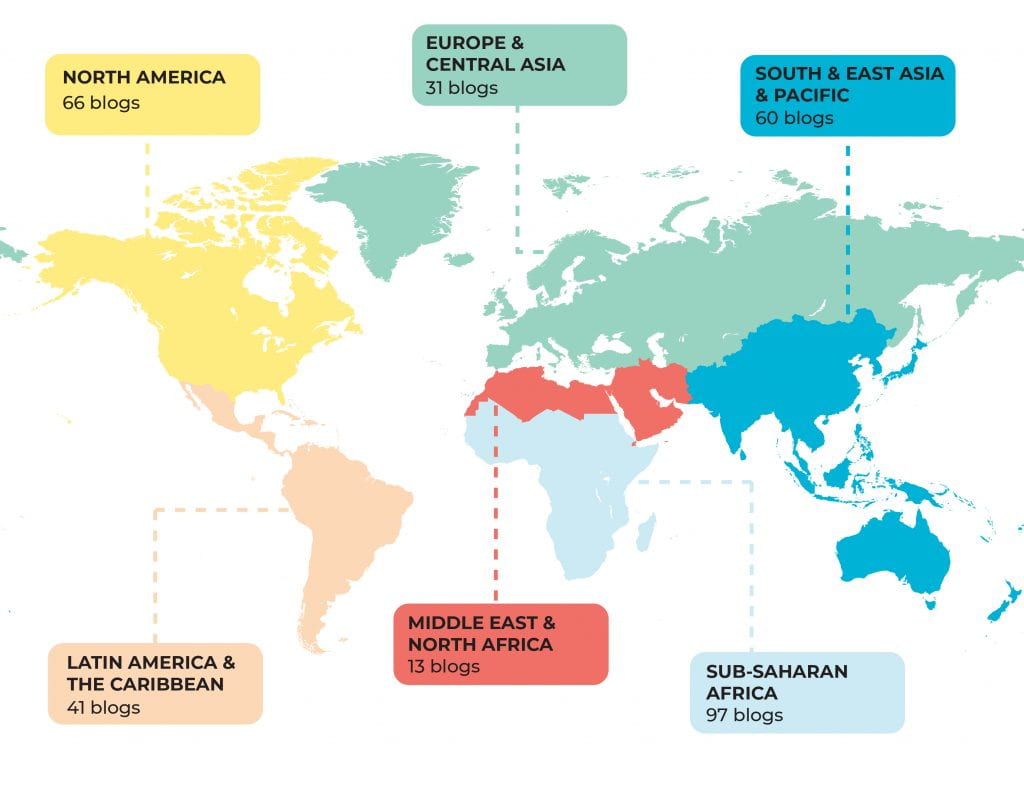
Instead, our journey across the world transpired via the stories of more than 400 global practitioners – practitioners who are working to address some of the world’s most complex and pressing problems.
Civil unrest and misinformation in South Africa
Guest blog written by Collin Mashile
- What were your expectations of IPP Online when you signed up?
A few weeks before the closing date, I received an e-mail request from my then Authoriser (Acting-Director General) to consider applying for the Harvard Kennedy School (HKS) Implementing Public Policy Program (IPP). Her exact words: “there is this amazing academic from South Africa, Professor Matt Andrews, he is offering this course and I think you will love his methods, see if you can apply or register; it will be a worthwhile training for you”. Having read the information on the programme, I had come to a conclusion that I needed this training because South Africa was being praised for having developed good quality regulatory policies; but the implementation was not seen as being effective. The training would equip me with skills required to assist my country in public policy implementation. The prestige of the institution and the professional testimony on how the training was the best and would provide practical and theoretical lessons on how to assist in effective policy implementation. My supervisor was actually right as this course opened my eyes to concepts and learnings I was not exposed to previously. Online made it more interesting, challenging and worthy.
(more…)Inclusion of youth in public and private decision-making bodies in France
Guest blog written by Fadila Leturcq
“Le savoir est une arme” (“Knowledge is a weapon” in English) is a recurring punchline in French rap lyrics and one that resonates with me when I take the time to reflect on my journey through the IPP program. “Le savoir est une arme ” suggests that learning, acquiring knowledge or making discoveries, is the prerequisite for winning battles, progressing and advancing. This is what the IPP program encourages us to do through a method that is well-constructed and inspiring for many of the challenges we face as professionals or public policy actors.
(more…)The Importance of Entry Points in Long Term Policy Problems
Guest blog written by Jake Lestock
After a little over a year working from home during the pandemic, I quickly realized that returning to ‘normal’ was still far from sight in a professional sense. Virtual work has become the new norm even in public policy settings. Many of the benefits of living in a political hub like Washington, DC with its excess of work events, meet-and-greets, and policy happy hours to network with new people from various public policy fields had abruptly ended. I realized I would need to be more proactive in looking for new opportunities to help advance my own professional development and learn from others about new ways to work on public policy challenges. It was around this time that I came across HKS’s Implementing Public Policy Program and thought it would be a perfect opportunity to fill that void.
Coming into the program I was uncertain of what I could expect as I had little knowledge of the problem driven iterative adaption (PDIA) and how a course designated for public policymakers across the world in the public sector would intersect with my policy problems working for a trade association representing the private sector. On top of this, it was both inspiring and intimidating to hear from my colleagues in the program who are working on such impressive/important public policy issues across the world. Once I was able to catch my bearings, I came to find that there are a set of key concepts and strategies that one can use to help break down any complex public policy challenge. While numerous strategies and concepts have proven helpful during the 6-month course, here are a few that proved particularly useful with my challenge.
(more…)Implementing to design better: Clean energy transition for islands
Guest blog by Ana Laca
I work primarily in foreign affairs and regional development, but as a side passion project, I have been actively working on islands’ energy transition. I work for a European institution on legislative procedures, following particular files as they pass through a legislative train until their final adoption.
For my action learning process, I focused on islands’ energy transition as my project for this course. My policy challenge was to tackle the energy dependence of islands since they have an abundance of natural resources that could be used for renewable energy.
This is my most tangible project as I authored or co-authored three successful pilot projects approved for financing from the EU budget. Their purpose was to provide technical assistance for islands and rural areas, to start and guide them through their clean energy transition processes.
My incentive to apply and my first expectation was to learn more about the implementation process. I hoped to gain theoretical and practical knowledge on challenges practitioners face while implementing their policies, to take that with me and apply it in my work – which is legislative work. I wanted to learn about implementing public policy to cover the link I frequently think is missing in the institutions when we design public policies. I feel that we design without really having the perception of the policies’ implementation and outcome. To my (positive) surprise, this class was more practical than theoretical.
(more…)Unsustainable civil service expenditure in Fiji
Guest blog written by Susan Kiran
Expectations
I never imagined I would have the privilege of enrolling in a course from the Harvard University even though I had always harbored the dream of going to Harvard. When the IPP online opportunity was offered, I grabbed it instantaneously and I did not regret any single moment of having to wake up for the group sessions and the Q&A sessions, the weekly assignments and later the fortnightly assignments. It was not easy juggling a full-time job with its many demands, and being a mom to two girls, but it was a worthwhile journey of understanding how to implement policy solutions for complex problems especially in the public sector.
(more…)Private sector investment in renewable energy in Mongolia
Guest blog written by Hisaka Kimura
1. My expectation of IPP Online
Asian Development Bank, which I work with, has been strengthening its field offices to respond more effectively to the evolving challenges. Based in Beijing, one of the largest field offices, I lead private sector country work for China and Mongolia, focusing on strategy, business development, structuring, negotiation, implementation, regulatory monitoring, and knowledge-sharing. Following COVID-19, implementation jumped up the agenda among the full spectrum of new challenges. I had to deep-dive more project implementation, and I was thrilled at IPP online opportunity to prepare myself to deliver greater responsiveness to the client needs in these trying times.
(more…)Building sustainable and equitable transportation systems in Toronto
Guest blog written by Judy Farvolden
I am passionate about vibrant, equitable, sustainable urban life. My journey began in Paris when, as a 17-year-old living for a year in the City of Light, I wondered at the difference between living in a place where every day-to-day thing I needed was on my own block and my familiar and comfortable North American suburban life. I decided that the difference was the extensive subway system that made it possible for me to get anywhere in the city in 30 minutes, cheaply and safely, even as a teenage girl. That led me to study transportation engineering, and in particular systems design, because I believed the answer was to be found in mathematically optimizing transportation networks.
In the 30 years I’ve lived in Toronto, Canada I’ve watched the city grow from – not much – into North America’s fourth largest and fastest growing metropolitan region, with North America’s worst traffic congestion. About 10 years ago, after three engineering degrees and two decades in network optimization and mathematical finance, I realized that more math was not the “answer” to our transportation problems, and the real problem must be getting it done in policy. I decided to see if I could come back around and contribute to addressing the issues that had so motivated me but that I’d never actually engaged in.
I found that opportunity at the University of Toronto where, earlier this year, our proposed Mobility Lab was designated an Institutional Strategic Initiative and granted three years of seed funding on the promise that it would create a multidisciplinary network of researchers that would drive innovation in urban policy, thereby addressing the global challenge for cities to evolve into more sustainable, equitable, and resilient urban forms and mobility systems. The question was, how?
(more…)IPP: A master key to close problem doors and open solution doors for a better world
Guest blog written by Mamadou Mouctar Diallo
The thousands of miles that separate Guinea from the United States and COVID 19 were overcome by technology to enable us to attend this public policy implementation training at the prestigious Harvard Kennedy School. When the opening bell rang in June, I knew I was about to embark on a new adventure that would not only change my life, but also end the suffering of so many young people in my country, Guinea.
(more…)Civil Registration in Sierra Leone: A hero won’t save the day, applying PDIA might
Guest blog written by Laura Michelle Delgado Van Demen
A year after the COVID-19 pandemic started, the perception that our team working on the establishment of a Civil Registration and Vital Statistics (CRVS) system in Sierra Leone, was standing alone in front of a very massive reform had increased. We were very frustrated since each time we were taking a step forward it seemed we were also taking two backwards. Authorisation was not there neither a spirit for reform and collaboration with different agents through this European Union funded project.
I have been working for five years in the field of EU development and external aid and one thing is clear to me: the system, collaboration and approach to building capacities needs to be done differently. It was in 2019 when I heard PDIA for the first time from a very inspiring PFM practitioner when discussing on alternatives and approaches for the projects we were implementing. Thus, building on frustration and trying to find a new way of doing things, I joined the Implementing Public Policy at HKS with the hope of regaining hope again.
(more…)