
Reforming Economic and Banking Policies Using IPP Course in Liberia
Guest blog by Leandro Ward, IPP 2021
My participation in Implementing Public Policy (IPP) 2020 has further deepened my understanding of the numerous public policy challenges that we are faced with on a daily basis. It has also enlightened me on the importance of creating needed policies in the public sector and the successful implementation of these policies for the improvement of this sector. I have also learned to identify challenges and find ways to tackle these challenges.
When I signed up for the course, my expectation was to learn the different tools and techniques available for use in the implementation of policies, especially in the public sector. During my six years in the public sector, I have come to realize the need for both the formulation and implementation of workable policies. As I completed this program (which is my second Executive Education Program) I was convinced that HKS has all the necessary programs to build the capacity and create the leaders needed to take on this tedious but necessary task of improving policy implementation in the public sector.
Some key learnings from the course were the Plan and Control Approach which has to do with unknowns and uncertainty and the Problem Driven Iterative Adaptation (PDIA) which is a step-by-step approach that helps you break down your problems into their root causes, identify entry points, search for possible solutions, take action, reflect upon what you have learned, adapt and then act again. This approach is a problem-driven process that is important in addressing complex problems and very essential in the implementation of policies. Other key takeaways from this course were learning to build teams, the various elements of the delegation process, using the Change Space Analysis which is often novel for many as it requires making assumptions about the behavior of others, constructing and deconstructing problems, and the TOSCA checklist which is a practical way to state a problem. This checklist is to be used by answering the following questions:
1. Trouble: What indicates the current situation is not the desired one?
2. Owner: Who is responsible for its resolution?
3. Success: What will success look like and when?
4. Constraints: What are the binding constraints on developing a solution?
5. Actors: Who are the relevant stakeholders?
The implementation challenge that I am working on is the periodic shortage of US dollars in the Liberian economy which is caused by several factors including individuals taking the physical cash out of the country for business and other purposes. This shortage causes an increase in the exchange rate which also causes the price of basic commodities to increase.
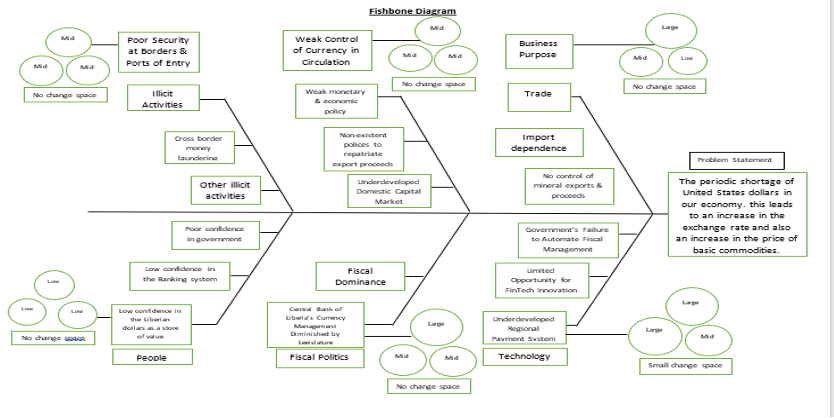
I built an initial team of two other people both of whom agreed to work along with me on my policy challenge. We met the Deputy Governor for Economic Policy at the Central Bank of Liberia (CBL) to present my policy challenge from this IPP course after which he pledged his support to the process. We also spoke with the Senior Advisor for Multilateral Affairs at the CBL who also expressed an interest in the project. Lastly, we spoke to an immigration officer assigned at one of the borders of entry. Once this policy challenge is implemented and there are policies designed to control this challenge, this will make a tremendously positive impact on the economy.
The below photo shows the members of my group 13 that worked on the policy challenge in Liberia.
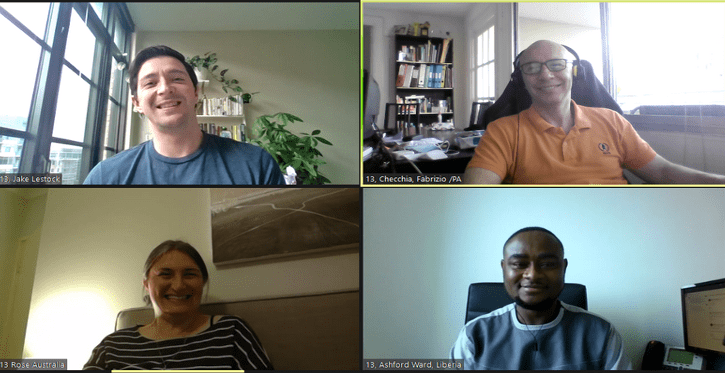
The group was nicknamed “Wo Tiri nkwa”, which means “luck” in a local Ghanaian language by a member of the group who unfortunately could not complete the program. This team met before every Live Q&A Session in a peer learning group session where we shared our individual experiences as we progressed in pursuing our policy challenge. We also reflected on challenges faced during the week before and a member of the group compiled notes and submitted them on behalf of the group. We also shared acts of kindness, and commonalities including birthdays, vacation plans, and other information.
My motivation came from the impact that this challenge has on the economy and on low-income earners. This approach might change the way I tackle problems because I have gained a wealth of knowledge from this IPP course which can be used to tackle this challenge and many others that we are faced with.
Some years back I was supervising a Corporate Social Responsibility project for my previous employer where we did several projects for communities that were within the company’s operational areas. These projects made huge impacts on the lives of these community dwellers. I will continue using the different tools, techniques, and insights that I learned during the course in policy challenge development as well as in my everyday professional life. The world is filled with many challenges. It is left to you as an individual to identify the one that would make a positive impact in the lives of many and work towards making that challenge a success so that people will feel the impact of your work even in the smallest possible way.
This is a blog series written by the alumni of the Implementing Public Policy Executive Education Program at the Harvard Kennedy School. Participants successfully completed this 6-month online learning course in 2021. These are their learning journey stories.
Implementing Public Policy (IPP) and the Art of Sticking with Problems
Guest blog by Maurya West Meiers, IPP 2021
I began the 2021 Implementing Public Policy (IPP) online course thinking that I would come away with tools and approaches to solve problems. I knew that the IPP course is organized around the Problem Driven Iterative Adaptation (PDIA) approach. Working in international development, I’m confronted every day with problems. I thought I can learn all sorts of tools to apply in my work. I did learn about tools, practices, and different ways of thinking about problems in my work at the World Bank. But a lasting memory from the course, and something that I did not sufficiently consider at the start, was the challenge of iterating and sticking with the problem. As I’m completing the course, this Albert Einstein quote resonates with me—“It’s not that I’m so smart, it’s just that I stay with problems longer.”
(more…)My IPP Journey in Louisiana: The World Got Smaller as the Process Deepened
Guest blog by Delery Rice, IPP 2021
The COVID pandemic offered many challenges and horrible outcomes for so many people across the world. If I find myself searching for anything that resembles a positive result produced over the last two years, I would undoubtedly pick my experience with Harvard Kennedy School’s Implementing Public Policy (IPP) course. Without the advantage of the online learning structure of the class, navigating this course while working in the public sector, raising four boys, and the rest of life’s time-consuming requirements would likely have proven impossible. So, armed with all of the time management skills I could muster, I began this journey. It proved to be so much more than I expected, and I am forever grateful to have had this experience.
(more…)Using PDIA to Tackle Educational Inequities in Brazil
Guest blog by Cesar Nunes, IPP 2021
It was a joy to know that the new edition of the Implementing Public Policy (IPP) course would be offered in 2021. I knew about the Problem Driven Iterative Adaptation (PDIA) approach and was already following the Building State Capabilities website and YouTube channel. I had already read and watched all of their online materials: books, papers, podcasts, and videos. At the end of 2020, I identified PDIA as a path to overcome lots of difficulties experienced in the Brazilian states I was collaborating within the public education sector.
The COVID-19 pandemic in Brazil was quite severe. Schools were closed for a long period, solutions based on technology were increasing inequities, and we were and still are amidst a national education reform. When the 2021 IPP Online started, we were already working for 5 months on the challenge of introducing hybrid learning with reduced inequities. We decided to combine PDIA with other approaches to reach scale and consider the specificities of the educational sector. The course came at a moment of the implementation process early enough to allow redirecting activities and efforts, and brought a lot of insights and contributions. Having a real and enduring process happening provided concrete meaning to tasks and reflections proposed along the course.
(more…)Using Inquiry as a Strategy in PDIA to transform Barbados Education System
Guest blog by Doreen King, IPP 2021
Coming into the program, I had a pretty good sense of what to expect, given that I’d already taken 2 Harvard Kennedy School courses with Matt Andrews, which covered some of the material. What I wasn’t prepared for, was the group dynamic of working on a weekly group assignment. Why? At first I was concerned about how it would work given that we were all doing completely different challenges. I wasn’t sure how productive the weekly exercises would be. But despite and because of the diversity of our challenges, I think this approach was especially successful. It was great to have 4 extra set of eyes, ears and minds exploring each other’s challenges weekly. The diverse insight and engagement were immeasurable.
In the class interactions, I was expecting a discussion forum where the entire class would get a chance to engage and understand perspectives and mindsets of our classmates. The optional sessions provided some opportunities but not as vivid as the ones we would have had in a discussion forum.
(more…)Assess your Authorisation, Acceptability, and Adoption while Implementing Public Policy
Guest blog by Kingsley Emu, IPP 2021
I have taken four courses in the Executive Education Program of the Harvard Kennedy School in the last six years. These are Public Financial Management in a Changing World (PFM), Leading Economic Growth (LEG), Creating Collaborative Solutions: Innovations in Governance (CCS), and Implementing Public Policy(IPP)—the most impactful one for me so far. While all other courses were in-person and one week long, Implementing Public Policy (IPP) was an online-first, five-month long program. It touched upon the cores of myriads of challenges in the public sector where I have been an active participant and supervisor over the last 10 years as a Senior Policy Adviser. I was familiar with the Problem Driven Iterative Adaptation (PDIA) framework that forms the core of IPP course from the Public Financial Management (PFM) course that I had taken earlier. However, once I dived deeper into using PDIA in the IPP course, it became an ‘unputdownable’ learning experience. By the end of the course, I was convinced about the potency of the tool to create solutions in any given context while strongly driving the building of internal capabilities of teams to implement those solutions.
After reading the content and context of the programme in the personal email from Prof Matt Andrews, I immediately felt that I finally had the guiding framework and learning support that I had been yearning for over the years while working in public policy. Previously, I had believed in PDIA as a methodology but doubted if it was practical in public sector. This thinking also informed the fluid nature of the public policy challenge that I brought into the programme. The IPP teaching team did a fantastic job of ensuring that the teams understood the concepts and practice the sequence and the process of designing and delivering interventions. Reflecting back, here are some of my key learnings from the IPP program.
(more…)Using PDIA to tackle Claiborne Expressway challenges in New Orleans
Guest blog by Derek Chisholm, IPP 2021
The Implementing Public Policy (IPP) course attracted my attention as it seemed to focus on providing direct, hands-on means of implementing public policy. Successful public policy, in my experience, is much more dependent on implementation than on the passage of initial policy legislation, especially when that legislation is general or aspirational in nature.
A. Selecting the Problem
My initial focus was the Complete Streets Policy. By the fourth week, I had changed my focus to a specific project with Complete Streets and many other implications. The problem was that streets had been built for decades with overwhelming attention paid to providing capacity for automobiles with street design and operations that left behind the pedestrians, bicyclists, differently abled, and transit users.
(more…)PDIA — or for me, Please Do It Atypically
Guest blog written by Leticia Born, IPP 2021
It took me some time to really understand what PDIA (Problem-Driven Iterative Adaptation) is all about. By the end of the IPP Online I was able to expand my thinking beyond having access to useful tools that will support me in identifying realistic ways of thinking about solutions for bottlenecks in policy implementation.
PDIA is about identifying a problem, deconstructing it, understanding the spaces for change, trying out potential solutions, and then coming back, re-thinking the approach, and trying again. However, it’s not about waiting for a year-end report to assess learnings and only then, learn about what went wrong. It’s not about having the conviction that one specific leader or a typical public officer “hero” will find the solution. It’s not about sticking to typical behaviors and beliefs.
PDIA for me is fundamentally about incorporating a new mindset—an “atypical” mindset, I would say. A mindset that is more oriented towards feasibility of real problems and not ideal solutions. It also reminds me that those typical phrases we hear on and off about public policies implementation can be challenged – such as “We need more time to implement a solution!”, “We need more resources to do this!”, “Why do this now if the governor will change next year?” or “The bureaucracy is just impossible to deal with!”. These challenges will remain. But the PDIA mindset supports us in not having them as barriers. It’s possible to try within the contours of public policy.
(more…)PDIA to accelerate energy transitions and net zero economies in LAC
Guest blog written by Alfonso Blanco Bonilla
I have the honor of leading the Latin American Energy Organization since 2017. OLADE is the international organization formed by 27 LAC countries, represented by their governments, to act in support of the development of the energy sector in the Latin American and Caribbean región (LAC).
During my period at office, much of our efforts as an international organization have been aimed at supporting and accompanying the construction of public policies for the energy sector, with a focus on energy transitions. In that sense supporting the actions to decarbonize the energy matrix of the region and integrating the energy policy as a fundamental part of the climate actions committed by Latin America and the Caribbean.
(more…)Civil service expenditure in Fiji
Guest blog written by Bernadette C Bainimarama
I signed up for this course with the belief that I would learn strategies to implement policies for problems that I assumed I knew the solutions to. What I did not expect was that I would learn so much more than that – not only about my problem, but of my “solutions” and especially about my role as a (young) leader in bureaucratic machine in the midst of a global crisis.
(more…)