
Implementing Public Policy in Maryland: The Journey is the Final Destination
Guest blog by Chelsea Hayman, IPP 2021
Initially, I signed up for the Implementing Public Policy (IPP) Online course with the hopes to help my department secure more sustainable funding for our regular operations. Several other Directors within our agency have been under the constraints of a rapidly depleting federal grant from over a decade ago, stretched thin for resources that were limited when the initial award was made. I quickly found that philanthropic and private organizations have no interest in funding the state government to continue operating. I worked with a specific program facing funding concerns, bringing their issues to private sector investors, who were only interested in selling us their products.
(more…)Tackling Challenges of Raising Minimum Wage in Nigeria using PDIA
Guest blog by Abubakar Shuaibu, IPP 2021
Fulfillment is an indispensable and fundamental index that can be employed in the assessment of any worthwhile project, goal, or journey. My 13-week learning journey, an unforgettable and worthwhile endeavor to be qualified, is nothing short of a fulfilled experience. On this note, I would like to introduce this article with a few words of appreciation for my instructors, learning group, team members, stakeholders, and every actor who played a role in Implementing Public Policy (IPP) course over this brief period.
When I signed up for Implementing Public Policy online, I had a few clear expectations. What I didn’t know, however, was that I would get to come across a lot of other things I didn’t capture in my expectations. First, I didn’t think I was going to be meeting a lot of people from different political, social, and cultural backgrounds. During the course of working on the policy challenge, I had to go far out of my way to meet government officials and politicians at both federal and local levels. Also, a lot of my team members and stakeholders were experts from different fields and backgrounds. Another thing is, I didn’t know I would be relying on some other people to make decisions I would normally consider simple. I have never really worked in a large team or group, and having to work with people in this capacity requires that every decision had to be approached with a lot of ideas coming from different team members.
(more…)Practicing the Art of Implementation
written by Salimah Samji
Implementation is often the Achilles heel of good policy. Yet there is dearth of practical tools focused on how you get things done. You can have the best policy, the money, the people, and still not achieve your end goal. Knowing what to do is not a sufficient condition for success.
Results: Getting Beyond Politics to Get Important Work Done, written by Governor Charlie Baker and Steve Kadish, is a wonderful addition to the growing collection of practical guides on the ‘how to‘ of policy implementation. The tips, tools, and tactics shared in the book are relevant for practitioners far beyond the state of Massachusetts and even the United States.
The book has two parts; the first part explains their approach and the second part provides four case studies of how they used their approach to solve real problems in the state of Massachusetts.
Their approach has four parts and is very similar to the PDIA process:
- People are policy: The first step calls for building a team of drivers and doers to solve the problem. They then explain in detail how to select the best people for the team – the “who”. They recommend having both new people as well as veterans who know what is not working and may know what needs to be done, but may not have the permission to act. Some of the characteristics they outline include: know-how, comfort with complexity, able to problem solve, diverse backgrounds/experience, and a collaborative spirit. They exclude people who are know-it-alls and arrogant. They then go further and explain “how” the team should work together. They should be devoted 100% to the effort and they should have trust, humility, respect, and the ability to compromise. “results come when we are talking ‘with’, not ‘at’, one another … it’s easier to point fingers than to do hard work together to make something happen.”
- Building teams is of paramount importance to the PDIA process. You cannot solve complex problems alone. You need a team in which the whole is greater than the sum of its parts. In PDIA we are purposeful about creating both psychological safety and group accountability to build effective teams that live in the learning zone.
- Follow the facts: The second step calls for both data evidence to describe the problem and stories of the human points of pain that brings the abstract down to the personal. They argue that this offers a mind-and-heart perspective on what needs to change. Understanding the facts is essential to the design and implementation of any successful intervention. What is the size of the problem? How long has it persisted? What are causes? They highly encourage going beyond reports to seeking out different perspectives (peers, customers, local universities) and thinking about options instead of a single solution. “It means being objective, learning from others, and uncovering human stories – it’s about what is there not just what you want to see.”
- In PDIA we also use a combination of data and stories to construct our problem narratives. We then use the 5-whys and fishbone diagrams to deconstruct the problem into its root causes. Throughout the process of problem construction and deconstruction we highly recommend including the perspectives of key change agents as well potential agitators for a more robust understanding of the problem (see PDIA Toolkit for more details).
- Focus on how: The third step focuses on both the ‘what’ (policies, programs, proposals) to do to address the problem defined by the facts as well as the ‘how’ to do it – implementation and execution which is the ultimate measure of success. Strategy and structure. They highlight the importance of structure which involves projects, work streams, and a dedicated mission-oriented team, as well as the investment of attention, time, and resources.
- In PDIA we use sequencing (or triple-A) to identify entry points and crawling the design space to find ideas to act upon (see PDIA Toolkit for more details).
- Push for results: The fourth step uses metrics to determine real-time performance and to make appropriate adjustments. These adjustments could include the people involved, understanding of facts, and the what/how of implementation, in order to push progress. “Relentless, incremental progress – not one and done.” They caution against using averages as they can mask the extremes and make things seem ok when they are not. They encourage discussing metrics in the open without fear of repercussion to create a learning environment that allows for adaptation as needed. Finally, they stress the importance of ongoing, proactive, broad communication that is timely, helpful, and accurate. “It’s a two way street – inspired listening – listening to input and learning from our actions.”
- In PDIA we use short two-week iterations to facilitate lessons and leads. We also use our check-in tool to structure the learning and adaptations (see PDIA Toolkit for more details).
In the increasingly complex and uncertain world we live in, we need more practical tools focused on the “how” to drive real change.
I want to end this blog with a powerful quote from the book.
“We are in the problem-solving business, and that business is iterative. Times change, tools change, context changes, expectations change, impact changes. Success is never final. It moves as we move … As long as we stay humble about the constantly changing context in which we operate, focused on our commitment to get better, keep in touch with people we work with and serve, the public will be with us …. Stay focused on the problem to be solved and “dwell in possibility”… ”
To learn more about this book and the approaches used, watch this BSC Seminar hosted at Harvard Kennedy School on November 20, 2022 featuring Steve Kadish.
Supporting vulnerable children in South Africa using lessons from IPP Online Course
Guest blog by Lungile Magqibelo, IPP 2021
I am employed by the government of South Africa in the Department of Social Development which has a core mandate of providing social welfare services to marginalized and vulnerable communities. Amongst my key responsibilities is to develop policies and programs that are responsive to the needs of vulnerable children in the country. The opportunity to attend Implementing Public Policy (IPP) Online program was presented to me by a colleague and friend of mine who is an IPP alumnus of the 2020 group. When I signed up for the course, the only expectation I had was to enhance my skills and knowledge in developing public policies that are responsive to the needs of ordinary South Africans. I can proudly say that the IPP Online course has fully met my expectations and introduced me to various tools such as PDIA, the Fishbone Diagram, and Change Space Analysis. The tools indeed enhance my skills and knowledge and I do not regret joining the program.
IPP Online provided me with learning opportunities and takeaways that I will continuously embrace and integrate into my work. Here are some of the key learnings I’ve reflected upon after the course.
Problem Driven Iterative Adaptation (PDIA) is the key method I learned through this course. It is a unique method that assists in addressing policy and program implementation challenges. What makes it unique is its step-by-step approach which helps you break down policy or program-related problems into their root causes, identify entry points, search for possible solutions, take action, reflect upon what you have learned, adapt, and then act again. What I have learned about this methodology is that if one follows the process it works perfectly. PDIA also assisted me in engaging with participants and those who are affected by the problem. It also suggests strong intersectoral collaboration with other stakeholders which provides a more complete way to gather information and ideas.
Fishbone Diagrams assisted me to get a better understanding of my implementation challenge. I was able to use the ‘fishbone’ to identify the causes that resulted in the poor implementation of my policy challenge. For example, I identified the five main causes that resulted in my policy challenge:
i. Poor monitoring and evaluation systems
ii. Fragmented services
iii. Inadequate infrastructure
iv. Governance and management support
v. Insufficient funding
Change space analysis became useful when I integrated it with the fishbone as I was able to list and categorize challenges. It also assisted me in setting realistic objectives and could easily identify causes that needed short, medium, and long-term intervention. As a result, I knew which causes could be resolved at my level and those that needed management and political intervention.
Peer learning group sessions were immensely beneficial to me because I was able to learn about other countries and brought diverse information. I learned how policy challenges are addressed in Brazil, Burkina Faso, Peru, and the United States. Group members were able to provide constructive inputs on how to approach certain issues especially when I had to establish a team to work on my policy challenge.
I am working on ‘Ineffective Implementation of Core Package of Services for vulnerable children in South Africa’ as a government policy that seeks to address the plight of vulnerable children in the country. The core package of services was developed as a response to the needs of vulnerable children. However, its implementation is currently faced with many challenges such as insufficient resourcing amongst others.
I believe that I made considerable and incredible progress in addressing my policy challenge though some of the causes needed long-term intervention. The use of fishbone and PDIA has provided me with some insights on how I should deal or address with my policy challenge.
My Fishbone Diagram:
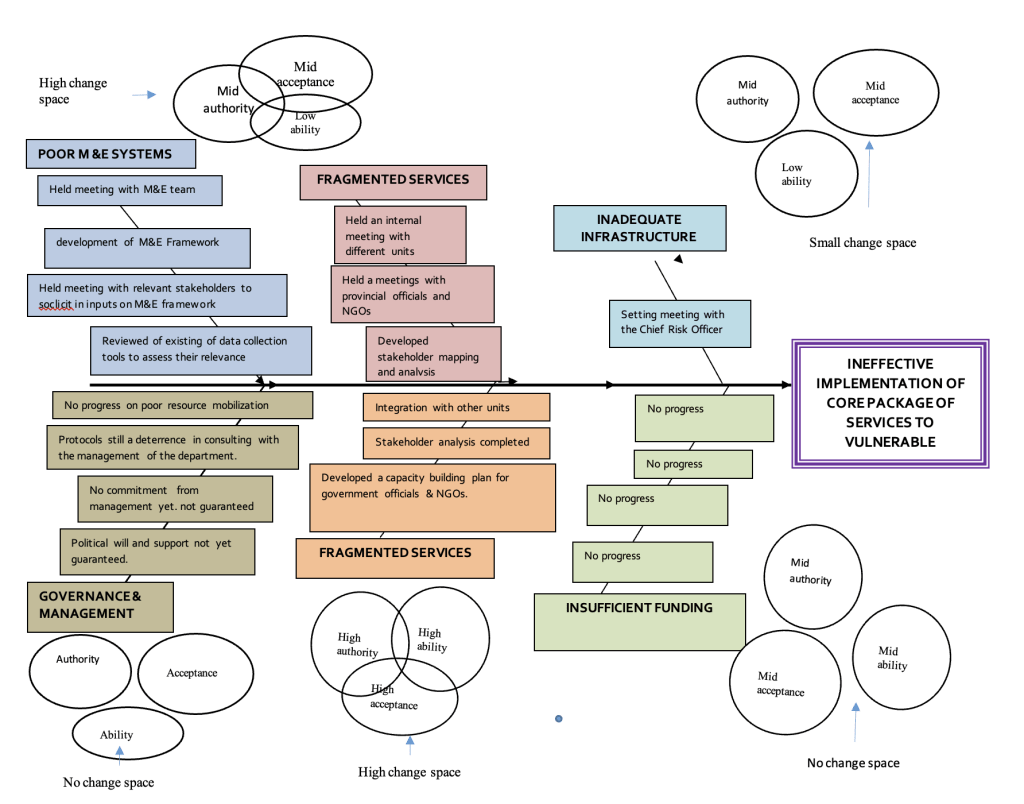
Poor monitoring and evaluation systems: developed a monitoring and evaluation tool in partnership with stakeholders to strengthen existing monitoring and evaluation systems. The tool is currently piloted in three provinces and will be rolled out in other provinces in the 2022-2023 financial year
Fragmented services managed to use existing structures and forums in the department as leverage to put the agenda of the core package of services forward. I further established an internal task team meeting to address the silo approach in the department in order to foster the integration of services. There is now an existing coordination structure in place such as provincial coordinators’ meetings to address the issue of fragmented services.
Inadequate infrastructure is one of the causes that need long-term intervention as it needs to be funded. There are existing policies and legislation that guides the development of infrastructure for children. However, many of these are managed by Non-Government Organisations and do not have sufficient resources to improve the infrastructure in order to meet the set standards.
Governance and management support provided by the minister has been minimal as she decided to launch the program and foster integration with different stakeholders.
Insufficient funding is still a challenge. However, provinces were able to make provisions within the existing budget to ensure that the program is being implemented. However, this will be included in future planning by ensuring that this forms part of future planning and the Medium-Term Strategic Framework (MTSF). The IPP program assisted me to establish a network of partners and stakeholders that would assist in the implementation of my policy challenge effectively.
My Peer Learning Group Members:
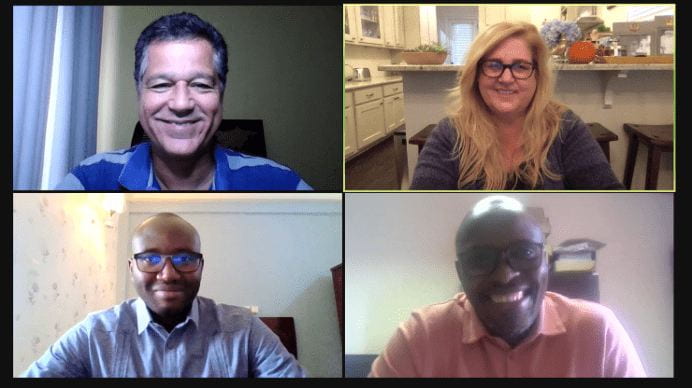
I have been motivated by the fact that policy implementation challenges are not only unique to South Africa but a global problem. I also got motivated by the support and guidance received from my peer learning group members. The peer learning groups also assisted me in understanding the importance of working in groups. The approach of using teams in addressing or tackling program or policy challenges is key because it provides an opportunity to make well-informed and collective decisions. I also found the use of the PDIA approach to be effective because it also provides an opportunity to address program implementation challenges at the initial phase by involving all the relevant role players. I will make use of PDIA and teaming as a new way of working in addressing my policy challenge.
I am able to integrate what I have learned from this course. I found the use of PDIA very much relevant to my work. I also learned that as an individual I should be able to adopt new approaches and methodologies that are introduced in order to improve the quality of work. The world is evolving and thus new approaches should be embraced and more importantly also find ways to integrate with existing interventions
The words of wisdom that I could share with my fellow PDIA practitioners is that you need to be flexible, open-minded, and able to adjust to new innovations that are being introduced especially if they will help improve the quality of work and services offered to the marginalized and vulnerable communities.
This is a blog series written by the alumni of the Implementing Public Policy Executive Education Program at the Harvard Kennedy School. Participants successfully completed this 6-month online learning course in 2021. These are their learning journey stories.
Driving Mental Health Reforms in Australia using the PDIA approach
Guest blog by Kerry Hawkins, IPP 2021
When I signed up for Implementing Public Policy (IPP) Online course, I thought it would be a lot of implementation theory within a public policy setting, possibly with some change management within a government context. I didn’t expect it to be so experiential, practice-oriented and expansive in its values and generosity of spirit, these were unexpected joys.
Throughout the course, I had lots of reflections that I have tried to summarise in the list below.
- The flexibility and depth of the Problem Driven Iterative Adaptation (PDIA) approach seems to be able to accommodate most challenges.
- There is power in bringing the different perspective of a discipline outside mental health to the conversation – most people are caught up in the frustrations and politics of a sector that is both insular and caught in health paradigm. Raising up some of the issues to a proposition and challenge of implementation makes people curious.
- Adopt an ‘Organized to Learn’ posture. Professor Matt Andrew’s mantra “What did you do? What did you learn? What are you struggling with?” creates a sense of safety and intellectual curiosity that enables people to feel more comfortable taking risks.
- Understand the importance and power of productively and attentively delegating work.
- The 4 P’s – particularly being alert to perceptions, correcting if necessary, and the power of process positively impacts perceptions of you at the same time.
- The fine art of both taking brave risks and letting people down slowly.
- Validation of an expansive generosity of spirit and power of it.
- Becoming a PDIA practitioner means holding a position of enquiry, exploration and learning.
- The value of exploring the problem and pulling apart the various elements has been a powerful way to both manage the unmanageable (conceptually) but also provide a solid platform for communication with people.
- The value of internalising and diarising the logging and reflecting on learnings, leads, and struggles. This is a practice I will continue.
- Change crawl spaces! I now seek them out and hunt them down.
For IPP Course, I chose to work on the mental health reforms in Australia – in particular the shift from a health lens to a social lens. We are working on dismantling the power and clinical/government machinery that underpin it, moving towards a whole of government approach. This means changes in models of service, inter-government approaches, reforming data/evaluation, workforce re-skilling, workplace changes, rebalancing of funding etc.
Mine was a big and complex challenge and so breaking it right down into problem-origin and component parts was really helpful to conceptualise change crawl spaces. I’ve made significant progress in three major components to my fishbone, and found some allies to work on some of the other trickier components such as short term political cycles.
In particular, I’ve progressed the area of lived experience infrastructure (across lots of areas nationally and at state level) to the point where people are talking publicly about ‘tipping points’ and have two invitations to collaborate on academic papers. In the data space, also, there’s now a stronger awareness of the dreadful limitations of the current indicators and frameworks, and funding commitment to develop lived experience indicators.
This will have whole of government implications and the creation of a mechanism for whole-of-government mechanisms. I’ve also now got a coalition of clinicians and people with lived experience putting forward a proposal for a translation centre to enable rapid implementation of research into innovative models of service.
As part of this intentional approach, it’s given me the confidence/bravado to talk more openly with politicians, which has also provided significant opportunities for allyship in areas where it’s hardest to break through, in developing the infrastructure for work that won’t be realised for several political cycles (social determinants, early intervention in understanding child mental health etc).
My motivation is both personal and a social justice motivation, which I’m finding continues to resonate with people because it’s mental health. It’s an instant point of connection and allyship building. And because it’s mental health, it’s an issue that touches nearly every family and broaching the subjects becomes a topic people instantly want to be a part of working towards a solution. This approach – if you have a way of holding people through a process, continues to pay off for me.
I’m continuing to use the Fishbone Technique that I have developed it for one of the sub-problem areas as part of a collective exercise. I’m going to repeat this process for several of the ‘bones’ on my original fishbone too, as opportunities arise. Doing this exercise really helps in building relationships, particularly if you come across someone who is a potential ally in a particular area. You can immediately build a connection and have a useful conversation, not only because you’ve thought about the problem at length, but may have already built connections in this area, or have some work underway they can tap into as part of the snowflake.
I think one of the useful learnings for me has been the 4 P’s and the importance of process – and of being organised, with time management tips. This is a practice I need to develop more, but I really notice the responsiveness I get from people when I’m able to attend to preparation for meetings, workshops or other collective work.
Someone once told me, “In the history of the world, miracles have only happened when action is taken!” There is something about the power of taking action in a positive, controlled, intentional and inclusive way that enables shifts to occur. I hope that PDIA practitioners all over the world remember this while driving their efforts to make the world a better place for everyone.
This is a blog series written by the alumni of the Implementing Public Policy Executive Education Program at the Harvard Kennedy School. Participants successfully completed this 6-month online learning course in 2021. These are their learning journey stories.
Driving Financial Inclusion in Peru using PDIA Approach
Guest blog by Jennifer A. Infantas, IPP 2021
When we think about designing public policies, we need to understand the needs that we are trying to solve and who will be our target beneficiaries. But what about having the responsibility to implement those policies? Probably it might be as hard or even more complicated, challenging, and sometimes frustrating.
Some years ago I has the opportunity to browse in the PMO world. It helped me understand that every project manager needs to identify the scope, time, risks, costs, procurement, quality, human resources, communications, inside a project before launching it on full scale. When I decided to join the Implementing Public Policy (IPP) Program, I expected to find not only what I needed to lead a project, but also the best way to organize my work, team, and short, mid, and long-term tasks to achieve my policy goals. Looking back on my IPP experience, I can summarise my key learnings in 3 points.
(more…)Minimizing impaired driving in Colorado using insights from IPP course
Guest blog by Michelle Stone, IPP 2021
My expectations for the Public Policy Implementation course were to gain a broader perspective and strategies on how to implement sound public policy, with creative and innovative solutions. I wanted to learn how to engage and develop conversations even when various industry members’ perspectives are divergent while being cognizant of the changing dynamics in the marketplace, and the ability to adjust to industry and public concerns while collaborating with public health officials with an eye on public safety. I very much enjoyed working with our Formula 1 Team assignments and hearing about their public policy implementation goals, challenges, and progress with their implementation projects.

Implementing PDIA for driving tax reforms in Switzerland
Guest blog by Juan Pedro Schmid, IPP 2021
I knew about the Problem Driven Iterative Adaptation (PDIA) process before as I had done the 10 weeks online course Principles of PDIA: Building Capability by Delivering Results. However, as time passed, I had not really applied the concepts and I did not have a full recall of all the details anymore. In the meantime, I also started a new role with the Government of Switzerland and wondered how I could apply PDIA in my new role. I manage the technical assistance programs remotely from Bern through multiple implementing agencies. I wanted to learn about the Agile method for Plan and Control which has now become fashionable in several donor agencies.
(more…)Using IPP Learnings to Reform Uganda’s Cash Management Policy
Guest blog by Robert Okudi, IPP 2021
I signed up for Harvard Kennedy School’s Implementing Public Policy (IPP) program hoping to find ways to get one of my draft policies to be implemented at the national level. I had been developing policy recommendations to reform Uganda’s Cash Management System for my department. Through IPP, I planned to find ways to get the draft accepted by all key stakeholders and implemented as a national policy for Uganda.
The first lesson I have learned from the IPP course is that defining the problem that needs to be solved for is not as easy as we think. Adequate time should be put into defining the problem properly otherwise, we end up prescribing the wrong solutions. The Problem Driven Iterative Adaptation (PDIA) tool helps us in this process and demands that in order to get it right you should be prepared to keep going back to the challenge again and again. PDIA is demanding and you need to commit emotions, time, and energy. I have learned to be patient and celebrate small achievements and build on them to overcome policy implementation challenges.
(more…)Using IPP to tackle HIV, Substance Abuse, and Gender Violence in South Africa
Guest blog by Chris van Rooyen, IPP 2021
I had several expectations when I signed up for the Harvard Implementing Public Policy (IPP) course. First, I was privileged to represent Africa at one of the best global universities. Second, the IPP course was the first international study program of my career. I had preconceived ideas about the world-renowned Harvard University. A few days into the course, I realized that the stakes were high to complete the course successfully over the next 22 weeks.
I had graduated from several South African universities and anticipated a heavy academic system with reading material from journals and research books. My prospects for the course presentation and content were to receive some theoretical frameworks and tools for implementing public policy effectively. However, to my surprise, the course at Harvard University was accessible to learning based on my own lived experiences. I was impressed with the “flip flop” approach of the course design, where students prepare themselves through readings, case studies, blocks, podcasts, and one weekly discussion and presentation. The social hour exceeded all expectations, and the learning was exceptional. Finally, I was privileged to be part of the best group, which and indeed, the group, was my biggest asset during difficult times.
(more…)