
Increased Youth Unemployment Deteriorates Societies and Hinders Economic Growth in Papua New Guinea
Guest blog written by Ferdinand Aimatuk, Tau Hera, Pauna Kule, Rhoda Maiyeh, Obeth Singol, Slyney Tau
Our key learning throughout the 12 weeks of the Problem Driven Iteration and Adaptation (PDIA) program is the systematic process of solving complex problems. It is a new perspective of problems solving which has changed the way most of our team members are looking at problems in their work and private lives. Most of the time, we look at problems and immediately start thinking of suitable solutions, which in most cases leads into solution traps or we come up with narrow framing and ended up not solving the problem at all. This is the sentiment most of the team members shared in-group discussions. PDIA provided a new dimension and perspective into problem solving, focusing more on the problem using models such as “problem deconstruction” and using tools such as “fishbone diagram” and triple ‘A’ analysis to provides detailed insight into the problem itself and drawing out entry points into solving problems.
A key learning is that do not jump into conclusions or solutions based on narrowly framed ideas or emotions. It is important to spend more time breaking down the problem into small pieces and understand their root causes. In that way you will identify entry points to start mobilizing resources and energy to start the solution process.
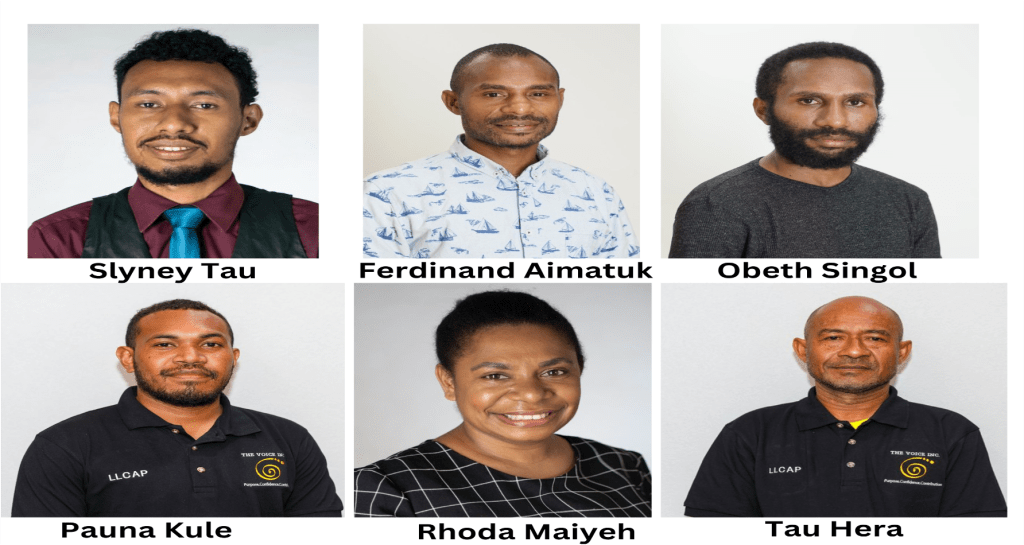
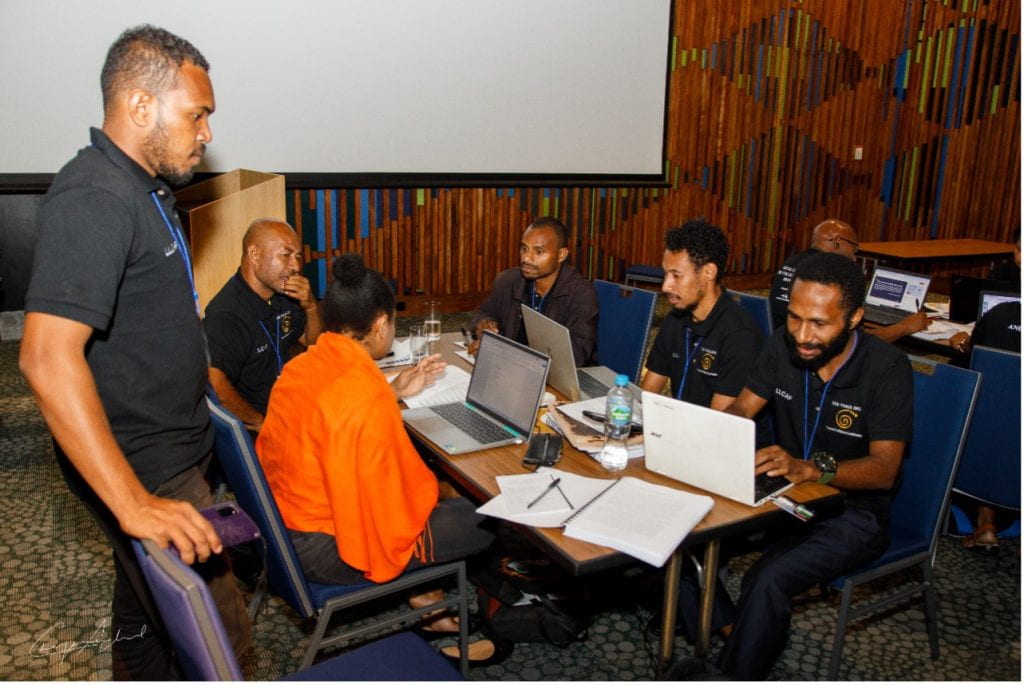
In a team of six members, we were working on the problem of Youth Unemployment in PNG and its impacts on social structures and economic growth. Unemployment in general is an economic indicator used in measuring economic performance of a country. In no doubt, most of the developing countries have some highest rate of unemployment and PNG is no exception. Our team, the ‘Heregabe Ihanamona’ in local Motu language means ‘for the good of young people’ have a diagnosis into the problem of youth unemployment and came up with some very interesting findings.
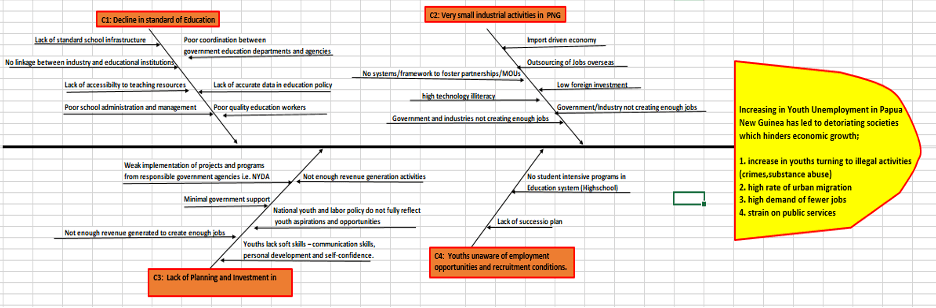
The team came up with a final problem statement: ”Increase in Youth Unemployment in Papua New Guinea contributes to deteriorating societies and hinders economic growth.” Four main causes were identified and sub-causes under each causes as detailed below and summarized in the fish bone diagram;
- Decline in Standard of Education
- Poor School Administration and Management
- Poor quality education workers
- Poor school infrastructures
- Very Small Industrial Activities in PNG
- PNG is an import driven economy
- No investment into industrialization or downstream processing of raw materials
- General and technology illiteracy is high which leads to poor innovation.
- Lack of Planning and Investment
- Weak collaboration and implementation of programs by responsible government agencies.
- Youth policies have narrow framing that does not capture plans to create opportunities.
- No avenues to foster soft skills to build self-confidence and motivation.
- Youth unaware of employment opportunities and recruitment conditions
- No student internship programs in education system leads to student lacking basic competency skills.
- Education system designed to create job seekers and not entrepreneurs
- Lack of succession plan in government system resulting with aging public servants occupying roles that throws young graduates on the streets
The findings in the problem deconstruction captured our individual attention and interests that has kept us together and provided the drive and motivation as a team to seek more tips to solve the puzzle. We further looked into the problem and the causes with sub causes and came up with our triple ‘A’ analysis noting the ‘AAA’ being Authority, Acceptance and Ability. We found out that youth unemployment is a problem that affects everyone and key government agencies such as National Youth Development Authority (NYDA) and Department of Labor (DOL) are the government agencies that directly responsible for policy framing and implementation. The two organizations are the authorizers in our case study noting other agencies have similar responsibilities, however, the saddest fact is that the two key organizations have a narrow framing of the situation and have no ability to effectively implement any plans to incorporate other stakeholders in addressing the problem, despite their acceptance of the problems that it matters most to them as the entrusted government body.
During the iteration process, we came to face the reality of the situation. Our request for meetings and interviews were not formally responded to. We also found out from the National Youth Policy that the policy goals are focused on social outcomes. It was narrowly framed to focus on advocacy against drug and alcohol abuse rather than economic sustainability of individual young person. The policy does not capture avenues to advocate on self-sufficiency and self-confidence in building individuals to be productive economically while observing social responsibilities.
The learning we gained added value in the way we approach the situation in our personal lives and the organization we work in. As a team we believe that in order to contribute to reducing unemployment, we need to take the path of “positive deviance” and that is to work with other stake holders that wants to address the situation from a difference perspective which deviate out of the government policy framework. We have already applied the learnings in our conversations with friends, family members and our project team members in our organization we work in.
Through the positive deviance approach, team member Ferdinand Aimatuk had a few conversations with PNG SME No. 1 Limited’s director Dicky Lao and connected his SME project in Tangu Development Association Inc. (TDA) to participate in the programs of creating SMEs in the district. Through the partnership, TDA will act as an agent to implement the training and loan scheme for PNG SME No.1 Ltd. The project is focusing on training and lending out startup capital of minimum PGK500.00 which will assist aspiring entrepreneurs to start their small business. This is an intervention by a private organization as a positive deviance from the narrowly framed PNG government SME policy which parked money in two commercial banks that have very stringent lending policies that hinders many aspiring entrepreneurs to access capital. This approach has gained momentum and two donor agencies already shown interest in supporting it financially. As a team, we will individually connect with organizations like the PNG SME No. 1 Ltd and involve more people from our area into SME space where they can develop their own businesses and create employment instead of looking for employment.
This blog was written by participants who completed a 12-week PDIA for PNG online action-learning program from September – December 2022. 31 participants successfully completed this program.
PDIA and the Increased Use/Abuse of Illegal Substances by Youth in Papua New Guinea
Guest blog written by Jenna Fave, Wesley Marian, Moses Sebastian, Barbara Thomas, Jareth Wallen
The use and abuse of illegal drugs and alcohol by young people in Papua New Guinea (PNG) is a pressing problem that has contributed to many social ills in the country. Our group consisted of individuals working within the youth development space interested in exploring the problem through the PDIA.
(more…)Utilizing Growth Diagnostic Tools on Growth Challenges in Australia
Guest Blog by Tim Larkin, LEG ’22
There are many learnings that I am taking away from this course as every week I learnt something new. The main learnings included:
- Economic Complexity Index (ECI) – I had never come across the ECI before and it really helped put into perspective the issues that my growth challenge for the Pilbara Region has with achieving diversification of industries.
- Knowhow – Similar to ECI it helped my thinking with what will be needed going forward.
- Fishbone Diagram (FB) – I have utilized FB diagrams in the past but never so effectively to establish not only to deconstruct the problem but to identify the binding constraints and to prioritise them to progressively find solutions. The iterative approach to do this. is a great concept.
- High Bandwidth Organisations – This also was a new concept for me but a very valuable one. It has formed a key aspect of one of the solutions to my growth challenge.
- Sense of Us – I have learnt that understanding what the key drivers of the Pilbara’s, Western Australia’s and Australia’s, “Sense of Us” are very important in assisting to establish what type of future industries are best suited to attracting human capital and workforces.
- Inclusion – This has been a priority in the Pilbara and WA Australia for many years, but it has not necessarily been implemented successfully. Inclusion will form a key part of the solutions to my growth challenge. Involvement in the workforce of women and indigenous peoples, is very important and in fact provides opportunities to employ new, previously untapped, workforces. This can assist with the current lack of skilled labour.
My growth challenge developed in Assignment 2, was slightly redefined in Assignment 6 due to ideas that I learnt during the intervening weeks. Specifically, I realized that in developing new industries (diversifying) to replace current but maturing industries that a number of the technologies developed by current industries can be utilized to develop new industries rather than starting from scratch. The Pilbara/Western Australia is world leading in the development and operation of the mining extraction of resources – there is no reason why this knowhow cannot be turned to new diversified industries.
In addition, in Week 6, I reviewed my original Fishbone Diagram (attached) and the relative importance of each binding constraint. I identified that of the original 20, 9 were the key binding constraints and the ones that should be focused on going forward and the priority for finding solutions. Furthermore, I realized that one of the constraints, the lack of development of local technology was in fact not correct. See the learning in paragraph one above.
In summary, I believe I made significant progress in developing my growth challenge throughout the course. Each week I moved a positive step forward. The insights I gathered (refer Q1 above) through the case studies of the cities/regions/countries that utilized the various tools that we were introduced to and their use in solving solutions in these places was particularly valuable.
I will be using the skills and utilizing the tools that I have learned during this course to help implement solutions for my growth challenge. The growth challenge is real for Australia as a whole and needs to be tackled.
The course will enable me to better articulate to both the private and public entities utilizing the growth diagnostic tools we have learnt assist in solving the problem of diversifying our industries to future proof our economy and grow our wealth whilst being inclusive and maintaining the sense of us.
As Chairman of the Pilbara Development Commission, I am well positioned to influence key players in regard to the growth challenge. Most importantly, I am in in position to ensure key players take real ownership rather than just acknowledging there is a future issue that needs to be dealt with.
This is a blog series written by the alumni of the Leading Economic Growth Executive Education Program at the Harvard Kennedy School. 71 Participants successfully completed this 10-week online course in May 2022. These are their learning journey stories.
The Delay in Academic Audits and the Quality of Higher Education in Papua New Guinea
Guest blog by Dagia Aka, Leah Margis, Boboya Noiney, Janet Rangou, Veronica Thomas, Jessica Wohimane
Our team comprised of six individuals with vast ranges of experiences in practice, research, policy, student management and university administration. BOAB which is the abbreviation for “bearing one another’s burden” was initially agreed upon as our group name. BOAB became our motto and the reason we submitted all our assignments on time.
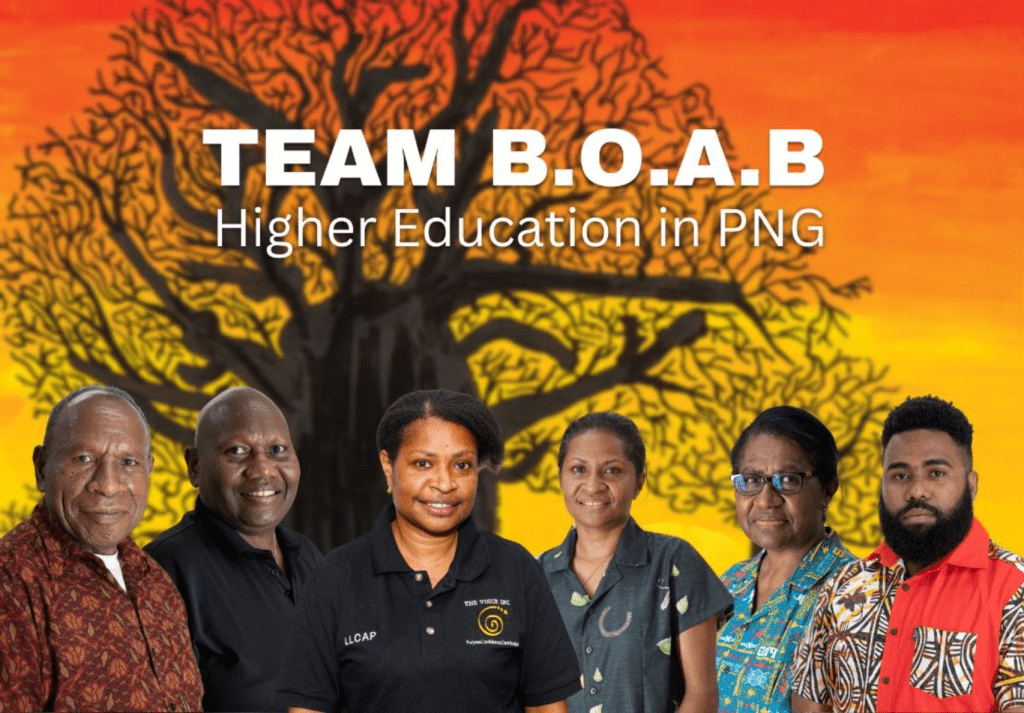
In a multicultural, linguistically diversified country like Papua New Guinea (PNG), higher education remains a pillar of unification. The BOAB team’s futuristic interventions shall be fostered through small wins:
- Small-actions within the authority of existing reform laws where universities focus on quality of their academic programs, measured by graduates’ global and digital citizenship.
- Empowering teams through delegating tasks to those who are competent and honest enough to own problems and actually do something about a problem not just talking about the problem.
- Positive deviants leading to best practices. Pockets of good practices may already be present in some aspects of (partnered) university learning, teaching, training, research and entrepreneurship. Where positive deviants have led to successful “small wins”, learning from these experiences may inform BOAB’s 2023 iteration actions.
The following is a reflection of our collective PDIA journey and possible 2023 futures.
Some of our key learning included problem sensemaking and conceptualization- in addressing wicked complex challenges, holistic understanding can be identified through practical tools. Why does it matter? To whom does it matter? Moreover, taking small steps, staying focused, on the problem and the processes from small wins, latent practices and positive deviants are crucial for local solutions.
Whilst our problem statement was the delay in academic audits is affecting the quality of higher education in Papua New Guinea, the BOAB team focused on the extent to which sub-causes emerging from measurements, leadership and product, can be addressed using identified actions, authority and authorizers. Throughout the course, the problem statement and key questions were further refined. Exploratory conversations leading to positive deviants were key approaches undertaken.
A key progress has been the opportunity to freely and fairly share our problem statement with others, and being open to different people’s perspectives. Weekly feedbacks from “who did you speak with” added volume to appreciating others’ perspective while “why does it matter” insights with teaching peers provided lens into positive deviants. These interactions also identified aspects of previous audit implementations attempted at various divisions/schools/faculties.
Improvement in the quality of higher education remains a concern and we are committed to enabling interventions and iterations in our spaces, and in accordance with reform policy as established by the national government. Taking the small steps and seeing acceptance, as well as having others embrace what can be done to improve practice makes it all the more exciting. Additionally, where others may have positive deviance, it can also be considered in improving practice, and mapping the way forward. Moreover, dissection of the problem statement into academic audit and institutional audit clusters may diagnose specific sub-causes of each cluster thus amplifying smaller fishbones which may have been overlooked in this PDIA journey.
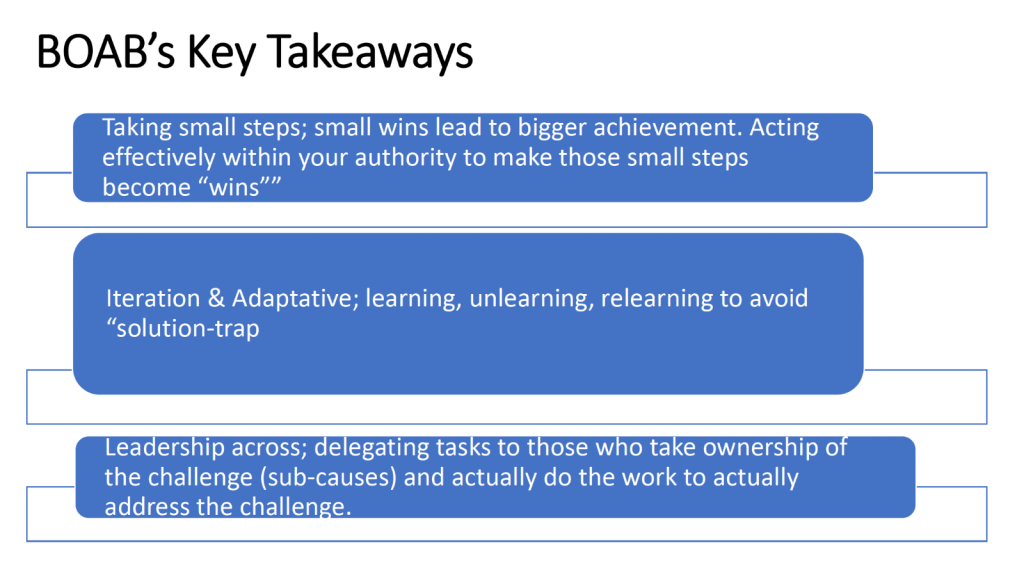
Here is how each of us is using what we learned in our day-to-day work:
- I have been using the 5 questions about the problem in trying to gain conceptual understanding of the problem. In fact, I have now used the questions as habitual tools for collective problem solving. More recently, I employed the “AAA, why and to whom does it matter” in one of my focus group meetings with a team of academic staff who are undertaking a Teaching & learning space.
- I have already begun using PDIA in other workplace problem areas and I intend to continue to do so. Looking also at other problems in the community and in other organizations, I have begun advocating for the PDIA program as I have found the tools to be very useful!
- I will now apply the learning gained from this course to address the challenge of providing suitable accommodation for our Overseas International Students accepted to undertake Postgraduate programs in 2023. Have already engaged in the process but need to keep my diary and progress this with regular and consistent reflections with the Team. This will be a real task especially when the Team Members are used to working without the big picture in their mind.
- Later this week, we will be facilitating a conference session with university student leaders (for 2023 academic year). I have applied tools from the PDIA iteration in the discussion design. My aim is to instigate mind-mapping plans for the students in their institutions, as well as seek their views, on how they think, my work intervenes/iterates with their problem-solving/2023 for upskilling plans.
- I am seeing it work in my workspace and organization. Authorizers and authorized working collaboratively to deconstruct problems. My takeaway from this course is the taking of small steps, and small wins, setting a clear vision, on where I want to go or see done together with everyone around me. Sharing the vision.
The words of wisdom we want to share with fellow PDIA practitioners around the world are: Trust the process, even when it seems confusing, trust the process! It will make sense. Bear each other’s burden along the journey, and enjoy the collective learning experience. Much appreciation, tenk yu tumas long olgeta halivim (Much appreciated and thank you so much PDIA Harvard Team).
This blog was written by participants who completed a 12-week PDIA for PNG online action-learning program from September – December 2022. 31 participants successfully completed this program.
Decentralization to Lower Levels of Government and the Challenge of Basic Service Delivery in Papua New Guinea
Guest blog by Joseph Sumanop, Alois Walsamis, Cecilia Yamugara, Absalom Maenui, Preston Karue, John Kombiku
There were many learnings derived from this course, the most important one being how to work in teams to solve a common problem. Throughout the course, we gained invaluable learnings from our teamwork and that will now shape the way we work, and these include:
- Importance of clearly defining problems and further de-constructing them as points of intervention to inform our stakeholder engagements. If we do not clearly define problems, it is impossible to engage relevant stakeholders to be interested enough or to care more to want to be involved to be part of a solution.
- Having engaged with stakeholders at various levels, it was interesting to note that most stakeholders were willing to engage by sharing information or be available to talk if they feel there was a genuine interest to achieve a mutually beneficial outcome. The challenge was in properly clarifying what it is we needed their support with so these stakeholders can see points of intervention where they can be involved.
- Whilst data was very important part of the learning, and that it is important to utilize accurate data when defining your problem, you can still use narratives to generally describe the state of problem and what the problem will look like once it is solved.
- We also learnt about the importance of expanding our change space, or clearly understanding the constraints of our change space, and what we can realistically achieve overtime through consistent and meaningful engagement.
We worked on the problem of a lack of basic service delivery not reaching the people through the LLG Government system. We found out that the most important link in the system were the people who needed to care more about their problem and demand greater accountability and transparency on use of development expenditures.
We initially thought that the problem of basic service delivery not reaching the local constituents was because of a lack of bottom – up consultative development planning so that scarce resources are allocated based on community identified priorities. We eventually found out that this problem narrative suffered from a solution pitfall as we wrongfully assumed that a great plan could solve the problem of resource allocation based on priorities.
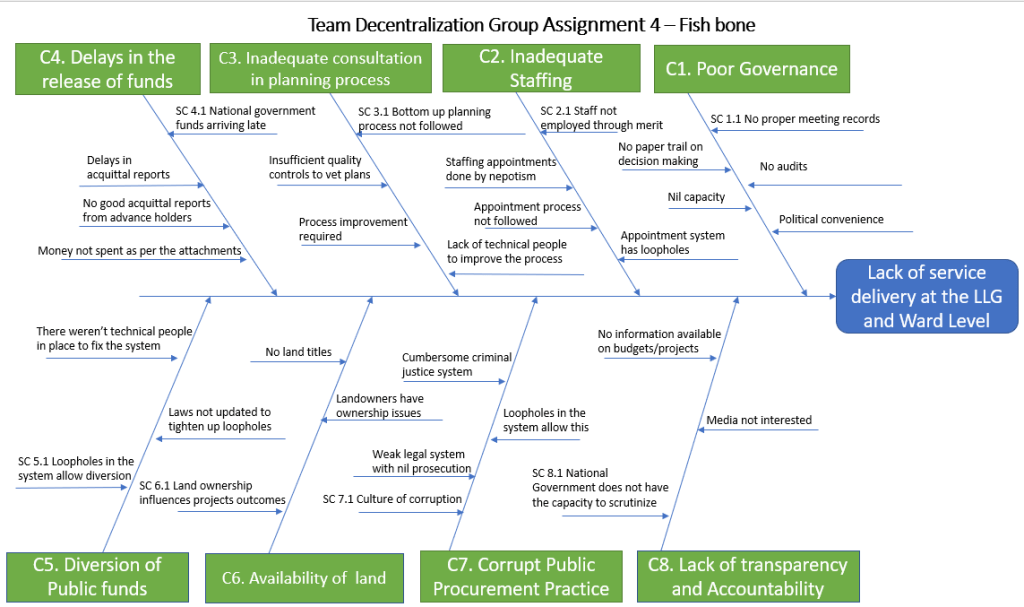
The reality on the ground as we have learnt is that the Local Government Council Presidents who normally sit as part of the Board of the District Development Authority (“DDA”) always struggle to get their voices heard at the District or DDA level. This was because of political self – interest of the chairperson who is the elected member of parliament of Wewak district. With weak governance, transparency and accountability, it is easy to see how agendas and resolutions are bulldozed through at the DDA Board Level, and the LLG Presidents becoming mere spectators.
As our result of our learnings, the group have now formed a 3-pronged approach as a way forward to support us as local leaders (inclusive of the 2 LLG Presidents in the team) on the ground:
- At Local level Government level– we have identified the need to secure the buy-in from the people (local constituents) and key stakeholders through consultative bottom-up planning processes by developing wards and LLG plans for the Boiken and Dagua LLGs of the Wewak district. It is hoped that by having those plans developed and shared publicly, there will be an increase in visibility and shared ownership of developments aspirations by the local constituents.
- At District and Provincial Level – we acknowledge that there are significant constraints through the DDA structure where political self – interest overrides genuine development aspirations of the community which can impact implementation of any well documented development plans.
To manage this risk, we identified the need to push for the creation of the right type of incentives for the DDA Board Members (i.e. the LLG Presidents) to be motivated to do the right thing vs being comfortable with the status quo. This could be to empower the LLG Presidents to speak up and demand greater accountability at the DDA Board Level. For instance:
- Develop Incentive Programs – work with the East Sepik Governor’s Office to develop a program to publicly celebrate top-performing LLGs and /or LLG Presidents for those that are able to effectively implement their development plans, and consequently rewarding them with increased capabilities to do more good for more people.
- Mobilize Ward Councillors – increased engagements with ward councillors, who hold power to elect the LLG Presidents, to ensure they are adequately trained and mobilised to demand greater accountability from each DDA BOD Member (i.e the LLG Presidents) on how development funds are expended through the DDA structure against set ward and LLG plans; and
- Improve Reporting and Enforcement of Laws Against Corruption – Increased engagement with Office of the Ombudsman Commission, Police Department and Public Prosecutor to improve reporting and enforcement of relevant legislation to eliminate issues of corruption at the DDA and LLG levels.
- At the National Level – work with key stakeholders to bring more visibility and accountability of development expenditure records and sharing that data with the local constituents or public in general to generate public interest and contribute to increase in public demand for accountability on use of development funds against Ward and LLG Plans.
We then develop the following potential ideas for Reform to pursue as part of our continued iterations:
- Ward/LLG Plan – Support the local leaders with ward and LLG planning and documentation.
- Incentive Programs for LLG Leaders – continued brainstorming of ideas on existing or potential incentive programs to equip LLG Presidents to encourage or compel the expected type of behaviour for good governance.
- Improve Engagement for Ward Councillors– Continue to look for ideas or advice on existing programs to mobilize ward councillors to take a more role in good goverance of DDAs by increasing demand accountability from LLG Presidents and DDAs in general.
- Improve Reporting and Enforcement – Seek opportunities on how Boiken Rural and Dagua LLGs can utilize existing partnerships (if any) between DPLLG and key stakeholders like Office of Ombudsman Commission, Royal Police Constabulary and Office of the Public Prosecutor to improve reporting and enforcement of relevant legislation to address issuess of corruption at the DDA and LLG Levels.
- Improve Public Visibility on Development Expenditure Records – Seek opportunities on how Boiken Rural and Dagua LLGs can utilize existing partnership (s) (if any) between Department of Provincial and Local Level Government Affairs and Department of Implementation Rural Development, National Fiscal Economic Commission or National Planning, etc on what development expenditure data can be obtained and shared with the local constituents of Dagua and Boiken LLGs and the public in general, to equip / empower the people to demand increased accountability on the way development funds are used.
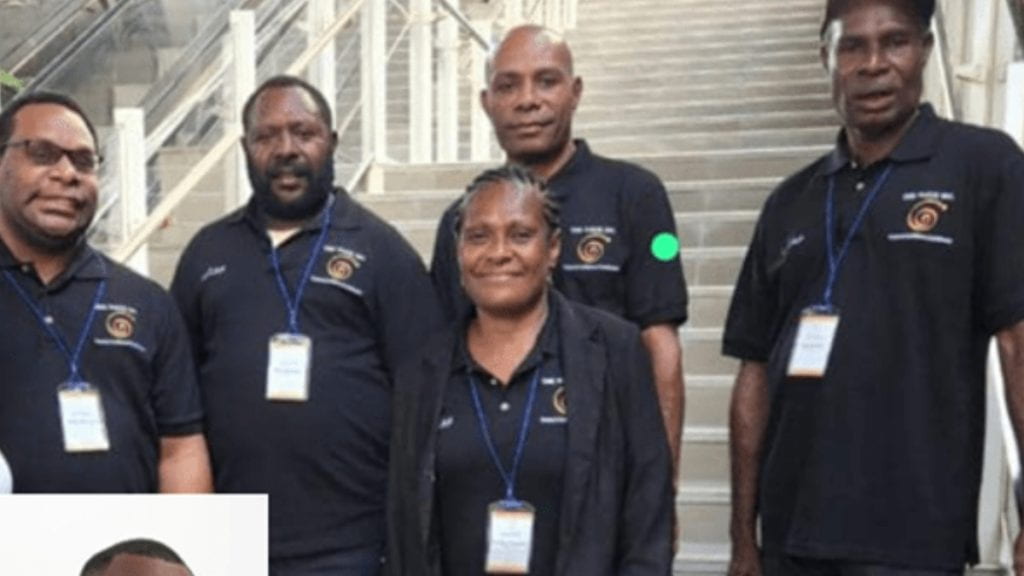
This approach has completely changed the way we tackle problems, by ensuring we properly understand the root cause of all problems whilst working in very constrained changes spaces, and the tools we learnt in the course were very practical in terms of helping us map out our stakeholders through the AAA change space analysis and seeing where we can work hard to increase our change space.
Most of the tools we developed are practical that is applicable to our everyday work and will be used to help us become more focused and intentional about our engagements as we work through our interactions to solve the problem. These tools will be used to shape our way of working in teams to address common problems.
Words of wisdom for fellow PDIA practitioners:
- Always know that your burdens are lighter when shared.
- People are more willing to engage and share ideas, solutions and data if they feel you share a genuine interest in a particular outcome that is mutually beneficial.
- Your biggest task will be to clarify the problem to the simplest element or root cause. Even if the first step looks like it is common sense, you will be surprised the amount of meaningful progress you can gain by completing that first step.
- Working as a team is more powerful that any other means of working to solve problems.
This blog was written by participants who completed a 12-week PDIA for PNG online action-learning program from September – December 2022. 31 participants successfully completed this program.
Poor Literacy Outcomes for Elementary Education in Bougainville, Papua New Guinea
Guest blog by Claire Asi, Valda Kerua, Melchior Sebelei, Michael Asi
Over the past 12-weeks we worked on the problem of Poor Literacy Outcomes for Elementary Education in the Autonomous Region of Bougainville.
The recurring issue that kept popping up in our conversations was Cause 1: Lack of qualified teachers, and sub- cause: teacher training programs have a low benchmark for recruiting teachers.
There is a lot of potential for education stakeholders to find PDIA tools useful, but not much time was invested in how best to apply the tools in real life. As Melanesians, we still prioritize ticking off our checklist by having conversations with different agents and authorities and using the dialogue from those discussions to give us insight into the problem. The discipline to have detailed logging of our activities no matter how small is a skill and habit that will need to be developed over time.
Those insights help to build and maintain authorization and acceptance of our organizations when we find entry points into particular sub-causes that are close to our authority and ability. Finding common ground and shared interest is more for strategic engagement. This will affect the type of trust triangle we have.
Individual members have confidence about how they can apply PDIA in their line of work, but building acceptance for greater collaboration based on the learnings and reflections in the program as the PDIA Education Team will take some time. Approaches will change based on the continuous reviewing of our activities to learn, reflect, evaluate and strategize.
Successful iteration comes with us being more self-aware of the limitations to our thinking, rethinking new ways of approaching a problem, being more self-aware of our habits and norms that may get in the way, respecting the process, being able to distinguish what is a novelty and what is realistic, developing the habit to think through and discipline me to have some time to chronicle my daily activities, identify the emerging system and design context-specific tools using PDIA tools as a guide.
“Communication is key. Empowering and appreciating fellow team members is key. Building trust is key.”
– Claire Asi
Here is how we are using what we learned in this program:
- Melchior: With all the knowledge and skills learned, I’m planning to conduct a workshop/in-service with all my head teachers and the Board of Management in all my Primary and Elementary schools in my district. They can be equipped with the skills so they can solve problems at their levels. I also planned for a workshop to assist my community government members, and village leaders to also equipped them with at least some knowledge and skills of the PDIA process so they can use it to solve issues at their level. Finally, I will now use the tools to tackle some of the pressing issues in the district regarding district education.
- Valda: I’ll use what I have learned to help redefine problems and make them more specific. There are instances when trying to approach a problem the problem statement is too broad this will defiantly assist me in clearly defining my problem statements. I hope to go back to some of the work to see if I could have written my problem statement.
- Michael: I plan to use the course in helping those around me and ultimately for nation-building. In every exercise or opportunity to create change, I will always apply the PDIA process and everything that I have learned in this course.
- Claire: I plan on applying the learnings of PDIA to my work in program and project management, policy framing, analysis, and advice, in the various sectors of development that I work in as a political officer, research consultant, youth development practitioner, systems thinker, etc.
Our words of wisdom for fellow PDIA practitioners around the world
- Self-Discipline and Consistency in applying a step-by-step process to integrate the PDIA approach to one’s work benefit the team as a whole.
- PDIA is not about individual approaches, teaming is at the heart of it. It is a shared responsibility through collaborative leadership at different levels but it requires more genuine and authentic ways to engage with each other in addressing the problem.
This blog was written by participants who completed a 12-week PDIA for PNG online action-learning program from September – December 2022. 31 participants successfully completed this program.
Top Insights from “Leading Economic Growth”
Guest Blog by Dina Alzubi, LEG ’22
Below are some key ideas/learnings that I took away from this course
1. Taking time to construct and deconstruct the problem is important: the course really emphasized for me the importance of spending enough time constructing and deconstructing the problem at hand. Tools like the fishbone diagram and identifying the ‘why’ of the problem were really helpful.
2. PDIA—start action, don’t get stuck on ‘perfect’ analysis: The problem-driven iterative approach is a great framework to tackling complex problems. I think having such a process where one is prompted to identify entry-points to act on their problem and then iterate by integrating what is learned is a great way to prompt action. A few key lessons that stood out to me here were: 1) the goal is to find do-able actions to begin moving toward addressing the solution, rather than producing perfect analysis of the problem; 2) the iterative process can be used to build authority, acceptance, and ability along the way; 3) much of the knowledge required for answers to complex problems emerge through learning from active engagement within the context, not necessarily in passive academic knowledge.
3. Focusing on the ‘binding constraint’ for the specific context in question is better than taking on a laundry list of policies: Wholesale policy reforms taken from other contexts might not necessarily deliver the desired growth objectives, it is important to identify constraints in the local context. Differential diagnosis to discern whether the constraint is indeed binding in the given context is important.
4. High-bandwidth organizations are important for growth: Given that economic activity requires a large and highly interacting set of policies and services, having organizations that are connected—where collaboration and the flow information is frequent both within the organization and outside of the organization—is crucial for growth. It is important that decisions are delegated to where the information exists.
5. A team of agents of change across the system makes all the difference: the course really highlighted how important it is to have a team of agents of change across the system (with varying degrees of authority, ability, and acceptance). The peer learning groups (shoutout lucky 13!) were a great example of how beneficial it is to have other colleagues speaking the same language regarding tackling the economic growth challenge. The difference in background, focus, and experience all made for enriching and thought-provoking conversations.
6. What we tell ourselves matters: Engaging with the problem with the belief that it can be addressed, that the solutions and process of generating solutions can be meaningfully inclusive, and taking efforts seriously is important.
I would be remiss not to add: 7. Metaphors are a great tool to communicate complex ideas: though this was not a central lesson in the course per se, Prof. Hausmann’s use of metaphors really highlight to me how great metaphors are in communicating complex ideas.
Jordan’s productive capabilities are better than I had previously guessed. Per the Atlas of Economic Complexity, we have the space and ability to move toward producing more complex products by leveraging the existing know-how in Jordan and developing it.
There is a lot I can be doing (and have been enabled to do during the 10-week time period), and that it is great to link up to others struggling with the same problem and thinking about its answers.
Spaces of creating shared meaning go a long way: I think there is something to be said about having the space to think through problems and answers together (like that offered by the course) which is conducive to generating new ideas and insights. I think this is not discussed as much but actually goes a long way!
While I work on acting on the entry points I see in my fishbone and discussing the learnings and actions with others, the course calls my attention to focusing on engaging peers in conversations that move out of defeatist or apathetic bureaucratic thinking and move more toward trying to own and take seriously what parts we can have in building solutions within our specific context.
I remain really curious about the inclusive growth component. Specifically, I feel that the interview between Prof. Rodrik and Prof. Andrews left me wanting to learn more about what focusing on domestic growth and a new social contract between firms and government would look like. I’m also curious how tensions between such an agenda and an agenda focused on exports industries look like and how they may have been dealt with.
This is a blog series written by the alumni of the Leading Economic Growth Executive Education Program at the Harvard Kennedy School. 71 Participants successfully completed this 10-week online course in May 2022. These are their learning journey stories.
Providing Effective and Quality Health Services in Kaduna State, Nigeria
Guest blog by Dr. Amina Mohammed Baloni, IPP’22
I got accepted for the Implementing Public Policy Program following a late application, I had first applied for another executive program focusing on women in leadership positions which I thought would be interesting given my current work context. I was initially apprehensive as the course was a seven-month program which involved blended learning. I was not sure how I would cope given the heavy workload I had and the demands of my position coordinating the health sector at sub national level. Looking back, it turned out that this was the course that would be most relevant for my work! I am extremely happy I got accepted and it has changed the way I view the work of implementing policy. I am sold on PDIA and think it is the way to go. I wanted to learn firsthand how to implement public policy in a way that will provide maximum impact on the people who should benefit from it and this was exactly what I got. As we say in Nigeria, we have excellent policies, but implementation has always been a problem! To my relief, this wasn’t just a Nigerian problem but one which different countries across the world experience, whether they were developed or developing!
Key learnings
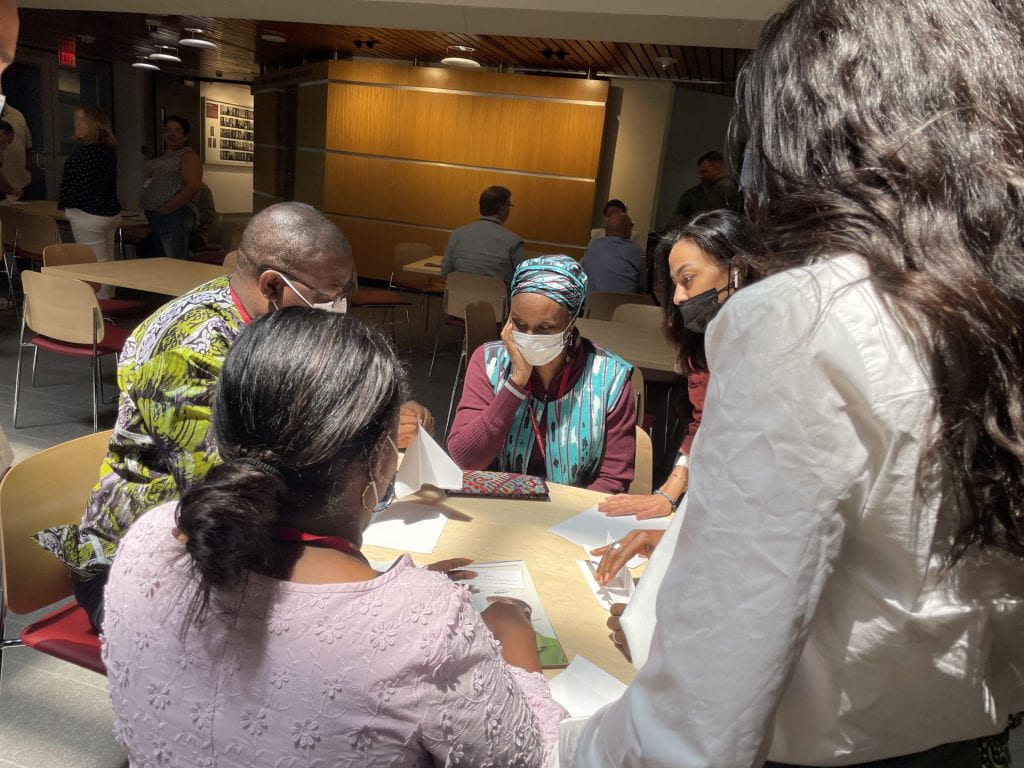
Our class was very diverse, and we were working on all fields of policy from education, housing, youth empowerment and even in finance. I learnt that implementing policy is challenging especially in the public sphere where there are so many different and contending issues from politics, leadership change, bureaucratic bottlenecks, and citizens interests. We learnt that though we were working on different challenges, we hand similar problems with implementation. Many policies were in existence but many more were never implemented. Very often, those in charge of implementation were disconnected from those responsible for implementing on the ground which meant that sometimes these groups of people were acting in conflict. Insufficient progress in implementation had the effect of making top level authorizers withdraw support from those seeing implementation through. As a result policies are abandoned and there is a rush to develop more policies that would suffer the same fate. Learning about PDIA and using its toolkit, gave us the opportunity to learn by doing, reflecting on what works and what didn’t, embarking on the next iteration, repeating the process again, all the time making incremental gains that ultimately add up to the desired change.
Implementation challenge
My implementation challenge was focused on how to improve service delivery in public health facilities. The health sector has a quality-of-care policy which had been existence for many years but not much progress had been made in implementing it. Public Health services provide a majority of the 10 million or so citizens in Kaduna State with healthcare, many of them out of pocket though subsidized for key populations such as children and pregnant women. The quality of services in public facilities are considered poor by many citizens, this was because of poor infrastructure, inadequate human resources of the right skill mix mainly concentrated in the urban areas to the detriment of rural areas where most of the population reside. Stock outs of drugs and commodities, poor staff attitude and low demand by citizens all combine to discourage citizens from accessing service in these facilities. This has led to poor health outcomes, with insufficient progress made in improving health indices despite many initiatives and interventions being implemented. For many years there have been concerted efforts to improve quality of care, policies have been developed, standard operating procedures have been put in place and many capacity building initiatives have been implemented but we still grapple with the problem.
Progress made and insights gained about the problem through the process
I gained several insights while working on my implementation challenge. First, stakeholders agreed that quality of care was a clear problem and we all agreed that it needed to change. It is also important to get as many perspectives as possible on the causes of the problem, this was achieved by talking to different stakeholders as management staff, those in charge of supervising frontline staff, the people that would translate the policy to day-to-day actions, those that work at facility level, the community and beneficiaries of the service. These conversations provided insights as to why some solutions did not work and what they envisaged would work. The fishbone analysis threw up many different sub issues which needed to be worked on to solve the bigger problem. I also learnt that though we had a consensus on the problem, there were different levels of commitment to doing the work required to bring change. It means that in implementing policy, there must be a concerted effort to rally the team round the goal by providing motivation through celebrating the successes and looking at the setbacks as opportunities to try new things that may work. It is also important to iterate in small steps and break the main goal into smaller goals to avoid demotivation when things do not go well. We must also ensure that our authorizers are kept abreast of our progress, or we may lose the political support needed to push through reforms and policies which sometimes take a long time to come to fruition. The longer a problem has been around, the more difficult it is to tackle, there are many setbacks and sometimes it feels as if no progress is made but perseverance is key. Complex problems can have many entry points and the nature of the problem changes as solutions are being implemented, for example my initial take on my implementation challenge was that it was a simple one but on drawing the fishbone with many diverse stakeholders, it became apparent that the problem was quite complex, and each sub theme had many other branches. Our fishbone changed and evolved as we continued the different iterations and learnings. Another interesting aspect was different teams could work on different parts of the problem and we could make progress faster. However, this requires good coordination of the teams and constant check ins to ensure that we are all aligned.
My approach to policy implementation in the future will utilize learnings from PDIA and its practical application. Digging out the root causes of any problem, wide stakeholder consultation to gain insight into different perspectives of the problem, forging a consensus on the goal to be achieved and most importantly making sure implementation level insights and concerns are given prominence as the success of any policy implementation depends on those at frontline to get it done. Learning from successes and failures to guide future iterations, fostering a learning culture within our organization, and communicating successes especially to authorizers to maintain support for policy implementation are key future take aways.
Already, we have incorporated the use of fishbone analysis to tackle our problems within service delivery and beyond. The four whys are now the baseline interrogation of issues and challenges. We have also reinforced our consultation across all levels of the organization and trying to break the rigid bureaucratic barriers and creating the psychological space for people to contribute, raise concerns and jointly tackle our problems in small steps, learning from our missteps and trying new solutions and seeing the result.
To my fellow PDIA practitioners, the road may be long with many setbacks but if we are to make lasting impact through implementation of policies, we must stay the course, dig for the root causes, celebrate the small wins, learn from the setbacks, and ultimately make a difference in the lives of people we serve!
This is a blog series written by the alumni of the Implementing Public Policy Executive Education Program at the Harvard Kennedy School. Participants successfully completed this 6-month online learning course in December 2022. These are their learning journey stories.
Understanding Economic Complexity, Knowhow and Inflation in Ethiopia
Guest Blog by Sisay Biru Melese, LEG ’22
I have learned a lot form this course. It may be one of the best courses I have ever taken. It is interesting to categorize problems as complex and complicated. Most economic growth problems are complex in nature. Such kinds of problems demand the PDIA approach to solve. Most policy makers consider economic growth problems as simple and solutions are sought to be present on the shelf. But, that kind of solution to economic problems does not bring lasting solutions.
Rather than rushing to solutions for the economic growth problems, policy makers are advised to deeply study the major causes and sub-causes of economic problems. They need to identify problem-driven solutions to the economic challenges faced by their respective economies. It is difficult to give a solution to a range of economic problems. That is not only because giving solutions to economic problems is costly but also sometimes policies intended to solve problems have unintended outcomes. So, the better approach is it to deal with the binding constraints after undertaking a proper growth diagnostics.
I this course, I have learnt the importance of knowhow, the implicit knowledge. Knowhow is a key part of technology. The other components of technology will be tools and the recipe of making goods and services. Besides knowhow, the other two tools can be copied by other countries. The difference between the rich and the poor countries is on the availability and diversity of knowhow among the people of the country. Rich countries have diverse and ample know how. They have a capacity to produce complicated products.
Developing countries have low economic complexity while developed countries have high economic complexity, showing that the products they produce comprise of a high amount of knowhow.
The Atlas of economic complexity shows the number of products produced by countries. Atlas of economic complexities shows an atlas filled with different kinds of products ranging from low complex product to very high complex products all shown on the same atlas. The atlas gives policy options for policy makers on what kinds of policies to focus to enhance their economic growth challenge.
Another important lesson of this course is the fact that implementing of policies needs a special type of organization: high bandwidth organizations. These organizations need to have sufficient authority and capacity to solve the economic challenge of a country. Above all, they are organizations that are meant to solve the information revelation problem of governments. These types of organization are organized to have a capacity to attract FDI, solve problems of firms faced by interlinking different economic stakeholders and by engaging in proactive economic activities.
Another important lesson of this course is economic growth strategies need to be inclusive. This is to be made through solving the problem associated with fixed costs such as lack of information, education and infrastructure. For governments, rather issuing redistributive policies that is meant to compensate the poor for its poorness it is advised to engage the poor to participate in economic growth process of a given country. Finally, the type of the political organization of a country determines the type of economic policies countries practice.
My growth challenge is inflation. Inflation is the major problem Ethiopia is currently facing. This LEG course has given me a good chance to look into causes and the possible solution to my problem. And I understood that the causes of inflation in Ethiopia are rather deep and structural. Traditional monetary and fiscal policies do not solve the inflationary process the country is facing. To solve the inflation challenge, the country should focus on producing more products and services, eliminate the structural bottleneck constraining the free operating of the market.
I am private consultant. I have a company having six employees under me. I consult both private businesses and government offices alike. I have a plan to customize the concepts that I have learnt here to help a growth challenge of private companies. I also have a plan to use the concepts to overhaul the growth problem faced my own company.
This is a blog series written by the alumni of the Leading Economic Growth Executive Education Program at the Harvard Kennedy School. 71 Participants successfully completed this 10-week online course in May 2022. These are their learning journey stories.
Tackling Homelessness in Scottsdale, Arizona
Guest blog by Sue Oh, IPP’ 22
I had been in my role as the Homeless Outreach Coordinator for six months before I was presented with the opportunity to be a part of the Implementing Public Policy Program. There was an increasing number of people experiencing homelessness in the City and I had been tasked to find a solution. I was so excited because I had so many ideas, but I did not know where to start. I didn’t fully know what I was getting into and how much I would actually get out of this course.
I learned how to start with a problem, not the solution. I realized that I had a solution in mind but had not dug down deep into the problem. Homelessness has been worked on, battled, tackled, and fought in many cities in the world. I realized a solution for another city would not necessarily solve the problem in my city. I had to look at what homelessness meant in my city.
A very important lesson I learned was to create a team. I always thought that if I worked really hard on my own, things would get done the best. I was so wrong. I learned that a team can be made up of so many different people. I started talking to the police department, non-profit organizations, the faith community, even the real state and legal department! These people had so much to offer to the team. There are many people who have so much knowledge and information and who want to help. I just had to start talking to them.
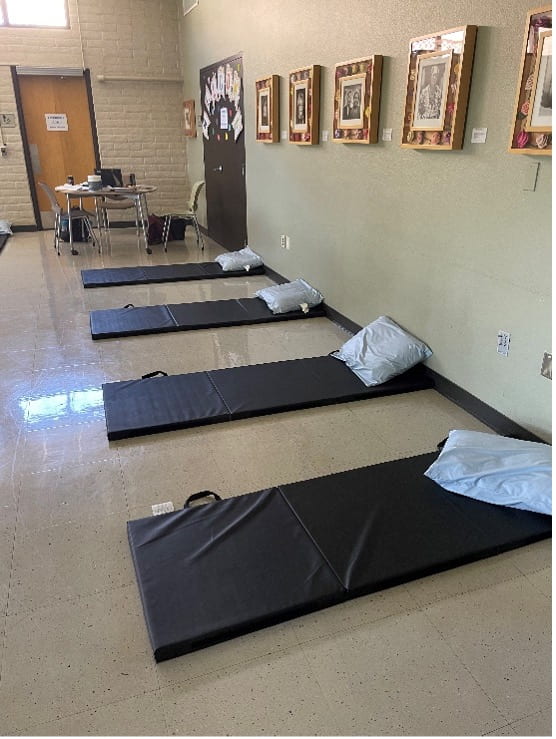
Through PDIA, I have been able to propose, start, iterate, and adapt many homeless services for the City. Many agencies had already been doing great things around the city and when people with authority were given information and data, many programs were given the green light. Although some programs didn’t work and others are still a work in progress, I am so proud of how far my city has come.
This approach has taught me to focus on the problem and why it matters. I question my problems and make sure that it is not a solution.
In my notebook, I wrote down so many great quotes that were made by Professor Matt Andrews. Here’s one of them: “We don’t need to do something perfect but we need to do something good enough together so that we can do something together.”
Do not be afraid to fail. Failing helped me grow and be stronger to try something else. Implementing public policy is a hard journey so take people with you. Finally, remember to celebrate the little wins because that is what may help you to keep going.
This is a blog series written by the alumni of the Implementing Public Policy Executive Education Program at the Harvard Kennedy School. Participants successfully completed this 6-month online learning course in December 2022. These are their learning journey stories.