
Revitalizing Downtown San Diego’s Civic Center Neighborhood
Guest blog by Chris Ackerman-Avila, Christina Bibler, Jaymie Bradford, Jessica Lawrence, Kohta Zaiser, Kris McFadden, Paola Avila, Rania Amen.
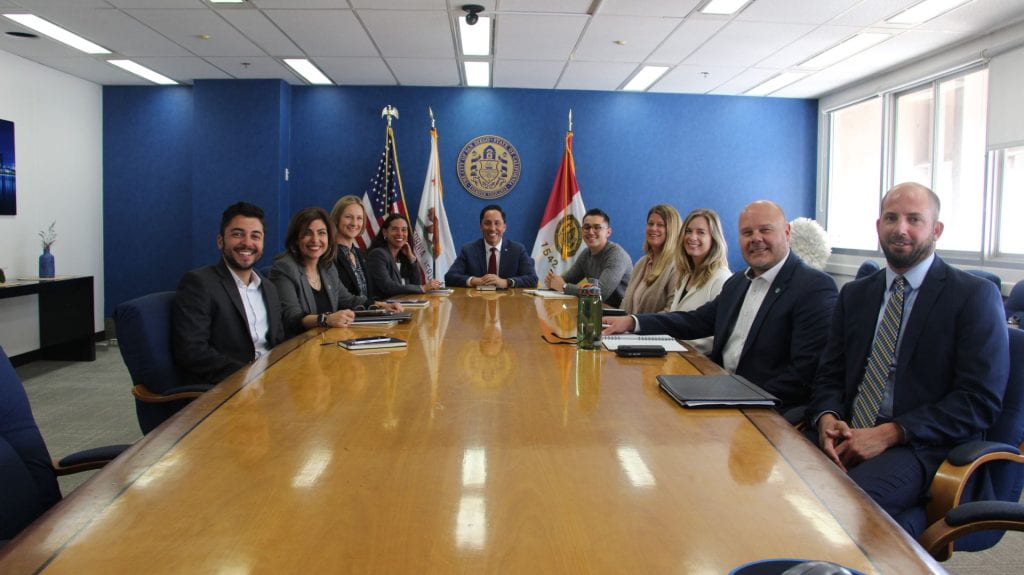
We focused on tackling the lack of public support for the revitalization of our civic core, because we want our residents to be effectively served, our employees to have a safe and conducive workplace, and to better utilize our public land.
Our biggest accomplishments included the following:
- Receiving State Housing and Community Development Department approval for our Notice of Availability.
- Successful Land Use & Housing Committee vote of 3-1 to advance our Notice of Availability to City Council.
- Successful City Council vote of 8-1 to release our Notice of Availability to interested parties and create a capital improvement project for a new City Administration Building with initial funding; $2M.
- Milestones in geotechnical work for proposed new City Administration Building site and nearby proposed new Fire Station site, both confirming site suitability for future construction.
- Positive media coverage of our efforts, including from news sources that are typically adversarial of our administration.
- Spreading the word about our efforts to dozens of groups and organizations through presentations and word of mouth to hundreds of people and more than two dozen groups.
- In the process of evaluating proposals from an RFP to secure real estate advisory and community engagement consultants which will support our efforts moving forward.
- Productive and recurring briefings and conversations with all (except 1) City Councilmembers to address concerns and answer questions.
- Additional affordable housing or shelter solutions will be explored offsite as a response to the conversations and concerns from City Councilmembers regarding civic center redevelopment: Former Central Library and Homeless Resource Center.
- Uncovering and reviewing existing employee workplace satisfaction data.
- Uncovering and sharing with the media the current deteriorated condition of the City’s Administration and Operation Buildings where tours and condition assessment information are made available to the public and media.
We learned not to define your problem as the lack of a solution! There is more to the problem, and you need to dig and ask why. Stakeholder mapping can offer new entry points and ideas. learning how to construct and reconstruct a problem as the first step toward solving it. Also, the fishbone diagramming process can take several iterations and evolve as more conversations and entry points and root problems are uncovered. Continual process to understand feedback and collect/note small wins.
The problems we face are complex, but that does not mean they’re not digestible. Large problems are usually just a combination of multiple little problems, each with a realistic and achievable entry point. There is no reason to feel overwhelmed when a massive problem comes your way if you look at big problems as a series of little problems. Make a bigger deal of small wins to bring stakeholders. This approach is truly helping put effort into solving the true problem rather than jumping on unrelated actions and solutions.
The team is already using the work we’ve learned into current and future campaigns, controversial funding prioritization policies, and chronic/wicked problems facing several of our operational departments.
In reflecting on the large strides we’ve made in a matter of months, we urge those reading to take pride in incremental progress you make, no matter how small and ensure you have a team with varied voices and trusted hearts to whom you can communicate along the way. Also, despite the complexity of the landscape you are in, by expanding your outreach to the various stakeholders, we can shift from finger-pointing to creating a learning environment for all.
This is part of a blog series written by city leaders who participated in the Bloomberg Harvard City Leadership Initiative cross-boundary collaboration track during 2023.
A Policy Neophyte’s Journey Through Organizational Change, Policy Failures & Enlightenment in the United States
Guest blog by Lucas R. Martinez
In December of 2021, I embarked on a 6-day trek through Torres del Paine National Park, in southern Chilean Patagonia. A yearly ritual with a best friend from college, I would find a multi-day hike far from civilization to collect my thoughts, reenergize my spirit, and challenge me mentally and physically.
On that long hike in the mountains of Chile, was a fortuitous encounter with an amazing young woman who had recently decided to transition from her impressive job in the non-profit sector to obtain a Master of Public Policy from the Harvard Kennedy School (HKS). We quickly bonded over our shared life priorities and goals. Two months later, I was working for a national civil rights organization and leading its healthcare policy initiatives. Soon thereafter, there was a realization that HKS could be a great resource to hone my policy skills and I decided to apply to the Implementing Public Policy (IPP) Program.
(more…)Exploring Health Inequalities in South Yorkshire
Guest blog by Will Cleary-Gray, Chris Edwards, Andrew Gates, Joe Horobin, Sheena McDonnell, Sally Pearse, Car Ross, Rupert Suckling
Our Public Value Proposition
“We will tackle the fact that too many of our children are locked out of a successful future and are dying too soon, and we will do this because we want our children to have a good start in life, so they live healthier and happier lives.”
It’s hard to disagree with. It has a galvanising clarion call. And it’s deliberately blunt.
Which is why we liked it.
Doing something about it though – that’s the tricky bit. It is, quite simply, a cracking WICKED problem.
(more…)Slowing Down To Go Fast: Fishing Out the Education Problems in Washington State
Guest blog by Sharonne Navas
In a world of high speed wars, high speed internet, and high speed dating — can we slow down to solve world problems?
I was trained to problem solve in under five minutes. Math club, speed chess, wordle — the idea of speeding through a problem towards the solution was simply the way we do things.
But what happens when you slow down time and process enough to get to the root problem of a system or institution, a problem that you are trying to solve and not just throwing solution spaghetti onto the world map?
(more…)Street Homelessness in Rochester
Guest blog by Charlie Albanese, Michael Burns, Corrinda Crossdale, Wanda Cooper, Linda Kingsley, Tammy Mayberry, Gabe Person, John Oster
Our group focused on homelessness, specifically street homelessness. Our public value statement is: “We will tackle street homelessness, particularly homeless individuals residing in City encampments identified by GIS, because everyone in the community should be treated with dignity and respect by having their basic living needs met.”
We have made significant progress, primarily focusing on the following entry points:
- Formalize community outreach to improve coordination among available services
- The presence of encampments and the reduced quality of life camps bring to those living in the encampment and those working and living nearby
- Many shelters lack the resources or capacity to provide necessary services for higher needs individuals and some of our most vulnerable populations
Specifically, we have done the following:
(more…)Improving Access to Quality Employment for Vulnerable Young Mothers Using PDIA Approach in Romania
Guest blog by Oana Toiu
Why are there high chairs and heavy mahogany bookcases and tall ceilings and actual silk flags and the most serious of fountain pen in the office of key decision makers in policy? It looked like a weird travel machine to the XIX century for me, when I started my State Secretary term in the Labour Ministry and opened the heavy door with golden embellished letters to my office.
For the thousands of people in the national authorities and directions put abruptly under my leadership by our technocrat prime minister it might have seemed the opposite: that the 30-year-old social entrepreneur with no political experience they were introduced to as their new boss traveled from Mars with little to no understanding of the habits, culture, rhythm and huge scale of government decisions. But I had two advantages working for me: I had the ministerial rank and with it the fountain pen (the first fountain pen in the world was invented in Romania, by the way) that signed off on the policies and the budget proposals to be adopted by the Ministry and the Government and a decade of social innovation work in the field, work that taught me to ask the right questions (most of the time) to the right people.
(more…)Addressing the Plight of Caregivers in Monterrey, Mexico
Guest blog by Cecilia Ávila, Celina Fernández, Alejandra Hyver, Ana Luna, Gabriela Muñoz, Cordelia Portilla, José Francisco Salas, Rocío Salazar
When Mayor Colosio came close with the Districts of Care in Bogota, he called me right on the spot to tell me “stop everything you’re doing, we need to focus on caregivers and the economy of care.” Of course, he immediately said “well… don’t stop everything you’re doing but we really need to do this”.
The Bloomberg Harvard City Leadership Initiative program began right after that and the Mayor saw it as an opportunity for us to learn how to tackle the care crisis in our context with our resources. From the beginning we realized that we needed to bring the state government on board if we wanted -whatever the solution was- to work.
(more…)Building and Sustaining Local Crude Oil Refining Capacity in Nigeria Using the PDIA Technique
Guest blog by Nyeso George
The last six months has been like six years learning the nuggets of policy implementation especially using the PDIA Technique. In the process, how I plan to use what has been learnt and my key takeaways can be summarized as follows:
Centrality of clarity in problem definition – in most cases what we see and present as problem awaiting solution are hydra headed and can be drilled down to make it more amenable to solutions through the iterations and the Fish bone concept. For instance, what I choose as the problem was to be redefined through many iterations to remove ambiguity and in the process, I came to realize that most of the problems formulated had no SMART objective that can easily be effectively evaluated. Accordingly, it was easier to incrementally approach the problem making small but quick wins. For instance, a country with Nigeria’s kind of challenges ordinarily should be thinking more of small modular refineries than big, gigantic refineries that maintenance and management would be challenging especially when publicly owned. In this, instance clear definition of the problem exposed me to identify corruption, weak institutional arrangements, skills gaps, policy inconsistency, political will, tensions between elite consensus and elite conspiracy as some of the major challenges that need to be addressed while fixing the problem of local crude oil refining capacity. I will therefore continue to as much as possible clearly define problems, stating them in simple form that objectives and evaluation can be seamless clearly stating the cause-and-effect relationships.
(more…)From Silos to Bridges – Improving Children and Young People’s Experience of Safety in Helsinki
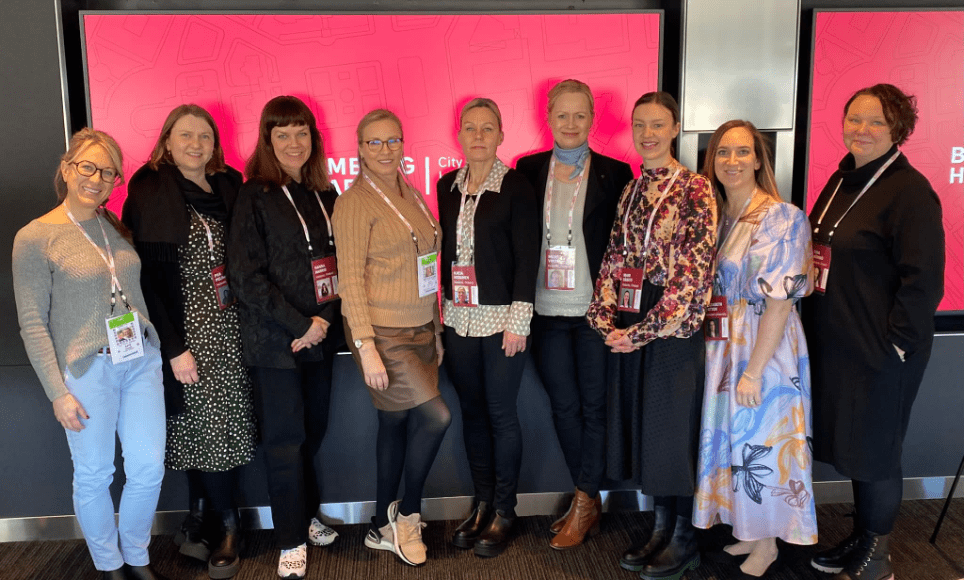
Guest blog by Hanna Harris, Arjariitta Heikkinen, Tiina Hörkkö, Satu Järvenkallas, Katja Nissinen, Piia Pelimanni, Mari Väistö, Meri Virta.
The challenge we decided to take on was improving children and young people’s experience of safety in urban environments. The problem was tackled by a core team of eight people representing each division of the City of Helsinki as well as the Preventive Policing Unit of the Helsinki Police Department. They are joined by a team of forty people representing internal and external cooperation partners of the City of Helsinki.
When You Dig In, You’ll Find It: PDIA Gold
Guest blog by Joe N. Savage Jr.
It was a late Wednesday night as I sat in my room at the DoubleTree hotel. I was sitting comfortably in my desk chair feeling supported by its stern back. My Pepsi Zero was resting in a glass splattered with tiny beads of cool water. My other comfort. Surrounded by these comforts, I was ready to read my PDIA materials in preparation for Thursday’s session. My Adobe app was ready for the multiple pdf’s, my eyes energized by Pepsi Zero caffeine were keenly focused, but my mind still sat in a place of confusion. There were so many swirling dots that were disconnected, orbiting far from one another. The task of connecting them seemed overwhelmingly daunting and my mind didn’t have the energy to do it. Sitting in that moment about to begin my readings, I felt a churning in my mind. What was originally anxiety, mixed with procrastination with a hint of confusion churned into a determination to understand. It was in that moment that I decided I would “dig in” and truly discover what PDIA was about.
(more…)