

Reducing Violent Crime and Addressing Homelessness in Albuquerque, New Mexico
Guest blog by Raul Bujanda, IPP ’26
One of the biggest lessons I learned from the Implementing Public Policy program is that understanding a problem is very different from being able to solve it. In public safety, we are used to identifying a problem, developing a plan, assigning resources, and expecting results. That approach works when the problem is fairly clear and the solution is known. It becomes much harder when the problem involves human behavior, politics, limited resources, different agencies, and competing expectations from the community.
The PDIA process forced me to look at the problem differently. Instead of immediately asking, “What is the solution?” I learned to spend more time asking why the problem exists and what is keeping us from making progress.
Another important lesson was the value of breaking large problems into smaller pieces. Violent crime, homelessness, behavioral health, addiction, repeat offenders, and public disorder are connected, but they cannot be solved through one initiative. Trying to solve everything at once can actually make implementation harder. Smaller interventions give us an opportunity to learn what works, what does not, and what needs to change before expanding an approach.
My implementation challenge focused on reducing violent crime and improving public safety in Albuquerque while developing a realistic and humane approach to homelessness, behavioral health, and visible disorder.
As Executive Director of Public Safety for the City of Albuquerque, I work across the Albuquerque Police Department, Albuquerque Fire Rescue, Albuquerque Community Safety, and the Office of Police Reform. I quickly realized that many of the challenges we face do not belong to one department.
A person experiencing homelessness may interact with police, firefighters, emergency medical personnel, community safety responders, hospitals, treatment providers, courts, and nonprofit organizations, sometimes repeatedly. At the same time, neighborhoods and businesses expect the City to address crime and disorder and keep public spaces safe.
The problem was not simply a lack of effort. A major part of the problem was coordination. Each organization could be doing its job while the overall system was still not producing the outcome we wanted.
The fishbone exercise was probably one of the most useful parts of the course for me because it forced me to move beyond the symptoms of the problem.
Our analysis identified several contributing areas: coordination and governance, the justice system, homelessness and behavioral health, staffing and resources, data and technology, and community and environmental conditions.
That helped me see that what initially looked like a crime problem was also an implementation and coordination problem.
For example, police can arrest a repeat offender, but the long-term outcome may depend on prosecutors, courts, treatment providers, housing availability, or other organizations outside the police department. Similarly, Albuquerque Community Safety can connect someone experiencing homelessness with services, but if appropriate treatment or housing is unavailable, that individual may return to the same location and the same circumstances.
The Triple-A analysis also helped me think differently about what I could realistically influence. I had authority to bring APD, AFR, ACS, and the Office of Police Reform together, but authority alone did not guarantee results. We also needed acceptance from employees, community partners, elected officials, businesses, service providers, and other stakeholders. Finally, we needed the ability, including staffing, technology, data, services, and operational capacity, to actually carry out what we were asking people to do.
Our early iterations reinforced this. We began looking at specific locations and operational problems rather than discussing homelessness or crime only at the citywide level. One example involved examining conditions around Robinson Park and bringing APD and ACS together to better understand what was happening and what each department could realistically contribute.
That experience led to another important lesson. We needed clearer short-term objectives. Saying we want to “reduce homelessness” is not an operational objective. Asking what we can change at a specific location over the next 24 hours, week, or month creates something we can act on and measure.
That thinking has carried into our broader approach to problem locations. Instead of simply moving people or increasing enforcement temporarily, we are looking at the entire environment: crime, repeat calls for service, behavioral health needs, outreach, property conditions, businesses, and the physical environment. We can then bring the appropriate departments and outside partners together, assign responsibility, measure results, and adjust.
The process also showed me how much we still do not know. My earlier analysis identified uncertainty around long-term coordination, political and organizational support, staffing, technology, data sharing, and our ability to adapt quickly. I no longer see those unknowns as a reason not to act. They are reasons to start small, learn, and adjust.
The biggest change for me is resisting the urge to immediately develop a large solution.
My background in law enforcement taught me to assess a problem, establish objectives, develop a plan, and execute it. I still believe strongly in accountability and execution. PDIA does not replace those principles. It adds another step before them.
I now spend more time decomposing the problem and asking what we actually know, what we assume, and what we still need to learn.
I also think more about whether we have enough authority, acceptance, and ability to implement an idea before launching it. A good idea without those three things can become another plan that looks good on paper but never produces sustainable results.
I am already using the approach in Albuquerque.
We are bringing departments together more consistently, focusing on specific problems and locations, and asking what measurable change we expect from the resources we deploy. I want our teams to become comfortable testing an approach, evaluating the results, and changing direction when the evidence tells us something is not working.
That requires a different leadership mindset. Changing a strategy should not automatically be viewed as failure. If we learn quickly and use that information to improve the next iteration, the process is working.
I also want to continue breaking down the silos between public safety agencies and our external partners. Police, fire, community safety, prosecutors, courts, behavioral health providers, housing organizations, businesses, and community groups all see different parts of the same problem. Bringing those perspectives together gives us a better chance of understanding what is actually happening.
My advice is simple: do not wait for the perfect plan.
Public sector leaders are often expected to have answers. Sometimes the better approach is admitting that we do not yet know enough and creating a process that helps us learn.
Start with the problem. Break it down. Talk to the people closest to it. Look at the data, but also understand what is happening on the ground. Identify what you can control and where you need partners. Try something small enough that you can see whether it works. Measure it. Learn from it. Then adjust.
I would also encourage practitioners not to underestimate relationships. Many implementation problems cross organizational boundaries. Authority can get people into a room, but relationships and trust are what keep them working together when things become difficult.
Finally, stay focused on outcomes rather than activity. In government, it is easy to measure how many meetings we held, how many people we contacted, how many calls we answered, or how many operations we conducted. Those numbers matter, but they are not the final measure of success.
The better question is whether conditions actually changed for the people and communities we serve.
That is probably the most important lesson I will take from this program. Complex problems will not be solved by one leader, one department, or one plan. Progress comes from understanding the problem, taking action, learning from what happens, and being willing to adjust until we begin producing better results.
This is a blog series written by the alumni of the Implementing Public Policy Executive Education Program at the Harvard Kennedy School. 33 Participants successfully completed this 5-month hybrid program in September 2026. These are their learning journey stories.
Implementing Healthy Meals in Abu Dhabi Workplaces
Guest blog by Nouf Albadi, IPP ’26
When I started the Implementing Public Policy program, I came with a challenge that sounded simple: How can we improve access to healthy food in Abu Dhabi workplaces?
As a public health nutritionist, I naturally looked at the challenge first from a technical perspective. We know what healthier food should look like. We can develop nutrition standards, guidelines, and policies. But throughout this course, I learned that having a technically strong policy does not mean that it will be successfully implemented.
Implementation is about people. It is about understanding the problem, building authority, creating acceptance, strengthening ability, communicating effectively, and continuously learning and adapting.
That has been one of my biggest lessons from this journey.
Many employees in Abu Dhabi spend a large part of their day at work. With long working hours, meetings, busy schedules, and easy access to food delivery applications, the workplace becomes an important environment where daily food habits are formed.
When healthy choices are difficult to find, while less healthy options are convenient and easily available, people may repeatedly choose what is easiest.
Over time, these small daily choices matter.
Obesity and related noncommunicable diseases are important public health concerns in Abu Dhabi. For me, this means that improving health cannot depend only on telling people to “eat healthier.” We also need to look at the environment around them.
My implementation challenge therefore became broader than simply introducing healthy meals. It became:
How can we successfully implement the Healthy Meals at Workplaces Policy across Abu Dhabi by creating stakeholder ownership and acceptance while coordinating implementation across multiple government entities?
This change in the way I defined the challenge was itself part of my learning during the course.
One of my most important learnings was how to break down a complex problem.
At work, we sometimes face a large problem and immediately start thinking about the final solution. The course taught me to slow this process down. Instead of asking, “How do we solve everything?”, I learned to ask what is actually causing the problem and which parts of it we can realistically influence.
Developing and repeatedly reviewing my fishbone diagram helped me do this.
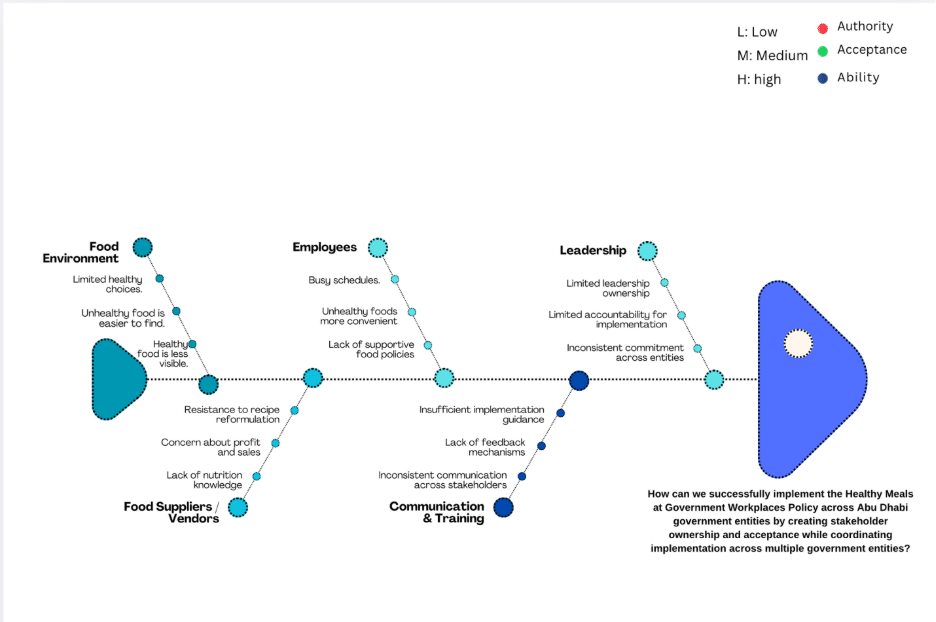
My fishbone identified several interconnected causes: the food environment, employees, food suppliers and vendors, communication and training, and leadership. Under these were smaller issues such as limited healthy choices, unhealthy food being more convenient, supplier concerns about sales, limited nutrition knowledge, insufficient implementation guidance, inconsistent communication, and limited leadership ownership.
Seeing the challenge this way helped me understand something important: there was no single cause and therefore there could not be a single solution.
The Authority, Acceptance and Ability framework helped me go one level deeper. A solution might technically work, but do we have the authority to implement it? Do the stakeholders accept it? Do they have the ability and resources to implement it?
This changed how I approached the problem.
My biggest progress was not only in the policy itself. It was in how I approached implementation.
At the beginning, I was approaching the challenge mainly as a nutritionist. As the course progressed, I started looking at it more as an implementation problem.
For example, I realized that the people authorizing a project do not always need or understand all the technical details that I work with every day. If I present a problem as extremely complicated, with many technical barriers and requirements, I may unintentionally make the solution appear impossible.
Instead, I learned to break the challenge into smaller and more understandable pieces and communicate what matters to each audience.
This connected strongly with the 4P leadership framework. I learned that Projection matters: rather than presenting the initiative only as a policy that organizations must comply with, I can frame it around improving employee health, wellbeing, and productivity. I also learned the importance of People: listening to government entities and food suppliers, understanding their concerns, and developing practical solutions together rather than only explaining technical requirements.
Another important lesson was learning how to communicate upward to authorizers.
In a government environment, information moves through different levels. I learned that communication needs to be simple enough for senior decision-makers to quickly understand the issue, while still providing the evidence and technical information they may need. In one of my assignments, I reflected that executive summaries can be useful, but important information can sometimes be lost as a message moves through an organizational hierarchy. I therefore started thinking more carefully about how to communicate the main message while keeping supporting evidence available.
I also learned that progress is not always a final result.
During my journey, I started looking at learning and leads as indicators of progress. In June, I learned that a strong policy alone was not enough and that authority, ability and acceptance all influenced implementation. In July, I identified technical limitations and expanded discussions with other partners. In August, I learned how multiple levels of authorization could slow implementation. By September, one of my main lessons was how important it is to maintain momentum while waiting for decisions.
This helped me appreciate that implementation is rarely a straight line.
How will this change the way I tackle problems in the future? Before jumping to a solution, I will first ask:
What part of this problem is actually within my authority? What can I influence? Who else has authority? Do the people involved accept the proposed change? And do they have the ability to implement it?
This sounds simple, but it changes how I work.
Instead of trying to solve a large problem at once, I can break it into smaller components, identify where I have space to act, test a small intervention, learn from it, and then decide what to do next.
I also learned not to depend only on formal authority. Throughout the course, I saw that authorization can grow through trust, communication, relationships, and demonstrating progress. My own reflection was that authorization is not simply receiving formal approval; it is also about building support throughout implementation.
This is particularly important when working across several government entities where no single person controls every part of implementation.
I am already applying these lessons to my work.
I am communicating more intentionally with stakeholders instead of focusing only on technical requirements. I am trying to understand their concerns before proposing solutions. I am also thinking more carefully about how I communicate progress to management and authorizers.
Most importantly, I am trying to make implementation a shared responsibility rather than the responsibility of one person.
The course also made me think differently about delegation and sustainability. A program should not depend entirely on one individual. Knowledge, capability, and ownership need to be shared so that implementation can continue even when people or leadership change.
This became very real during the course when changes in leadership meant that relationships with authorizers sometimes needed to be rebuilt. Our peer-learning discussions reinforced that implementation progress is not always linear and that changes in leadership and priorities can affect progress. What we can control is how we respond: rebuilding relationships, listening, adapting, and finding small opportunities to continue moving forward.
If I could share one lesson with other public policy practitioners, it would be:
Do not wait until you have the perfect solution to start implementing. Break the problem into smaller pieces, understand where you have authority and where you need others, take one practical step, learn from it, and keep adapting.
As technical professionals, we can sometimes become very focused on creating the perfect policy, guideline, or solution. But implementation happens through people.
Listen to the people who will implement the policy. Understand the people affected by it. Communicate differently with technical teams, managers, and senior leaders. Build relationships before you need them. And do not underestimate small progress.
For my own challenge, the ultimate goal remains simple: make the healthy choice easier for employees.
But my understanding of how to reach that goal has completely changed.
A healthier workplace will not be created by a nutrition guideline alone. It requires leadership ownership, capable suppliers, supportive food environments, informed employees, good communication, and coordination across organizations.
That is what implementation means to me now.
This is a blog series written by the alumni of the Implementing Public Policy Executive Education Program at the Harvard Kennedy School. 33 Participants successfully completed this 5-month hybrid program in September 2026. These are their learning journey stories.
The Deficit Show: We Keep Watching, but Don’t Act
Written by Matt Andrews
The third in a series of blog posts by Matt Andrews on U.S. federal debt and the capabilities needed for fiscal governance.
Note: all images were generated using ChatGPT.
In the previous post, I asked why the federal debt struggles to become a problem we act on together as a nation. I focused on Marshall Ganz’s familiar questions, Why this? Why us? Why now?
Unfortunately, I suggested that each question runs into a different difficulty:
- Why this? Reducing the deficit sounds appealing until it becomes a choice about a particular tax or program. People can picture the higher tax bill they might receive or the service they might lose. They can also picture what they would rather protect: retirement benefits, healthcare, defense, schools or infrastructure. General agreement that borrowing should fall does not tell us which of those commitments to change.
- Why us? Responsibility is easy to place elsewhere. Politicians can blame another party or an earlier administration. Citizens can blame politicians while opposing changes to their own taxes or benefits. These accounts may each contain some truth, but they can leave everyone waiting for somebody else to act.
- Why now? Action brings visible costs to people living and voting today. Continued borrowing postpones part of the bill. Its costs arrive gradually, through interest payments and reduced room for future choices, often in places that do not immediately look like part of the federal budget. There is nearly always a reason to say that this is the wrong moment to make a difficult change.
In sum, the US debt situation sets us up with a fundamental tension. We can all see it, and have strong feelings about it. Sometimes its hard to look away. But looking and doing are two different things.
A Reality TV Show?
In reflecting on this, I have come to liken the situation to a reality television series, The Deficit Show.

Imagine it showing a family struggling with its finances. Each episode, an expert sits them down and explains that their debts are growing faster than their income. The bills arrive. Family members argue about who spent the money, who failed to earn enough and who ought to give something up. Viewers take sides. Then comes the episode that promises to change everything. Someone announces a tough new budget. Someone else storms out. A cupboard is cleared, a subscription cancelled, perhaps a prized possession sold. It makes compelling television. We can see the conflict and the sacrifice. At the end of the episode, everyone says the family has finally faced its problem.
The next season opens with another stack of bills.
The comparison is uncomfortable because it captures something about how most Americans—including political leaders—seem to engage with the reality of federal finances. A debt-ceiling confrontation or a public spending cut commands attention. It offers characters, conflict and a moment that looks decisive. The less dramatic question—whether the government’s recurring commitments and revenues are coming into balance—receives far less attention. Different viewers applaud different interventions. When the annual accounts arrive, the underlying problem is still there.
Where are we in the show?
So where are we in the story? To start answering, let’s look at the most recent completed fiscal year, asking how much the federal government spent beyond its income, and what has happened to bills from prior seasons. If we titled the episode based on such data, we might call it, How exceptional borrowing has become a new normal.
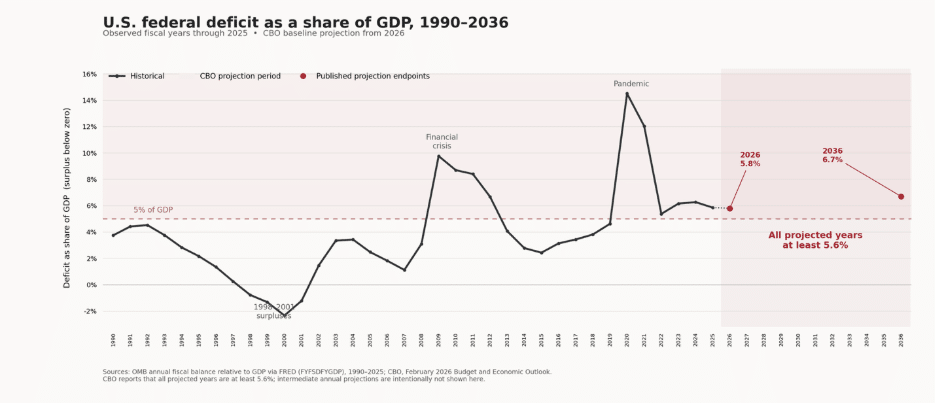
The current episode’s title derives from what I see in the figure below, which shows the federal deficit as a share of GDP since 1990:
- In the latest completed episode—fiscal year 2025—the government collected about $5.23 trillion and spent about $7.01 trillion.
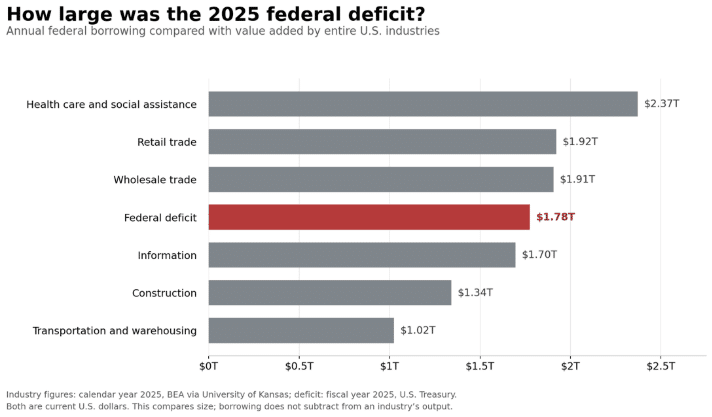
- It borrowed the $1.78 trillion difference—approximately 5.8% of overall U.S. GDP.
Those numbers are difficult to picture, so let’s widen the camera and allow a more textured comparison:
- First, consider that the entire construction industry in the United States contributed roughly 4.4% of GDP, and the information industry (including tech) contributed about 5.5% of GDP. That means that the federal government borrowed more in one year than the construction and tech industries added (separately) to the economy.
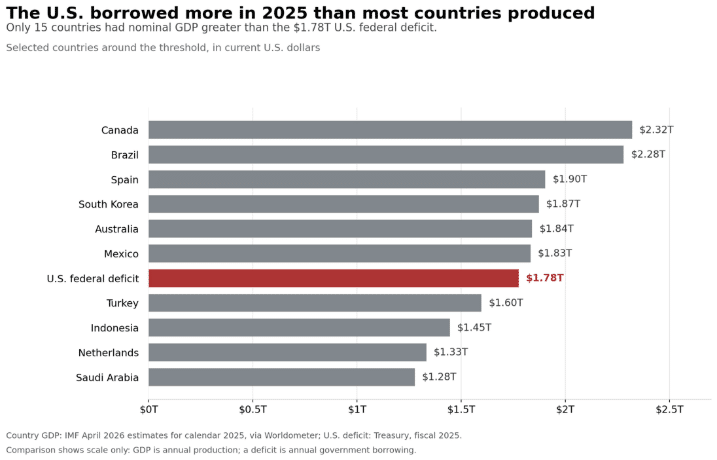
- Looking further afield, we can compare this to other countries. In an IMF-based ranking of national GDP for 2025, only 15 countries produced more in the entire year than the U.S. federal government borrowed in the same year. The US deficit was nearly as large as South Korea’s economy and larger than the annual output of Turkey, Indonesia, the Netherlands and Saudi Arabia. Note that I’m not saying the deficit was equal to these countries’ deficits; the deficit was equal to the size of the countries’ economies.
It is also useful to reflect on how the current instalment of this deficit show compares with past seasons, especially recognizing that the US has seen deficits above 5% before. This happened in prior seasons that were characterized by dramatic events, however, with the deficit jumping above 5% during the financial crisis in 2009 and again during the pandemic in 2020 (for instance).
But the plot seems to have changed since 2020. The Covid emergency has passed, but borrowing continues as a norm and not an exception. We see this in that the deficit exceeded 5% of GDP in all six fiscal years from 2020 through 2025. This happened in just five years between 1947 and 2019.
The advance preview of future seasons offers little reassurance. The Congressional Budget Office (CBO) projects deficits of at least 5.6% of GDP every year from 2026 through 2036.
If that forecast holds, the run of deficits above 5% of GDP will last 17 consecutive years. Future decisions could change the projection. But CBO is not assuming a decade of recession to produce these figures: it expects unemployment to remain below 5% throughout the period. Borrowing at a level once associated with emergencies has become the expected result under ordinary conditions.
These figures would make a startling reveal at the end of any television episode. Yet we have seen so many reveals that another large number may hold our attention only until the next scene. We tend to be more captivated by the tension of conflict.
Episodes that captivate us
Two recent episodes had all the ingredients needed for great viewing: recognizable characters, high stakes, public confrontation and a moment that looked decisive. Different viewers cheered at different points. The test, though, came after the cameras moved on. What changed in the accounts?
The showdown
In 2023, the deficit story became a suspense episode. The United States had reached its debt ceiling. The Treasury used temporary measures to keep paying the government’s bills, while President Biden and House Speaker Kevin McCarthy faced a deadline. Each meeting brought another round of cameras and commentary. Would they make a deal? Would the United States default?
The confrontation made compelling television. Biden and McCarthy disagreed over whether spending cuts should be a condition of raising the debt ceiling. Viewers could follow the arguments, count the days, and choose a side. It was harder to see that the debt ceiling concerned payment of obligations already incurred. Avoiding default would keep the family paying its bills; it would not, by itself, balance spending and income.
The negotiations produced the Fiscal Responsibility Act. It suspended the debt ceiling and capped some discretionary spending for two years. The Congressional Budget Office estimated that the agreement would reduce projected deficits by about $1.5 trillion over 2024–2033, relative to its earlier baseline. This was a real change in the expected borrowing path. It was also a ten-year estimate, not a plan to balance the annual budget.
Then came the familiar reality-TV ending: the confrontation was resolved, the principal characters claimed their victories, and attention moved on. The quieter question—what did the deal actually do to the family’s finances?—received much less attention than the fight itself.
When the next annual accounts arrived, the fiscal year 2024 deficit was about $1.8 trillion, roughly $138 billion higher than in 2023. That increase does not mean the agreement failed: the deficit might have been larger without it. It does mean the deal addressed only part of the imbalance. We watched the showdown closely. We paid less attention to the result. The family was still spending far more than it brought in.
The chainsaw
The next season gave the show a prop. In February 2025, Elon Musk walked onto a conference stage holding a chainsaw given to him by Argentina’s President Javier Milei. The crowd cheered. Here was a promise to cut government that could be understood in a single image.
The scenes that followed were just as vivid. The Trump administration moved to dismantle parts of the federal government, like the U.S. Agency for International Development. Foreign aid contracts were terminated; employees cleared their desks. To some, this looked like overdue action against wasteful spending. To others, including aid workers and organizations whose programs stopped, it was deeply alarming. People watched the same episode and saw either a government finally willing to make cuts or one destroying work it did not understand.
The conflict held our attention on news sites. But the question for this series is what happened to the deficit. A cut can be enormous for the people who depend on a program and still be small relative to the federal budget.
Reuters examined spending at agencies affected during the early DOGE period and found about $19 billion less spending—roughly 0.5% of total federal outlays over the comparison period. When the fiscal year 2025 accounts arrived, the deficit was still high—at $1.78 trillion—the current 5.8% of GDP.
The debt-ceiling showdown and the chainsaw drew different audiences and different reactions. Both involved decisions with real effects. Yet in each case, the most watchable question was who would win the confrontation? The less watchable question came afterward: Did recurring revenue and spending move into a relationship the country can sustain?
Reality television gives us a new conflict each episode. Fiscal governance requires us to keep looking when the drama is over.
The bill arriving between episodes
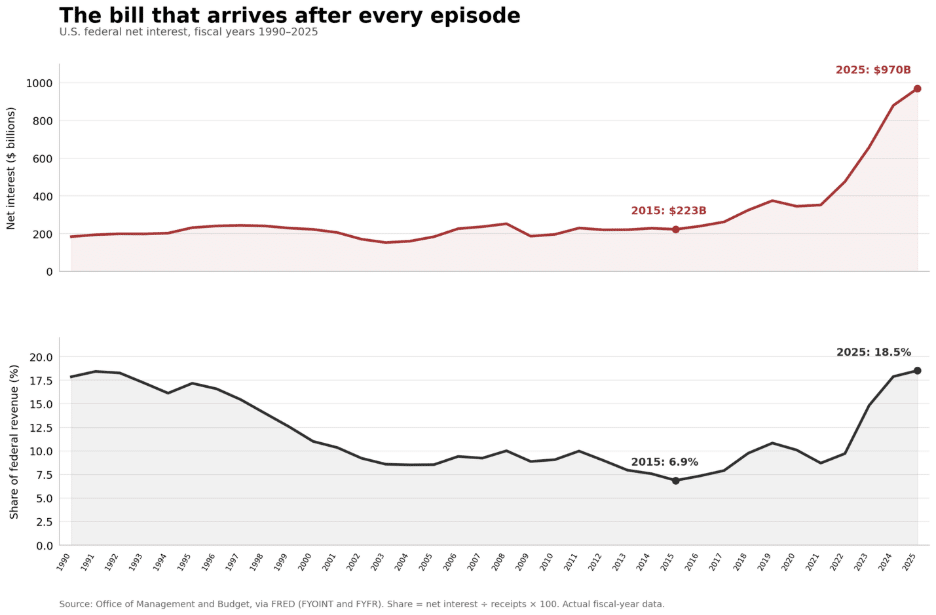
While we watch the confrontations, another part of the story advances with little drama. Every year, the interest bill arrives. It is the cost of borrowing undertaken in earlier episodes, and it must be paid alongside everything the government wants to do now.
In 2025, federal net interest cost $970 billion—about $2.66 billion a day. That exceeded the $917 billion spent on the national defense budget function. Interest claimed 18.5 cents of every dollar the federal government collected.
| Fiscal year | Net interest | Interest per $1 of federal revenue |
| 2015 | About $223 billion | 6.9¢ |
| 2025 | About $970 billion | 18.5¢ |
This is more than four times the annual interest bill of a decade earlier, in current dollars. The share of revenue going to interest has grown from about seven cents to more than eighteen cents per dollar. Those are two views of the same pressure: the bill has grown, and paying it takes a much larger portion of what the government collects.
This is money raised today to pay for yesterday’s borrowing. An interest payment does not renew a road, support a new discovery or prepare a community for the next disaster. Congress can still choose to fund those things, but it must do so while meeting the interest bill. If revenue does not cover both, the government has to borrow again, adding to the bills future budgets will face.
The scene is easy to miss because nothing visibly closes when an interest payment is made. There is no showdown, no chainsaw and no crowd to cheer or protest. The payment simply goes out. Yet each year it leaves less of today’s revenue available for tomorrow’s needs.
Where the Deficit Show now leaves us
The showdowns have subsided in our ongoing Deficit Show, and the chainsaw scene is long gone. But the country’s accounts are still open, and the latest figures tell us where the story stands. In 2025, the federal government borrowed roughly one quarter of what it spent, paid more in net interest than it spent on national defense, spent about $805 billion more than it collected (before paying interest), and incurred debt exceeding 5% of US GDP.
The current episode sits uncomfortably in the overall series: The federal government deficit has exceeded this 5% level of GDP in all six years since 2020—having surpassed the level only five times between 1947 and 2019. The Congressional Budget Office expects deficits above 5% of GDP every year through 2036. What was exceptional is now normal.
These are the realities that remain after the dramatic scenes we all watch on live TV, and that we will have to pay attention to at some point. Yet the attention is still lacking, ostensibly because the show offers other entertainment: follow the confrontation, cheer or condemn the intervention, then wait for the next shocking figure.
We know how to be an audience. We have been less willing to ask what it would take to change the family’s finances. That is the unsettling thing about The Deficit Show. We keep watching, but do not act. Every year we watch becomes part of the next year’s bill.
In the next post, I will look at recent experience in other countries where similar shows have unfolded. Their experiences cannot tell us exactly what will happen in America. They can, however, show what happens when fiscal room narrows without any treatment—and why it matters to make choices to change while those choices still remain.
This is the third in a series of posts examining the United States federal debt through the lenses of governance and state capability. To read more in this series, see Post 1 (A $40 Trillion Puzzle: Why Has the United States Failed to Address Its Federal Debt?) and Post 2 (Everyone Says the Debt Is a Problem. So Why Is It Not a Priority?).
A Gold Ring Cannot Fix a Hospital: Two Stories of Incentivizing the Wrong Problem
Guest blog by Prarthna Dayal
A gold ring to encourage women to deliver in public hospitals.
Yes. The Government of Tamil Nadu, a state in India has announced exactly that. The states’ new Thaimaman Thanga Mothiram Thittam scheme will provide a one-gram gold ring to babies born in government hospitals, aiming to encourage families to choose public facilities – in a state where 99.7% of births already happen in health facilities. The scheme has an annual allocation of ₹755.83 crore (USD 78.8 million).
The problem that the Tamil Nadu government is solving for is a steady drift away from government hospitals which are free, towards private ones, where care can cost 6-8 times more.
There is nothing inherently wrong with using incentives in public policy. The problem comes when an incentive is used to solve a problem whose causes lie elsewhere.
If families are willing to pay many times more for a private delivery, what are they paying for? Perceived differences in quality, cleanliness, responsiveness, waiting times, privacy, dignity, availability of staff and medicines, or simply trust in the care they receive. A gold ring resolves none of these deficiencies in public hospitals.
The instinct to hand someone a benefit or a subsidy rather than fix what’s broken underneath, is pervasive in how we often approach development. It has appeal to both politicians and the public. There are many examples of this from across countries in Asia and Africa where cash transfers to women to deliver in facilities led to increased utilisation but did not address the fundamental quality issues plaguing these facilities. There is a powerful attraction to policies that are immediate, visible and tangible. The gold ring is only the latest version of the same reflex. The alternative—reforming a public health system—is much harder.
That’s why it was heartening to see the Government of India’s Parliamentary Standing Committee on Health and Family Welfare recently released Report on Affordability and Accessibility of Healthcare Facilities in the Public and Private Sector making a strong case for exactly this harder path: systematic investment in public-sector infrastructure to strengthen the capacity of Community Health Centres, District Hospitals and state-run medical colleges to deliver dependable emergency obstetric and paediatric care. If we want people to choose public hospitals, we have to make public hospitals work.
But money alone doesn’t translate into better functioning services. Public hospitals are notoriously resistant to reform – across high-income, low-and middle-income contexts alike – even when reforms offer economic incentives, like hospital autonomy or pay-for-performance.
I looked at this conundrum recently – of why economic incentives built into reforms don’t always translate into action? Specifically, why public hospitals in a resource-constraint setting were not interested in engaging with a strategic purchasing reform which would provide an additional source of revenue to improve their functioning?
What surprised me was public hospital leaders either claiming they had sufficient funds or blaming junior contractual staff for non-performance and engagement with the scheme. This response was striking given how chronically underfunded public hospitals are known to be. Either longstanding resource constraints had become normalised, or that hospital leaders were consciously distancing themselves from the additional revenue.
The real explanation for their disinterest in the extra money lay not in the incentive itself, but in how existing institutional relationships, structures and patterns of behaviour in the public sector determined whether that incentive was seen as worth pursuing at all.
First, existing resource shortages – understaffing, poor infrastructure, unreliable electricity – combined with what were considered tedious processes, made lodging claims genuinely challenging. Doing it required initiative and experimentation – to align hospital systems to obtain required information and complete the paperwork – that were not in tune with how hospital leaders were used to working. They were used to following routine administrative procedures to execute budgets, not being entrepreneurial or investing additional effort to generate revenue.
Second, there was a risk attached to getting the money and no incentive to take the risk of using it, and in fact every incentive not to. They operated in an institutional environment marked by low trust and punitive means of oversight. This intersected with an absence of a performance management system that recognised their utilisation of funds to improve services, making risk avoidance a rational choice. As one government official put it, “Everyone is scared of scrutiny….and zero penalty for not doing anything but potential penalty for doing something.” There was an absence of incentives for public hospital leaders linked to hospital improvement.
Third, externally contracted staff and parallel implementation structures – set up presumably to work around an under-resourced bureaucracy – instead enabled everyone with real authority to disown responsibility by being able to lay blame elsewhere, often on the contractual staff with no power to change anything.
Inaction, in other words wasn’t a failure of individual motivation. It was a socially embedded disposition produced and reinforced by fragmented governance arrangements and weak accountability, misaligned incentives, challenging processes, resource and capacity constraints, and institutionalised patterns of behaviour.
This points to a deeper pattern in policymaking: reforms are too often designed on simplistic economic assumptions — that economic incentives carry a fixed, self-evident value and people respond predictably to them, regardless of context.
Health systems are social systems. Reforms have to work through existing institutions, organizational cultures, relationships, and power structures. They have to be understood and acted upon by the people expected to implement them.
These learnings could help inform countries like India as they embark on investing in their public hospitals. Below are a few suggestions:
- Integrate new initiatives with existing programmes and structures rather than simply adding another layer – so that responsibility is aligned with authority.
- Involve the people actually delivering services in defining problems and designing solutions – to build real ownership.
- Create monitoring systems that generate feedback and learning—and genuine incentives for improvement – simply identify failure and assign blame.
- Be willing to adapt when policies do not work as intended.
This is slower, harder work – it demands long-term commitment and a willingness to address the root of a problem, not a glittery gift wrap around it.
A gold ring might attract attention. A functioning public health system is harder to gift.
Everyone Says the Debt Is a Problem. So Why Is It Not a Priority?
Written by Matt Andrews
This is the second in a series of posts examining the United States federal debt through the lens of problem-solving governance and state capability.
In the first post in this series, I introduced a puzzle. The United States has extraordinary fiscal capacity. It has sophisticated institutions, extensive data, experienced officials, active think tanks, and unparalleled access to financial markets. Yet its political system has been unable to address a fiscal problem that it has recognized for decades.
Why?
To think about this, it is useful to distinguish between problems that receive attention and problems that generate action:
- The former sit on what we call the symbolic agenda. Political leaders talk about them. Experts produce reports about them. The media publish alarming stories. Citizens say they are concerned. Governments promise action. But nothing consequential follows.
- A problem moves onto the real agenda only when people are prepared to organize around it and do something. Decision-making processes are created. Resources and authority are mobilized. Actors accept responsibility. Difficult choices are made, implemented, and subjected to accountability.
The United States federal debt sits awkwardly between these two agendas.
Concern about the debt is widespread. In 2025, 53 percent of Americans told Gallup that they worried a great deal about federal spending and the budget deficit. Newspapers across the political spectrum regularly describe the fiscal trajectory as dangerous. Conservative, progressive and centrist think tanks disagree about its causes, but they generally agree that it cannot continue indefinitely. The Government Accountability Office and Congressional Budget Office have issued increasingly direct warnings.
The debt is therefore visible. It is discussed. It is periodically described as a crisis. But it does not appear to be generating sustained collective action.
This is an important challenge for what we—with our colleagues Quinton Mayne, Jorrit de Jong and Fernando Fernandez-Monge—call problem driven (or problem solving) governance and capability.
The first task in this kind of governance process—focused on making, implementing and accounting for decisions to address collective problems—is not finding a solution. It is establishing agreement that a condition represents a problem around which people are prepared to act. Drawing on work by my colleague Marshall Ganz, we only get to the point of agreement (and potential action) when we have credible answers to three questions: Why this? Why us? Why now? I believe the United States has not yet produced answers to these questions that are sufficiently compelling, broadly shared, and politically actionable.
Why this?
“Why this?” asks why the federal debt should receive priority over the many other problems competing for public attention. The difficulty is that addressing the debt does not involve one isolated intervention. Reducing deficits requires some combination of increased revenue, reduced expenditure, and stronger economic growth. Growth can help, but it is unlikely to eliminate the need to choose what government provides and how it is financed.
The abstract objective of deficit reduction therefore quickly becomes a series of concrete and politically difficult choices. People may want lower deficits, but they also want low taxes. They want a strong military, but they do not necessarily want to pay more to finance it. They want reliable infrastructure, good schools, and continued investment in scientific research. They want accessible healthcare. They want Social Security and Medicare to provide security in retirement. They may support lower government spending generally while opposing cuts to the programs that matter to them.
These preferences are not individually unreasonable. But they do not add up fiscally.
The difficulty becomes apparent when general support for deficit reduction is translated into specific proposals. A 2025 Gallup survey found that nearly half of all Americans wanted deficit reduction to come mainly or entirely through spending cuts. Far fewer favored relying primarily on higher taxes.
But which spending should be cut?
The largest expenditure commitments include Social Security, Medicare, Medicaid, defense, and veterans’ programs. These serve large and politically influential constituencies—and these constituencies don’t want the cuts!
A February 2026 Economist/YouGov survey makes the tension unusually clear. Forty-three percent of Americans said they wanted to decrease federal spending overall. Yet when asked about specific areas, majorities favored increasing spending on veterans (74 percent), Social Security (69 percent), Medicare (67 percent), aid to the poor (64 percent), and Medicaid (59 percent). These are preferences for increases, not simply for leaving current spending alone.
In that survey, more respondents favored decreasing than increasing spending in only two of the ten areas tested: foreign aid and Immigration and Customs Enforcement. In each case, 49 percent favored a decrease. These are pluralities, not majorities.
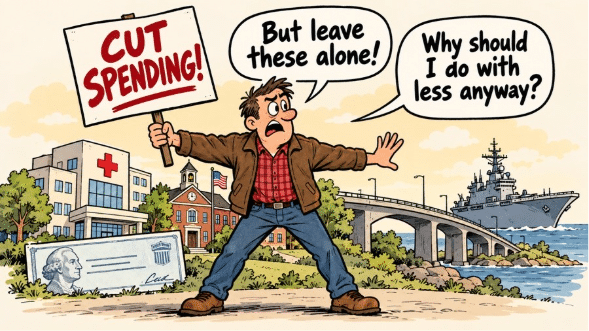
Smaller spending areas like foreign aid regularly attract political attention for cuts (and were a major area of DOGE focus in 2025) but account for only a modest share of total expenditure. Cutting them may be symbolically attractive, but it has not and will not resolve a fiscal imbalance of the current scale.
The same kind of difficulty arises with revenue. A Gallup survey from 2025 revealed that fewer than 20% of respondents favor using tax increases to cut the deficit, and the only taxes they are interested in are those levied on the ulra-rich (ostensibly not the group being surveyed). Essentially, people may support higher taxes on someone else, but resist taxes that affect their own income, consumption, savings, or businesses.
Together, these trends lead to political leaders promising broad groups protection from tax increases or spending cuts while also promising to reduce deficits. It’s like saying 2+2 = 0.
“Why this?” therefore competes with “not this tax,” “not this benefit,” “not this program” and “not this constituency.”
Something deeper may also be at work in the American political imagination. The United States is accustomed to thinking of itself as a country with unusually broad possibilities. It expects to maintain the world’s strongest military, reward enterprise, keep taxes comparatively low, protect major social commitments and respond forcefully to crises.
We are an exceptional nation. Not a limited one.
But talk of fiscal adjustment introduces the language of limits. It suggests that not every preference can be satisfied simultaneously. For an exceptional and exceptionally wealthy country, that can be a difficult proposition to accept. Why should the United States tighten its belt? Why can it not grow its way out of the problem, identify enough waste to remove it, or postpone the choices until conditions are more favorable?
The fiscal problem is therefore not competing only with other policy priorities. It is competing with a national expectation that we can avoid difficult trade-offs.
Why us?
Even when people agree that a problem matters, action is unlikely unless they accept some responsibility for addressing it. The federal debt makes this difficult because people can always locate responsibility elsewhere.
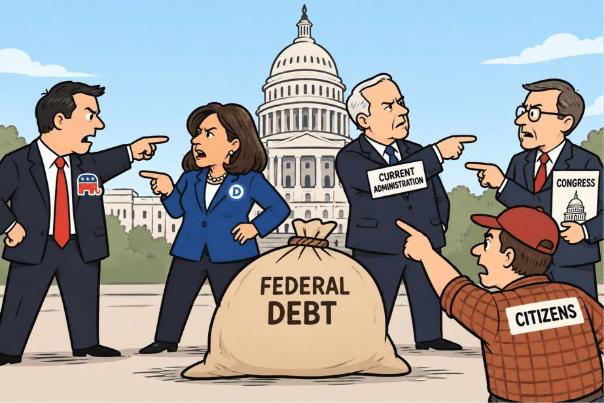
Republicans can blame excessive government spending by Democrats. Democrats can blame insufficient revenue and unpaid-for tax reductions by the Republicans. Current administrations can blame inherited conditions. Members of Congress can criticize the aggregate deficit while defending the individual tax and spending provisions their constituents favor. Citizens can blame politicians while opposing changes that would affect their own taxes or benefits.
Each explanation contains some truth. Spending decisions matter. Revenue decisions matter. Demographic change matters. Economic shocks matter. Interest rates matter—and so do choices made by successive presidents and Congresses.
The problem arises, however, when these partial explanations become instruments for transferring responsibility.
The fiscal debate then becomes an exercise in blame rather than a process of collective problem construction. Data are selected to show that the problem belongs to the other party, another administration or another social group. Each side develops a narrative that absolves its own coalition.
This happens across the policy community. Different think tanks often begin from the same fiscal projections but construct sharply different accounts of what produced them. Some emphasize spending and government growth. Others emphasize population aging and a revenue base weakened by unpaid-for tax cuts. These interpretations are not necessarily false. The difficulty is that they can harden boundaries rather than help people work across them.
This is where collaborative governance capability becomes important. Collaboration does not require everyone to agree about every cause or every remedy. It requires actors to develop a common-enough understanding to work together. They must be able to say: we interpret parts of this problem differently, but we accept that it is real, that none of us can address it alone and that each of us has some responsibility for the choices ahead.
The United States does not currently have an effective forum for developing that understanding. Budget processes divide decisions across committees and institutions. Electoral incentives reward assigning blame. Interest groups are organized to protect particular provisions. Citizens experience program benefits and tax preferences directly, while the resulting fiscal cost is spread across the population and over time.
The result is a problem everyone recognizes but no actor genuinely owns.
Why now?
The final question is especially difficult because of the timing of fiscal costs and benefits:
- Acting on the deficit creates costs now. Taxes may increase. Programs may grow more slowly. Eligibility rules or benefits may change. Public investments stop. Political leaders must ask current voters to accept visible and often concentrated losses.
- The benefits of action are less immediate. A more sustainable fiscal position reduces future interest payments. It gives future governments more room to respond to recessions, wars, pandemics and natural disasters. It lowers the risk of an abrupt fiscal adjustment. It protects economic opportunities that borrowing and interest costs might otherwise crowd out. These benefits matter enormously. But they are often dispersed, uncertain and located in the future.
Borrowing produces the opposite political arrangement. It lets government provide benefits or cut taxes now while shifting part of the cost forward. Present constituencies receive something identifiable. Future taxpayers inherit an obligation they did not help create.
This is a classic problem of time inconsistency. The action that may be responsible over the long term imposes short-term costs. The easiest short-term action makes the long-term problem worse.
It is therefore always possible to argue that now is not the right moment.
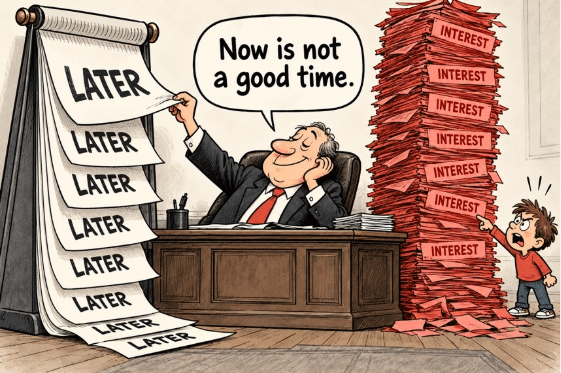
During a recession, fiscal restraint may weaken demand. During a recovery, leaders may not want to interrupt growth. During a security crisis, defense requirements take precedence. During an election, difficult fiscal choices appear politically impossible. When interest rates are low, borrowing seems inexpensive. When rates rise, the adjustment required becomes more painful.
Unfortunately, politically convenient moments to act are rare.
But postponement is itself a decision. It progressively reduces the room available to future governments. The Congressional Budget Office projects that the federal deficit will reach approximately $1.9 trillion in 2026 and rise to $3.1 trillion by 2036. Rising interest costs account for an important part of that deterioration.
The Government Accountability Office reports that net interest spending exceeded federal spending on national defense in 2025. Interest is expected to consume a growing share of federal resources in the years ahead. These payments finance decisions already made. They do not educate a child, maintain a bridge, fund new research, treat a patient, or equip a soldier. As they increase, they narrow the space available for current or future governing choices.
The danger is therefore not only a dramatic fiscal crisis at some unknown point in the future. It is also a gradual loss of fiscal space: a reduced ability to invest, respond to shocks and pursue new opportunities.
The question “Why now?” should not be answered by claiming that financial collapse is imminent. Such claims are difficult to sustain and easy to dismiss. A more credible answer is that every year of delay transfers more of the federal budget from choices about the future to payments for the past.
From recognition to commitment
The difficulty of answering “Why this? Why us? Why now?” helps explain why the debt remains closer to the symbolic agenda than the real one.
This is not simply a communication failure. It is a governance capability problem (in keeping with the work of our colleagues Quinton Mayne, Jorrit de Jong and Fernando Fernandez-Monge referenced in the first blog and earlier here).
- Having the data-analytic capability to address fiscal problems requires more than producing accurate fiscal numbers. It requires being able to use evidence to construct an intelligible and shared picture of the problem—one that reveals its scale and consequences without turning the data into another partisan weapon.
- Having reflective-improvement capability to address fiscal problems requires creating space for all actors in the system to examine their assumptions and acknowledge the tensions and problems within their own positions (not just those of others). It asks whether political parties, interest groups, and citizens can recognize how their preferred policies have contributed to the aggregate outcome instead of just blaming those of others.
- Having collaborative capability to address fiscal problems requires mechanisms through which all actors in the system can work across philosophical, political and social boundaries. They do not need to begin with an agreed solution. But they must develop sufficient common ground to accept shared responsibility and begin making choices together.
The United States possesses extensive capacity in all these areas. It has fiscal data, expert analysts, legislative institutions, executive agencies, universities, think tanks, media organizations, and civic groups. What it has not demonstrated is the empowered ability to bring these resources together in a process that moves the debt from widespread concern to committed action.
This second post examines that problem. Before asking how to reduce the deficit, we need to understand why a widely recognized danger has not become a sufficiently urgent, shared, and actionable problem.
Which brings us back to the key questions: Why this? Why us? Why now?
The inability to answer those questions may be one of the clearest signs that the United States is confronting not only a fiscal problem, but a fiscal-governance problem.
Fifteen years ago, in article titled The (Il)logics of Federal Budgeting, and Why Crisis Must Come, I argued that the deeper problem was a set of conflicting logics about government and ourselves: we want limited government and low taxes, while also expecting government to provide an extensive range of benefits, protections, and services. That argument seems more relevant today than when I wrote it.
Perhaps that is why the three questions remain so difficult. We are caught in a web of conflicting ideas about who we are and what we expect from government. We look into the fiscal mirror and see many things we value, but struggle to see ourselves—and our own responsibility for the choices involved.
The next post will turn to the data. It will ask whether we can construct a common-enough account of how the fiscal position developed—one that recognizes crises and political choices without using the evidence to blame individual presidents or parties.
Images are derived through ChatGPT.
This is the second in a series of posts examining the United States federal debt through the lenses of governance and state capability. To read more in this series, see Post 1 (A $40 Trillion Puzzle: Why Has the United States Failed to Address Its Federal Debt?) and Post 3 (The Deficit Show: We Keep Watching, but Don’t Act).
A $40 Trillion Puzzle: Why Has the United States Failed to Address Its Federal Debt?
written by Matt Andrews
This is the first in a series of posts examining the United States federal debt through the lenses of governance and state capability.
The United States has a fiscal governance problem that it seems unable to address.
In fiscal year 2025, the federal government collected approximately $5.2 trillion and spent just over $7 trillion. The resulting deficit was approximately $1.78 trillion.
This was not an isolated result. The federal government last recorded a budget surplus in 2001. It has now run deficits for 24 consecutive fiscal years and in 32 of the past 36 years.
This contributed to a federal debt that passed $40 trillion in August 2026.
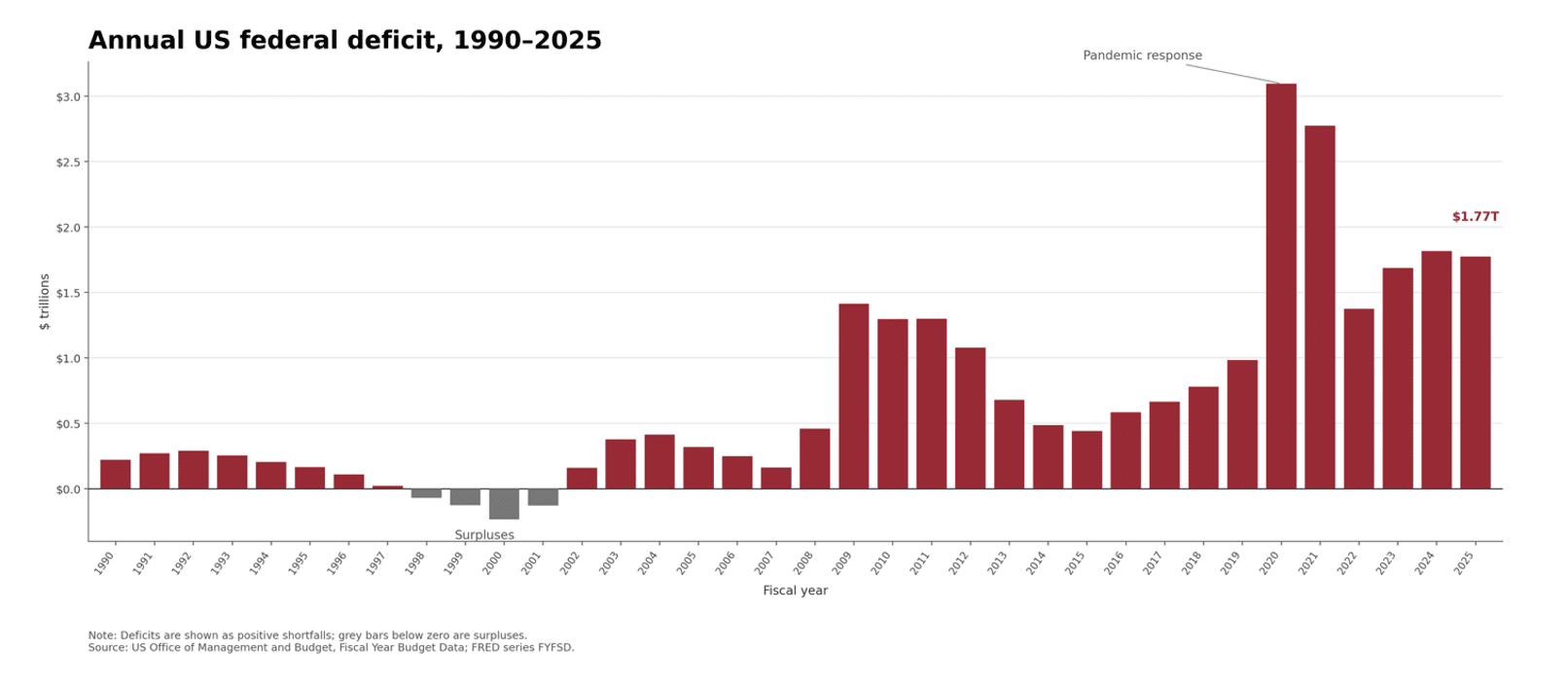
The annual figures fluctuate, especially during recessions and national emergencies, but the long-term trend is clear.
The deficit was approaching $1 trillion even before the Covid pandemic. It has exceeded $1.3 trillion every year since 2020 and remained near $1.8 trillion in 2025. The accumulated debt now creates a substantial expenditure of its own. In 2025, the federal government spent approximately $970 billion on net interest. This means that almost 14 cents of every dollar the federal government spent went toward interest on past borrowing.
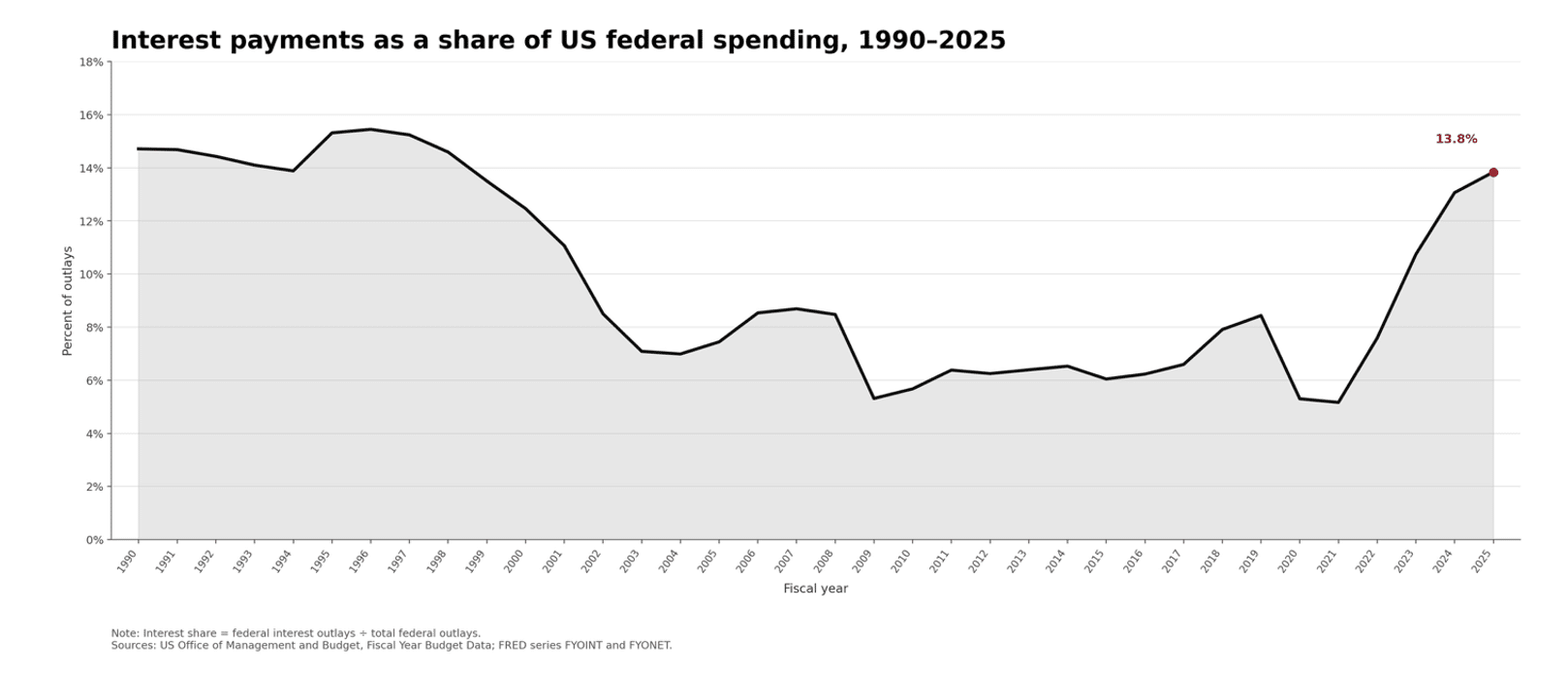
In 2025, the federal government spent more on net interest than it spent on national defense: approximately $970 billion compared with $916 billion. The debt is therefore no longer only a budgetary or economic concern. It is potentially a national security problem. Interest payments compete with defense and other priorities while reducing the fiscal room available to respond to the next recession, conflict, pandemic or emergency.
Many also recognize that the current trajectory is problematic.
This concern appears across the media landscape, including reporting by Reuters, the Associated Press, Fox News and The Guardian. It also spans organizations with very different political orientations. The conservative Heritage Foundation emphasizes the growth of federal spending and borrowing. The Center on Budget and Policy Priorities emphasizes the combined effects of an aging population and a revenue base weakened by unpaid-for tax cuts. The bipartisan Bipartisan Policy Center tracks the country’s deteriorating fiscal position and describes the present trajectory as unsustainable. The nonpartisan Government Accountability Office warns that this trajectory presents serious economic, national-security and social risks.
These organizations do not agree about what caused the problem or what should be done. But they do agree that there is a problem.
That gives us a puzzle.
The United States is not a country that is generally incapable of addressing difficult problems. Throughout its history, it has mobilized people, knowledge, and resources to respond to wars, financial crises, public-health emergencies, technological challenges, and profound social change. Its responses have often been incomplete, contested or imperfect. But the country has repeatedly demonstrated an ability to recognize important problems and act with considerable effect.
Why, then, has this particular problem been allowed to grow for more than a generation?
Put differently: Why has a problem recognized across the political spectrum not generated an effective and sustained response? And why do current projections assume that the debt and annual deficits will continue to rise?
I work at the Building State Capability program at Harvard Kennedy School. With my colleagues, I spend much of my time examining why governments can address some difficult problems but struggle with others.
Our work suggests that answering this question requires looking beyond a government’s resources. The United States has extensive fiscal data, highly qualified officials, sophisticated budget institutions, experienced political organizations, well-funded think tanks, and a political system with more than two centuries of experience. It does not obviously lack capacity.
The question is whether that capacity can be converted into action.
This directs attention to governance and capability. Governance concerns the mechanisms through which people make decisions, execute those decisions and hold one another accountable for the results. Capability concerns whether they can use the people, knowledge, resources and institutions available to make these mechanisms work in practice.
Fiscal-governance capability would therefore be demonstrated in the ability to make and execute decisions about revenues and expenditures, and to hold decision-makers accountable for their fiscal consequences.
Something within that process appears to be faltering. But which part?
Quinton Mayne, Jorrit de Jong and Fernando Fernandez-Monge offer a simple way to investigate this question, identifying three capabilities required for problem-oriented or problem-solving governance: data-analytic capability, reflective-improvement capability and collaborative capability:
- The first concerns whether the system can generate and use data to understand the problem. The United States produces extensive fiscal information. But does this information create a sufficiently common understanding of what is happening, why it is happening and what requires attention? Or does the same evidence become incorporated into competing political stories that reinforce existing positions?
- The second concerns whether the system can reflect on experience and improve. Can fiscal institutions and political actors examine the consequences of previous decisions, reconsider established assumptions and alter course? Where policies fail to produce expected results, are there mechanisms through which that experience changes subsequent decisions?
- The third concerns whether actors can collaborate across political and institutional boundaries. Collaboration does not require complete agreement. Nor does it remove legitimate differences over taxation, expenditure or the role of government. It requires mechanisms through which actors can move beyond those differences, develop a sufficiently common understanding and assemble enough agreement to act.
The United States appears to have achieved an important starting point: people across the political spectrum recognize that the fiscal trajectory is dangerous. But recognition has not translated into collective action.
Why not?
- Have political and institutional boundaries become too rigid?
- Are the existing mechanisms better at organizing disagreement than at helping actors work through it?
- Is the problem a failure to learn from experience?
- Or does the system generate large amounts of fiscal data without producing a shared account capable of motivating action?
These are questions, not conclusions.
This series will use the federal debt as a case through which to examine the three capabilities of problem-oriented governance. The purpose is not initially to prescribe which taxes should rise or which expenditures should fall. It is to understand where the process of governance is failing—and why a country with extraordinary capacity has been unable to address a problem that almost everyone can see.
Images are derived through ChatGPT.
This is the first in a series of posts examining the United States federal debt through the lenses of governance and state capability. To read more in this series, see Post 2 (Everyone Says the Debt Is a Problem. So Why Is It Not a Priority?) and Post 3 (The Deficit Show: We Keep Watching, but Don’t Act).
New Online Courses!
In a world where public needs are growing and trust in government is at an all-time low, the challenge is clear: we must achieve greater impact by investing in people and equipping them with tools to better serve their communities. To meet this moment, we’re expanding our online course offerings, bringing practical, affordable, high-quality training directly to you. Read more about our new online courses:
Public Policy in Action
Do you have a promising policy idea, but need a practical roadmap for implementation?
This 8-week self-paced, online course takes you inside the nuts and bolts of policy implementation. You will learn how to define success, map the people and resources needed, understand your context, identify critical unknowns, make key decisions, and select implementation methods that fit your problem, your people, and your constraints.
Session Dates: Oct. 5 – Nov. 29, 2026
Enroll By: Oct. 1, 2026
Course Fee: $499
Learn more about Public Policy in Action.
PDIA in Practice
Complex public problems demand experimentation, iteration, and the courage to test, learn, and adapt.
This 8-week self-paced, online course equips teams of 4-6 members with practical tools to turn ideas into meaningful results. Through experimentation, iteration, and small wins, you’ll build the confidence and capability to adapt your approach and create sustained improvements in policy implementation. Bring your team, work on your nominated problem, and transform how your organization solves complex public challenges.
Session Dates: Oct. 12 – Dec. 6, 2026
Enroll By: Oct. 1, 2026
Course Fee: $600 per team member 1-5; $300 for 6th team member
Learn more about PDIA in Practice.
Owning Your Time: Practical Tools to Reshape Your Relationship with Time
Are your days packed with meetings and obligations, yet the things that matter most keep getting pushed to “later”?
This 3-week self-paced, online course is designed to help you move beyond productivity and develop a more meaningful, intentional relationship with your time. Through daily reflections, intention-setting, and strategic reframing, you’ll learn to turn everyday responsibilities into purposeful choices and reclaim greater agency over how you spend and experience your time.
Session Dates: November 2 – 22, 2026
Enroll By: October 29, 2026
Course Fee: $249
Learn more about Owning Your Time.
Event: Crisis to Transformation: Policy Lessons from Ukraine
On May 12, 2026, BSC hosted a virtual event, “Crisis to Transformation: Policy Lessons from Ukraine,” which explored how Ukraine is simultaneously surviving war and driving deep institutional change. Anastasiya Dyakova grounded the discussion in everyday wartime reality: constant air-raid sirens, destroyed infrastructure, mass displacement, and pervasive uncertainty that makes even basic life planning impossible. She showed how this environment is reshaping Ukraine’s human capital—from refugee flows and collapsing birth rates to the growing role of women as primary earners, the long‑term needs of veterans, underused older workers, and a mounting mental health crisis. She argued for policies that build resilience and a “longevity economy,” actively integrating older workers and dispersed populations into reconstruction and growth.
Johannes Uhl and Artem Shaipov then shifted to how Ukraine and its partners are turning this crisis into a laboratory for adaptive governance, especially through the EU accession process. They described using the EU framework as an anchor for long‑term reform while working under wartime constraints. Both stressed that traditional, rigid reform models fail quickly in war; what works is problem‑driven, iterative, and highly flexible implementation, supported by strong local ownership and international partners willing to adjust rapidly, as they rebuild not just what was destroyed, but something fundamentally better.
Transcript
Salimah Samji Welcome everyone to our session titled Crisis to Transformation: Policy Lessons from Ukraine. My name is Salimah Samji. I’m the Executive Director of Building State Capability and I will be your moderator for today’s session. I’m really excited to announce and introduce our speakers today. Our first speaker will be Anastasiya Dyakova. She’s a policy research and founder and CEO of Dignity Online. Our second speaker will be Johannes Uhl. He is an implementation manager strengthening Ukraine’s EU alignment in the rule of law at GIZ. And then we will have Artem Shaipov, who is the team leader for legal and policy advice on the strengthening Ukraine EU alignment in the Rule of Law at GIZ. Both Artem and Anastasiya are both alumni of our Implementing Public Policy executive program. And we’re really excited to have alumni of ours at this session. So the session is gonna be each of our presenters, our speakers is gonna do a short presentation and then I will ask them a few questions and then we will open it up for your questions. So please, as they speak and you have questions, put them in the Q&A and we will get to them towards the end of the presentation. So with that, I’m gonna invite Anastasiya to kick us off with her presentation. Welcome Anastasiya.
Anastasiya Dyakova Thank you, Salimah. Hello, dear participants, and big pleasure and honor for me to be here today and to share with you experience from Ukraine, right now based in Kiev. So it’s really our experience. So let’s start. Since February 24, 2022, air raid sirens have sounded in my city for more than 2,100 times, lasting in combined totally more than 2,500 hours. That when we calculate it, it’s more than 100 interrupted days when you should be in bomb shelter and you cannot do anything. This means that you cannot plan anything in your life. An alarm may be going in the middle of your night forcing you to wake up immediately. As this night happened in my life, and run to a shelter. It may stop you on the way to dropping your children off at school. It may interrupt the training session you are running or our today event. Because when the sirens sound, everything should stop. And everyone must move underground. It may cut your doctor appointment or even a surgery. It may stop a concert or force passengers to leave a train in the middle of the journey because Russian forces are now targeting civilian trains. This means that people should leave their train and they should wait in the field and forest until the straight pass. Commercial aviation has been suspended for more than four years. So you cannot fly from Kiev to Warsaw that previously took two hours. Now you should use two trains that will take you more than 24 hours to get from Kiev to Warsaw. You cannot even plan a grocery run on the weekend because if the alarm sound while you’re in the store, you must leave immediately. Living with a radical uncertainty about even the next moment, not we are not talking about the next year, even the next moment, the next minute of your life, has become the new normal for Ukrainians. Moreover, the new normal as well is keeping a supply of water at home as Russia destroyed. Knowing how to set up a tent inside your own apartment, as this winter a lot of people in Ukraine already know. To keep warm when Russia destroys the central heating, owning a large portable power station for when the grid doesn’t work. And if you run a business, even own your own generator for your coffee shop or for small shop, because the enemy is systematically destroy our energy infrastructure, heating system, and water supply. The new normal as well means choosing an apartment, not by neighborhood, price, or proximity to work, but by the size of the bathroom, because when you no longer have the strength to run with your children to a shelter in the middle of the night, as this night, the bathroom became your refuge. Choosing by floor, because below the fifth is safer, or by location, mapped by where the strikes have been further. The new normal means as well having a will drawn up in your thirties, as I did. Offering paid mental health day to your employee after a night in metro as a shelter, as my team did this night. Maintaining an emergency vocation plan for your team. Having a company policy to compensate staff whose home have been destroyed. We had such case in our team last year. Running a dedicated emergency communication channel. And choosing your office not for its culture or design, but for whether it has a generator. Because the office has become a resilience hub, a place where your team can always count on electricity, water, internet and heating. From 2017 to 2021, I worked in the office of the President of Ukraine. And in 2024, I completed my master’s degree at the London School of Economics where my dissertation examines social investment trends and their practical implementation and addressing Ukrainian’s wartime labor market challenges. As you can imagine, we have a lot. Human capital and the longevity economy have become my deepest professional passion. And the impact of Poli-crisis on both, including geopolitical fragmentation, as we see this year and previous one, ecological disruption, technological transformation and the global demographic agent is now my primary area of research. So I would like to move from the individual and organization level we just explored to the national human capital challenges facing countries at war, because I really believe this experience holds lessons far beyond Ukraine borders. I genuinely hope, but cannot fully convince myself, that Europe will escape further Russia aggression, especially given the scale of military preparation we are witnessing in Belarus and beyond. In an area of accelerating geopolitical fragmentation and military escalation, the lessons Ukraine is living through may become relevant for more countries than any of us would wish. We have already seen how Ukraine’s wartime experience has become directly relevant beyond our borders, most recently as countries in the Middle East sought to learn from our military lessons during the US-Iran conflict. But military knowledge is the only one part of what war teach us. Ukraine’s experience of managing human capital under conditions of active war may provide equal, if not even more, valuable experience. Because I really believe that no nation can win or prosper or lead globally without a strong, resilient human capital base. What’s the impact of a long-lasting war on the human capital? Let’s scale up. To the national level, to the whole country. Since the full-scale invasion begun in February 2022, a large share of Ukrainian workforce has emigrated or been internally displaced or joined the armed force or been lost to occupation and captivity. By January 2026, approximately 5.9 million Ukrainians has become refugees, mostly in Europe. Represented 14% of the pre-war population. But what’s even more critically from this nearly 6 million, 75% of them are working-age women and children. The demographic foundation of future population grow the primary drivers of consumer demand and an irreplaceable part of the labor force. So it’s much less people in the country who can work and who can buy and support businesses. Furthermore, 4.6 million people are internally displaced. It’s creating enormous pressure on housing, health care, education in receiving regions and generating significant structural unemployment. As skilled and professionals profiles of displaced workers from one region to another region doesn’t fit each other. War also fundamentally reshapes society’s demographic composition. Ukraine has experienced a sharp decline in the number of children, driven by mass emigration, as I already mentioned, and a collapse in birth rate. The working-age population is shrinking through emigration and wartime casualties. Older people, who are much less likely to emigrate, now represent a growing share of those who remain. Ukraine currently holds the world’s highest mortality rate and together with it the lowest birth rate. The result is a demographic structure of profound fragility. So what do we have? We have 10.7 million workers supporting 10.2 million pensioners, 1.7 millions veterans and 3.6 millions of people with disability. So you understand that 10 million people who work support 10 million pensioners, nearly 2 million veterans and 3.6 million of people with disability. It’s an incredibly big pressure on budget. War has also fundamentally transformed the role of Ukrainian women in society and economy. Many have become solo breadwinner overnight, working full-time while simultaneously caring for children. As well alone, and their older relatives. And in many cases, managing businesses, their partners previously run together because their man and husband moved to army. This shift is not temporary. It’s reshaping the labor market, family structure, and social policy needs for generation. And as well, we have a really high level of divorces. As the impact on children has been equally profound. BAR has disrupted schooling on a massive scale, resulting in significant learning losses, the breakdown of social connection between different children and their relatives, and repeated displacement. Many Ukrainian refugee children are simultaneously enrolled in schools in their host countries and attending Ukrainian online schools. That created double academic pressure that few academic system and real children really can survive. We are absolutely seeing children spend more time online than ever in any way during COVID pandemic. Why it’s happened? Using a digital space children try to escape from the violence and instability of their offline reality. This has direct implications for their development, mental health, and future productivity. Veterans represent a not critical and growing demographic. Most are of working age, but they carry long-term needs for health care and social support that will shape public spending for decades. Ukraine’s national strategy is rightly working to adapt the labor market to this new reality. But the scale of the challenges is significant, and the policy infrastructure is still catching up. Older citizens who we already mentioned, however remain the most underinvested group in the Ukrainian society. This is a paradox because evidence consistently show that people aged 50 and above face greatest barrier to employment and require targeted risk-killing programs and active efforts to address workplace discrimination. I would argue that longevity economy approach one that actively integrate older workers into the labor market rather than treating them as a fiscal burden could become one of the most important pillars of Ukrainian long-term resilience. The need is concrete. The Ministry of Economy estimated that 4.5 million additional workers will be required for the reconstruction efforts alone. All the Ukrainians who remain in the country are an underutilized resource that Ukraine cannot afford to ignore. With each passing year of war, the share of refugees willing to return, of course, declined. The state has therefore begun to explore alternatives, attracting foreign workers, deepening engagement with the diaspora without requiring them physical return, and deploying a range of instruments from investment bond and expert exchange programs to even dual citizenship. None of these are simple solutions, but they reflect a necessary rethinking of what human capital strategy looks like when your people really spread it across countries and even continents. And underlying all of this in the fifth year of full-scale war and the 13th year of Russia occupation of Donbas in Crimea is a mental health crisis that can no longer be treated as a secondary concern. Be honest, you are not robots. We are ordinary people living under extraordinary and really sustained pressure. The evidence is clear. Mental health challenges have a direct and measurable impact on workforce productivity, economic output, and the long-term capacity of human capital to drive recovery. I want to close with a broader reflection, because what’s happening in Ukraine is not an isolated story. We are living through the era with the highest number of simultaneous armed conflicts since the Second World War. And war doesn’t not only destroy life, it restructures entire economies and societies in ways that resonate generations. Increased defense spending crowds out investment in everything else, from green transition and education to infrastructure and social protection. Moreover, labor market shift as military production scale up and absorb workers from other sectors. The combination of rising defense budget and political instability drives inflation and erodes living standards. Long-term planning becomes just nearly impossible for governments, forcing government into expensive and less effective scenario-based approaches that consume resources really without providing certainty and real result. War also diverts attention and funding away from the ecological crisis while simultaneously accelerating environmental damage through weapons manufacturing, emissions, and the direct ecological destruction of combat operations. It’s a compounding harm that rarely appear in the same policy conversation. So, in recent years, not a single international monetary fund meeting has begun without a new global crisis, even as the previous one remained really unsolved. We are living in the age of the Poli-crisis, and it’s our new reality, and the defining challenge of this era is that most governments are managing only one of these crises that are directly in front of them. Ukraine is focused on war, the United States is grappling with the transformative and now militarized implication of the AI. Australia is already hosting the world’s first climate migrants forced from their homes by rising seas and extreme weather. Japan has spent decades confronting demographic aging as it is now one of the fewest countries with active longevity economy policy in place. Each of these governments see only one wave, but there are four of them – war, AI, demographic aging and ecological crisis. And they are all moving forward and toward every country simultaneously. When they converge, the impact on human capital, on economies, on societies, and ultimately on the social contract between government and the citizens will be tectonic. The question is not whether this conversion is coming. Is it in which government we’ll see it’s in time? And whether they will have the framework, the tools, and the political courage up before the waves arrive. That’s the question I have dedicated my work to. And I believe it’s one of the most important policy challenges of our generation. Thank you.
Salimah Samji Wonderful, thank you so much, Anastasiya. I think it’s really wonderful that you’ve painted this context for us of from what a day-to-day life looks like in the Ukraine today from hearing the sirens and leaving the grocery store or leaving wherever we are to its impact on the demography, to education, to the labor market, to the future, to mental health. And thank you very much for that. We’re now gonna move to Johannes to be able to share his presentation. Johannes, welcome.
Johannes Uhl Yeah, thanks a lot. And thanks a lot to Anastasiya for painting this very tangible picture of what the reality in Ukraine currently is like and what we see in our day-to-day work with our teams on the ground as we say in Kiev and other places in Ukraine. What I would like to do is to also widen this picture a bit because I think what we’ve just heard is a very drastic account, a very fitting account also of what we can also see across news and across the discourse that are happening. But there’s even more to that. And this is what we are working on what is our day to day activities. And this is that we see that the crisis is not only about destruction, it’s also about the opportunities for change that it brings about, and we conceive Ukraine also as a really good and live laboratory of transformation under pressure. We see these different levels of crisis response of different levels of transformation that are happening. If you look at the immediate needs, the safety needs, the infrastructure needs, dealing with the chaos, that is of course, also already a level of transformation, but you have more layers to that. You have the midterm change, the functional change of systems, of institutions, and then also the long-term transformational level, where it is about yeah, the systematic, sustainable, long term building back better, if you will. And what the prices in Ukraine really shows us is that there is an opportunity to develop, especially this long term, sustainable change. We have seen over the past four years, an incredible amount of support to…To Ukraine and one of the key elements here is the EU accession process. As you know, Ukraine has submitted an application for membership in the EU, which was granted and the process is now ongoing, but that in itself already creates a huge challenge, a huge task for policy makers and international partners. And this is something that we are supporting the Ukrainians that we’re working on with our team in Kiev, supporting the country in moving forward with the proposal that is needed to move to the European family and to be a member of the European Union. And I would like to use this as an example of how the adaptive engagement and how our approaches are a good case for this. A new reality and that this can be also a lesson learned for others when it comes to these transformations in crisis. What we see when it come to the reforms that are needed and that are required in order to move Ukraine closer to the EU, and a huge amount of policy making demands. We have a long list of requirements that are needed. In essence, it is about aligning the Ukrainian law with the European standard of European law. And that then translates into more than 500 individual items alone in the top of the rule of law, judicial reform, fundamental rights, anti-corruption and so on. And the stakes are really high about this. And what Ukraine has decided to do is to come up with a roadmap and to break this down into actionable items. But at the same time, of course, accommodate the resource strategies that are there inevitably because of the process that the country is in and the dire situation that the company is in. So we have on the one side, a very formalized set of requirements that is imposed on the country and there is a contextual given. On the other side, there are all the political states and geopolitical realities that have to be accommodated. We’ve had lots of discussions within the EU over the past month and years, with supporters of Ukraine moving for as big as possible accession… Particularly also some, yeah, accelerated procedure, something that others have been very much opposed and using the institutional metrics and yeah, to slow down things for whatever political interest there is to gain. And then, of course, we are talking about a very complex and very long term process, where the rules of the game can also change while we go into that. So, the core task and the task of the Ukrainian partners really is to find a way to manage this in an active manner, but at the same time, accommodating for these challenges. And as I said, we have created jointly with our Ukraine partners, this roadmap, which is really about creating ownership across all the stakeholders that are responsible to really break everything down into additional items and reform packages. And at the same time, also create the feedback loops that are necessary. Because, of course, these kinds of reforms, we’re talking about systems-level change, we talking about the change of mindset in institutions, we’re talking about unlearning a lot of things that have been established for decades, if you will, and this doesn’t come across, and then this doesn t work. So, I don’t know if you wanted to build a house or a bridge, it’s really about being adaptive in these circumstances, and this is why we support that in creating feedback loops and creating a monitoring structure that is very robust and creates tangible outcomes, honest outcomes, honest feedbacks that the stakeholders and the decision makers are then being given. And what we get up then is a very complex structure of working groups of specialized, you get some specialized teams that work on these aspects. So for example, we have work dealing with specific elements of the judiciary for how cases are being treated. Then we have others that are dealing with specific elements of fundamental rights, data protection, the exchange of information internationally and by dividing all of this into these very small and tangible units and have a uniform structure behind it, we are able to make the problem tangible, we’re able to make the problem adjustable to a certain extent, and also tangible in terms of monitoring. Important is this approaching the stakeholders in a comprehensive manner. It’s not just about giving factual input, it’s not just about providing information and insight, which is relevant, but it goes beyond that. It goes also to recall the exchange, and that is talking to others, to peers in other circumstances. To learn the language, to learn what it’s actually about, what is the goal, to see it, to feel it, and also to build networks beyond the formal processes of the environment and to get new ideas from exchange with academics, for example, civil society with the influential decision makers and thought leaders, so that the reforms can be approached in a very comprehensive manner and seen also as an opportunity for creating this additionality that really people don’t always think about. Do I have to tick this box and how can I kind of fulfill the requirements that I have here on paper but really approach it in a manner that is creative and that also creates additional benefits. We’ll leave it there. I think we will have some Q&A later on for discussion. And back to you, Salimah.
Salimah Samji Wonderful, thank you very much, Johannes. And now I’m gonna turn it over to Artem to provide his comments. Artem, welcome. Thank you.
Artem Shaipov Yeah, thanks so much. It’s always a pleasure to be back at the Kennedy School, even if virtually. And many thanks to Salimah and the team of the Building State Capability Program for the invitation and for putting this event together. In my presentation, I’ll give you a macro picture and then zoom in to the rule of law sector building off what Johannes just mentioned, and also provide some insights into the efforts to develop a community of practice in Ukraine related to implementing adaptive iterative problem-driven approaches to policy implementation. And I’ll conclude with some lessons learned and recommendations for practitioners. When it comes to the macro picture. And that’s something that Anastasiya highlighted, and Johannes mentioned in their remarks, war increases complexity exponentially. And as we know, policy work, especially when it comes to reforms, it’s something that is related to a lot of complexity in the context. And in the context of war especially, you know, planning horizons, shrink and short-term sometimes prevails. However, in the context of Ukraine, the EU integration effort provides an institutional development anchor that actually helps Ukraine to better conceptualize and receive some sort of institutional scaffolding for building state capability through a comprehensive reform agenda. And in that sense, Ukraine is very lucky to have the EU accession perspective as this kind of institutional anchor and scaffolding for the reform effort. When it comes to some insights into the wartime policy reality, especially when it comes to the early days and months of war, first thing people think about, you know, immediate safety and especially after the full-scale invasion began, there was a bit of uncertainty to pose it very mildly when it come to the future. And programs need to be developed and policies implemented in this kind of context as well for the country to continue running. When it comes to midterm functionality and the need to restore or rebuild systems, this is where the first order of change comes into play. And when it comes to the long-term transformation focus, this is where, as Johannes put it, building back better and rebuilding the country and making sure that the second order of change can be achieved. This requires this kind of long-term approach. And going back to the EU accession context, this is what Ukraine gets in its efforts to join the EU, this longer-term perspective, institutional. Scaffolding that I keep talking about. And it’s critical to ensure this transition point from traditional linear reforms to more adaptive, iterative, and problem-driven approaches. And in the context of war, especially traditional linear reforms, policy approaches, they fail and they fail very fast. And that’s something that we’ve learned through practice. When it comes to the promised zoom into the rule of law sector, so building on what Johannes mentioned, and just to give you a couple of examples of some comprehensive instruments that we have in place for the respective sector-specific reform. For instance, there is the rule of law roadmap that Johannes mentioned, plus we also have the comprehensive law enforcement reform strategy and action plan, anti-corruption strategy and action plan, and that amounts to hundreds and hundreds of policy implementation measures. And in this context, it’s critical to build trustful partnerships with Ukrainian institutions. In the case of our program, we are privileged to have a really fantastic professional connection with the Deputy Prime Minister’s Office, who is responsible for the European and Euro-Atlantic integration. The Minister of Justice of Ukraine who is leading the coordination effort it’s critical to develop this set of partnerships and understanding of what needs to be done and what sequence, what the institutional arrangements should be put in place in order to enable such a massive reform agenda implementation. And it’s also critical to understand that the York session effort, it’s a marathon, you know, if we can use this term, it’s definitely not a sprint when it comes to institutional change, and it requires a lot of policy implementation work. When it comes the need for developing this community of practice, providing you with some insights into what myself, in particular, what I’ve been doing to promote problem-driven iterative approaches to policy implementation building on the online materials of the Building State Capability Program. I’ve been focusing on conveying the concepts, the basic concepts of building state capability and problem driven iterative adaptation at Ukrainian schools of public administration. That’s something that, and especially those of you who had the privilege of going through training at the Building State Capability Program at the Kennedy School, that’s something that we owe to society. We need to spread the word about such approaches and advance the doing development differently course through our work when it comes to our practitioner side of things, but also sharing the insights and lessons learned with people. And in addition to that, what I would like to flag, and that’s something that might encourage other people to do the same in their respective countries. I about a year ago launched a podcast series on policy and action. To bring in policy practitioners, policy makers, civil society activists in a dialog about how a real change happens, you know, what works, what doesn’t work, what are the lessons learned and in the context of Ukraine, it’s something that provides a selection of case studies when it comes to implementation of numerous reform initiatives ranging from, say, medical reform to public administration reform and other aspects of policy implementation work in Ukraine. And in conclusion, just to give you a couple of lessons learned from my side. And echoing what Johannes mentioned, crisis indeed creates not only a challenge, but also creates opportunities, and it accelerates change. And that’s another reason why traditional approaches, they don’t work in this kind of context, when the change has been accelerated due to the demands of war. That kind of massive challenge. We really need to stay problem-focused, adaptive, and make sure that we can iterate until we really solve the problem at its root causes. And it’s critical to navigate complexity through specific, timely set, adequate structures that could help us limit uncertainty when it comes to institutional engagement and dealing with bureaucracies in respective institutions, making sure that people working on change are aligned and well resourced and supported. It’s also critical to ensure local ownership. And in the case of Ukraine, the government of Ukraine who is in the driver’s seat, and it’s supported by the people of Ukraine and civil society, businesses, and international development partners to enable this massive transformation of the country. And of course, it’s critical to understand that reforms, they don’t equal strategies and plans or even adopted laws. It’s a process of continuous adaptation and institutional cultural change. And in the case of Ukraine, the EU provides this institutional scaffolding, which I mentioned earlier, for this kind of change. And it’s critical to move from control-focused approaches to facilitated emergence. In the context of change in Ukraine, it’s visible through analysis of different industries, for instance, when the feedback loops in the context of Ukraine are very short, people can really iterate solutions and adapt to the changing context of the war and institutional transformations. And it’s critical to support coordinated learning systems as opposed to just formal strategies and plans. So this institutional learning is key for success in this fluid political context. And we really need to embrace complexity and uncertainty and keep learning to navigate it and share our learning. And I’m very pleased to have this opportunity to share some insights with you and glimpse into the Ukrainian context. And my final message to you, if you can please consider visiting Ukraine. To witness how the country at war is changing real-time and very fast. Of course, there is a risk, but being a Ukrainian living in Kiev, I’m telling you, it’s the risk worth taking. Thank you so much.
Salimah Samji Wonderful, thank you very much. I will now just ask you a question and I’d like the three of you to be able to respond to this. All of you have talked about uncertainty, living with complexity, et cetera. And I was wondering if each of you could just pick some features of this complexity in your policy context and explain to our listeners how you’re managing it. So some concrete examples from each of your. Anastasiya, why don’t we start with you?
Anastasiya Dyakova Yeah, I think I will start from personal complexity, right? Because we all live in this context. So sport, sleep, when you don’t have a bomb alarm, really support and meeting with friends and meditation is really my base and don’t have toxic relationship in your team or with friends or with colleagues. But in the organization, how we work with complexity, we have additional weekend every month. Friday is our additional weekend. We have mental day off that’s paid. And we have only one day in office. So all the rest of the day team choose whether they want to go to office or they don’t want. So we really try to make our work as flexible as we can because we understand that different people have different contexts as well. We have families where husband is fighting in army and his wife working in our team. We have team members where their friends already were killed in battlefield. Some who have a husband or brother in captivity. So it’s really a different situation. And when you work with team in such a conflict context, you should as well understand people, it’s not ordinary people like in 2020 or 2019, who come to work and they should just do their task. There are a lot of things, a lot of context that they bring to office. And everyone is really different. So for me, as a head of the organization, it’s a big challenge to combine different people, some of them internally displaced, some of the refugees would work remotely. So it’s really challenging. But adaptivity to different people in different contexts and their level of resource as well, because none of them have 100% resource. It’s a really important leadership role and leadership understanding.
Salimah Samji Wonderful. Thank you, Johannes.
Johannes Uhl Yeah, well, I think first of all, the key is to have a second set of microphones and speakers and audio is better now, sorry for the glitches previously. Joking aside, I think one important element here is also to look at the resources that you have at hand in terms of the stakeholders and the actors that are involved. And what we do as an institution, for anything that we do in our global operations, we don’t conceive necessarily of what we as project management, but actually the first course that people take when they join us. It’s called creating and maintaining systems of cooperation. And I think this is the key here, that we think of what we do as not only executing a predefined plan of something that is there, but think of it as an interaction of stakeholders of actors of people with different interests, of course, with different capacities, with different backgrounds and conceive of the day-to-day work essentially as Venn diagrams to see where is the overlap that I can work with and that is conducive to whatever I have on my desk as task. And that of course then has a lot of underpinning with a very structured approach to that in terms of stakeholder analysis, in terms of mapping interests and relationships, in terms of assigning certain goals and certain effects, certain aims that you want to achieve to certain stakeholder groups and have a well-defined and well-sharpened toolkit at hand and knowing when to use what.
Salimah Samji Artem, go ahead.
Artem Shaipov Yeah, and if I may, yes, essentially you first of all need to learn how to apply which tools to which context to manage the complexity a bit better because complexity has to do with a lot of uncertainty that I was talking about in my presentation and in the context of war as we discussed, uncertainty surges. And in our case, for instance, through our program work. We have supported, for instance, in the context of the rule of law roadmap implementation that includes 500 plus measures. So essentially, it’s a massive fishbone diagram on paper. And you really need to navigate this complexity of implementation. And in our case, we have supported the Minister of Justice in setting up and conceptualizing the coordination and monitoring mechanism that is essentially a set of snowflake groups where you have people at the top at the political level coordinating the political aspects of this work, then technical level comes in with multiple groups focusing on specific aspects of work, coordinating and communicating needs to international technical assistance programs. And this is our approach to manage the complexity of this task in the rule of law context in Ukraine. But of course, as Johannes mentioned, it also requires constant communication and coordination at various levels, not only kind of formal working groups, but also informal working contacts, professional communication throughout this whole process. That is critical to better manage the complexity that we are dealing with.
Salimah Samji Thank you. I really like the thread from all of what you guys have talked about is the flexibility, meeting people where they’re at, whether they’re people on your team or they’re stakeholders, understanding their interests and just being really flexible and being ready to pivot and change. I’d like to ask you another question and then I’ll open up to any questions that you listeners may have. If listeners, you have questions, put them in the Q&A and we’ll get to those. So my second question is, you know, there’s been loss in funding from organizations like the USAID. Can you speak to what the consequences have been to that loss of funding and what are some ways forward to be able to make, to close that gap, if you will? Thank you.
Anastasiya Dyakova Maybe I will start, may I? Yeah, first of all, I think it’s a geopolitical field, right, and level. And we understand that globally, in a lot of cases where USA left, China came. So it’s mean as well changes in superpower role, and such element as like a soft power shift as well. But moving from like international context to more national context, For a lot of Ukrainian NGOs, it was really a nightmare. So some of them just closed. They left people without work for the next day. And when you live in war, it’s really, really big challenge. Some of the organizations had to scale down their programs and projects. But it’s not the same situation as in other countries, because take into account that Ukraine in war, more than 50% of our budget is spent for defense. So government institutions really rely on us and on civil society sector in supporting different initiatives. For example, in our organization we provide a huge capacity building support on children online safety and preventing child sexual abuse and exploitation, we train civil servant from teacher and school psychologist, fellow enforcement and prosecutors. So, government really needs this support from civil society sector, but civil society sector to work need financial support as nearly 100% now come from abroad. So it really shakes the whole system and last winter was a really nightmare for everyone. Thank you and I’m really happy to pass to colleagues.
Johannes Uhl Yeah, maybe I can continue here from kind of the other side of the of the value chain, if you will, for those who don’t know, GIZ is essentially the German equivalent of USAID. So of course, this has this had a huge impact on us as well, again, on these three levels. So we had this immediate survival response, if you will, because we saw that a lot of our partners that we work with, especially in civil society, were not able to act anymore because literally from one day to the other, they were stripped of a large part of their funding. So that, of course, then also led us to reprogram certain things, the German government to reprogram certain things to account for these gaps and that of course then has created the need to rethink certain elements of what we have been doing and then on the more structural level of course many of our activities and many of our programs have also relied on other elements of the value chain to be covered by the American funding. We see this for example in the Buffalo area that a lot of this structural support infrastructure that was provided in terms of IT equipment and so on, that was something where the country relied heavily on American support and that means that in a certain way we had to open up and to kind of fulfill these gaps as well and adjust our approaches, our standards in that regard. And when it comes to the long-term perspective, of course, it also has an impact on how we do things on a global scale. Because, as Anastasiya has already said, there is now a completely new power balance in this regard. There are new actors coming in with different interests and different approaches and different kind of preconceptions to that kind of work. That we want to create cooperation with and have to create a cooperation with. And then again, I think if we look at the more narrative element of this, of course, the decisions that were taken by the American administration already have an impact on how these policy fields are discussed also in our domestic context in Germany. And so there is much more pressure on us to justify why we are doing what we are doing to justify the the efficacy of that. And it’s also an opportunity here again, the crisis is an opportunity because it gives us the reason, occasion to reflect on what we may have thought of as being the ultimate truth, which of course it never is. There is no such thing and that gives us the opportunity to innovate and to reflect critically on what were doing as well.
Artem Shaipov If I may come in as well with my reflections. A big part of the problem with the USAID withdrawal had to do not only with the funding, but also with the timing. It came unexpectedly and without any transition period and of course it left a huge void in in the whole sector, or set of sectors rather, that benefited from USAID support, and a silver lining to this all is that, in particular, again, thanks to Ukraine’s path towards the European Union, countries in the EU and other European countries that are outside of the EU really stepped up to provide Ukraine with It’s vital, and this is not a figure of speech, truly vital support in the context of war. And some countries really prioritized the support for Ukraine. And of course, in the global context of aid, this is something that Ukraine has been criticized for when you know people say You know, some other countries are lacking funding, and Ukraine has been prioritized. Of course, you know, being Ukrainian, I am biased in this kind of situation, but the main point here is that for the country at such a massive war, full-scale modern warfare, I believe it’s justified. And this kind of support is very critical to have, and it’s important that European countries stepped up to fill in the void left by the USAID withdrawal. And from what I see, this effort to fill the void is still ongoing. So the amount of funding that Ukraine was denied hasn’t still been matched when it comes to international development support, and it’s still a work in progress, of course, for the country of war and the country that needs to be rebuilt from scratch sometimes. When I said this, I was thinking about my home city, Bakhmut, which has been ruined, in shatters, it has to be rebuilt from scratch. We require a lot of support to make sure that the country can thrive one day in the future. Thank you.
Salimah Samji Wonderful, thank you. We’ll take two questions. I will ask the first one and then the second one. The first question is really about both building back better and the longevity income. And the question is, what would be a genuinely transformative narrative? And for the longevity economy, how would it be genuinely transformative? For example, rethinking all system levels, dimensions from values, norms, power structures, to infrastructure, and tackling root causes. Maybe I’ll ask both questions and then you can choose to answer these questions. We have a second question on, Johannes talked about the fact that Ukraine will also need to de-learn a lot of successful institutional change. Can you give an example? Those are the two questions. Thank you.
Anastasiya Dyakova I can start about longevity, maybe. I shared the name of the book, but I’m not sure if everybody were able to see it. The Longevity Imperative: How to Build a Healthier and More Productive Society to Support Our Longer Life by Andrew G. Scott. I really recommend this book, so it’s more about how the system should be changed. But there are a lot of different levels. So it’s not only about older people. It’s more about how we get older. It’s about saving, about building relationship, preventive health care, right, and testing. So the whole system should be changed because we cannot first of all afford pension because people now live 20 years more in comparison for how many years this financial system were expected. But moreover, we have less people at the labor market. So we need more people to work. And the last point is that going to pension increase dimension risks are really significant. So it’s even better for people to work. So I can discuss the longevity for hours. So I just will stop here at these ideas and recommend you the book because I’m really crazy passionate about the topic of longevity economy and I really believe that it’s one of the silver bullets for the Ukrainian economy.
Artem Shaipov If I may step in responding the building back better question, when the full-scale invasion broke out in Ukraine, there were a lot of discussions to kind of conceptualize the reconstruction effort. Essentially, if not from day one, you know, from day 30th, that’s for sure. And I was part of many of those. And one of the key narratives that emerged is that indeed, we don’t need to just rebuild what was there in the first place. We need to kind of just re-create, rethink how our country should look like and use this opportunity for renovation as an opportunity to transform the country for something substantially better. Not just rebuild the buildings back or the industries that were there before the full scale invasion. And that’s something that people keep thinking about in the context of Ukraine. And the country continues to kind of reinvent itself. And when it comes to our position, as you could probably already have observed, I have observed the positioning of Ukraine in the international arena has been changing throughout this full-scale war, and the country continues to reinvent itself. When it comes to our positioning, our domestic efforts to rebuild, to reconstruct, even under the conditions of war. Because when we have occupied territories, of course, we need to consider the additional challenges with the occupied territories. But when we’re talking about the Ukrainian government-controlled areas, and that’s why invited people to come and see first-hand, because new industries are emerging. Not only in defense tech, but also in other things that Ukraine is innovating in and reinventing itself. So that’s something that has been constantly on everyone’s radar in Ukraine. But when it comes to the international development context and what would be the better motto for international development, something instead of building back better, we need to think about that. And I would welcome your suggestions, colleagues.
Johannes Uhl And let me just give a quick reply to Barbara’s question regarding what to unlearn. I think there are many examples for this. Just one thing that comes to the top of my head right now is this concept of multi-level governance, which becomes especially relevant now in the EU accession process, but it has already been before. I mean, we have worked for almost decades already, on the decentralization reform in Ukraine, so giving more power from the central government levels to municipalities to local level, and follow the principles of subsidiarity there. And of course the same will be mirrored now as Ukraine joins the EU and as certain competencies will be transferred to the supranational level in this regard. And I think this is something that not only Ukraine for that matter, there’s a lot of other examples for this centralized way of thinking that is something that has to be unlearned to a certain extent. And I think then there are many other examples, but this could be then continued for hours.
Salimah Samji Wonderful. I’ll do one final question. Are there concrete plans to use PDIA or adaptive approaches in GIZ’s work in the Ukraine?
Johannes Uhl Well, you could say that there are. Not under that name. We don’t claim that copyright here, but we have, as I mentioned, already quite a comprehensive, very well-developed system. How we manage projects, it’s called Capacity Works which is something that GIZ has developed with experts many years ago, and it’s very well established, and this is something that we adapt to the context that provides already some adaptability by focusing on the cooperation, by focusing on the stakeholders and in designing our processes in innovating internally, we are always adapting in this regard as well and coming up with new ways of doing things, both when it comes to our core products, which are these support activities that we provide to our partners, but also our internal mechanisms, our internal administration.
Artem Shaipov And if I may add to Johannes’ response, as long as there are people in GIZ who are trained and understand problem driven iterative approaches, I would say, and I’m a recent person at GIZ. I joined the company about 11 months ago. But I see a lot of openness to problem driven iterative adaptive approaches, that’s how the company operates, that’s our development approach. And even if when it comes to corporate terminology, it’s not called PDIA, but in its essence, it’s very similar and I’m very happy that I have gone through the Building State Capability program to be able to implement my knowledge and apply my skills. In the international development context in Ukraine at GIZ.
Salimah Samji Doesn’t matter what you call it, it matters that you do it, right? And I think what you’ve all shared is with uncertain, we already live in an uncertain world. And I that complexity is continually expanding day by day. You have the additional context of war and flexibility, being able to pivot, to learn quickly, to, I like the build back better, new things, right, to be more innovative. To meet the moment is really very exciting. I’d like to thank you listeners for joining us this morning and to our presenters, Anastasiya, Johannes, and Artem for giving us a real good understanding of what’s going on and some ideas of how they’re managing policymaking in the Ukraine. Thank you very much. We really appreciate your time. Thank you.
BSC offers training programs and hosts events featuring researchers, practitioners, policymakers, and academics who are working to solve complex problems. Visit our events page to view all upcoming and previous BSC events.
New Online Course: Owning Your Time
Are your days packed with meetings and obligations, yet the things that matter most keep getting pushed to “later”?
We’re excited to introduce Owning Your Time: Practical Tools to Reshape Your Relationship with Time, a new self-paced, online course designed to treat time as a leadership practice and an expression of your values.
Through simple daily exercises, you will clarify what and who you value, experiment with small daily intentions, and learn to reframe responsibilities so that even in demanding systems, your time feels more intentional, aligned, and purposeful.
(more…)Untangling the Arts Ecosystem in Providence: Strengthening the “Creative Capital”
Guest blog by Sattam Alqadadi, Asyifa Isvari, Sunny Jiang, and Sumbul Siddiqui
Our team examined how to strengthen the arts and culture ecosystem in Providence, Rhode Island. Although Providence calls itself the “Creative Capital,” arts and culture are not fully integrated into the city’s economic development and infrastructure strategies. As a result, the sector remains under-supported and underutilized, limiting its potential to contribute to economic growth, civic identity, and community engagement. Providence is also at a pivotal moment: the upcoming 2026 FIFA World Cup presents an opportunity for the city to showcase and invest in its arts and cultural sector, potentially catalyzing greater visibility, collaboration, and support.
(more…)