

Preparing Students for an AI-Driven Labor Market in Kazakhstan: From Policy Ambition to Institutional Capability
Guest blog by Assel Aryn, IPP ’26
When I joined Harvard Kennedy School’s Implementing Public Policy (IPP) program, I brought a challenge that was closely connected to my work: how can universities in Kazakhstan better prepare students for a rapidly changing AI-driven labor market?
As Vice-Rector for Academic Development at Almaty Management University (AlmaU), I have spent many years leading academic reforms. I am familiar with developing strategies, redesigning programs, and making institutional decisions.
I initially approached this challenge in much the same way: identify the problem, prepare a plan, engage stakeholders, and move toward implementation. However, the IPP journey challenged some of my assumptions about how change actually happens.
My most important realization was that complex problems cannot be solved through planning and control alone. They require continuous learning, experimentation, and adaptation.
Understanding the problem behind the problem
Kazakhstan has ambitious goals for integrating AI into higher education. However, introducing new policies, AI-related courses, or digital technologies does not automatically mean that students are developing the competencies they will need in the future.
My initial problem statement was: Students in Kazakhstan’s higher education system are not sufficiently prepared for a rapidly changing AI-driven labor market.
Using the PDIA fishbone diagram, I explored the possible causes: curriculum governance, faculty readiness, employer engagement, institutional resources, academic integrity, and regulatory constraints.
As I worked through iterations, my understanding became more specific.
I realized that the deeper challenge was not simply a lack of AI-related curriculum content. It was the limited institutional capability to translate changing labor market needs into learning outcomes, teaching, assessment, and faculty development.
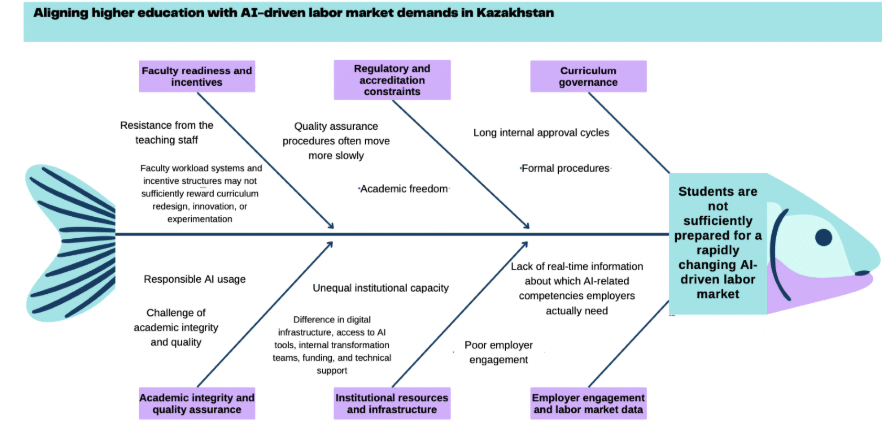
My evolving fishbone diagram
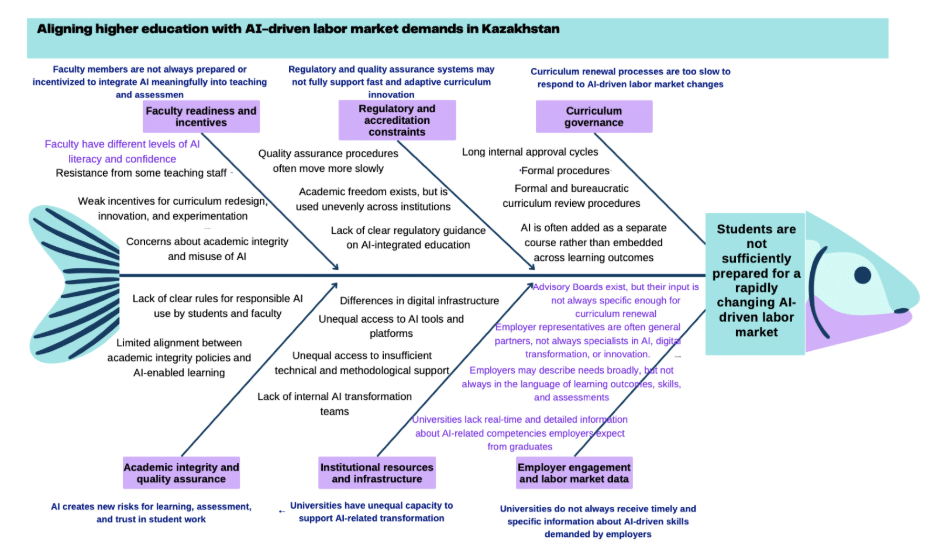
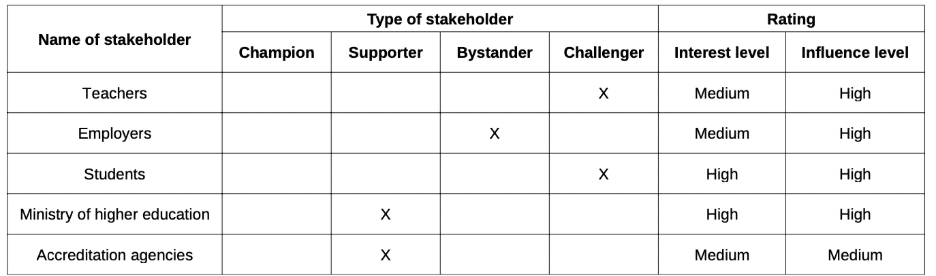
Moving from diagnosis to action
I decided to start with an existing mechanism at AlmaU: employer Advisory Boards.
My first assumption was that employers would naturally be interested in contributing to AI-related curriculum development. However, I discovered that interest in the topic did not always translate into active participation or concrete recommendations.
Instead of trying to implement a university-wide reform immediately, I narrowed the scope to one pilot: the Finance program within the School of Digital Technologies and Economics.
Together with our Career Center, we identified partner companies and invited representatives with experience in digital transformation, innovation, and AI. We prepared targeted questions and a survey to understand what competencies employers expect from graduates.
The Advisory Board meeting was initially delayed because of the summer vacation period. Eventually, we held it and received valuable recommendations.
I analyzed the discussion and survey responses and presented the findings to the pilot school. Together with the team, we developed a revised draft curricula for Finance at both bachelor’s and master’s levels.
In parallel, I worked with HR to develop a plan for strengthening faculty members’ digital and AI skills.
These are important steps, but they are not the end of the reform. We still need to implement the proposed changes and understand their impact on teaching and student competencies.
Five key lessons from my IPP journey
1. A policy is not the same as real change
In my experience, many reforms are implemented mainly to demonstrate formal compliance. Universities can approve new programs, introduce courses, and submit reports without necessarily changing what students learn.
The course helped me distinguish between producing policy outputs and building real institutional capability.
For my project, success is not simply having AI-related courses in the curriculum. It is developing the university’s ability to continuously adapt its programs as technologies and labor market needs change.
2. Do not jump to solutions before understanding the problem
As a senior university leader, I am responsible for making decisions and finding solutions quickly. PDIA taught me to spend more time diagnosing the problem, questioning my assumptions, and identifying realistic entry points.
The fishbone diagram and AAA analysis helped me understand where there was enough authority, acceptance, and ability to act.
Instead of beginning a large-scale reform, I started with one academic program and an existing Advisory Board. This made the challenge more manageable and created an opportunity to learn from practice.
3. Stakeholder engagement must lead to practical action
One of my biggest surprises was that even interested stakeholders could not always provide concrete recommendations. I learned that the quality of engagement depends on how we organize it. Simply inviting employers to a meeting is not enough. We need to ask focused questions, create a comfortable environment for discussion, and make it easy for people to contribute. Our Advisory Board meeting and survey helped us collect more useful input. But the real challenge was translating that input into curriculum decisions. This is where working closely with faculty and program leaders became essential.
4. Formal authority is important, but implementation requires relationships
As Vice-Rector, I already have formal authority over academic programs, faculty, and academic policy. However, the project required cooperation with units that do not report to me directly, including HR and the Career Center, as well as external employers.
I learned that authority alone does not guarantee ownership. Real implementation requires communication, trust, delegation, and the ability to bring people together around a shared problem. Through iterations, I was able to expand support beyond my academic team and involve colleagues from different parts of the university.
5. Learning and small wins are real progress
Before IPP, I was more focused on major outcomes and completed projects. This course helped me recognize the value of smaller steps: a new relationship, a useful conversation, a better understanding of the problem, or an idea that did not work as expected.
I also realized that I had rarely protected enough time for reflection. Now I want to make learning an explicit part of my implementation roadmaps. After each iteration, I plan to stop, review what happened, and adapt the next step. I no longer see reflection as time away from implementation. It is part of the implementation itself.
What comes next?
My immediate priority is to move from draft curriculum plans to implementation, while supporting faculty in developing the skills they need to teach and assess AI-related competencies.
I also see an opportunity to take this learning beyond AlmaU. Recently, I contributed a case about our university to a collection of essays: Universities After AI: Voices from the Global Frontier https://iaup.org/wp-content/uploads/2026/06/Universities-After-AI.pdf
In October, we are planning a meeting of the Rector’s Club: Central Asia+, which brings together universities from Central Asia. The meeting will focus on AI integration in higher education, and I plan to present the intermediate results of my project. I hope this will create opportunities for feedback, new partnerships, and possibly testing some of our approaches in other universities.
A final thought for fellow PDIA practitioners
If I could share one piece of advice with fellow practitioners, it would be this: do not wait for a perfect plan or immediate support from everyone. Start with a problem that matters. Find a small space where you can act. Engage people, listen carefully, and learn from what happens. And remember that a reform is not successful simply because it has been approved. Real success begins when people and institutions develop the capability to make change happen – and to keep adapting long after the original project is finished. I started IPP thinking about how to implement an AI-related education reform. I am finishing the program with a different understanding of my role as a leader.
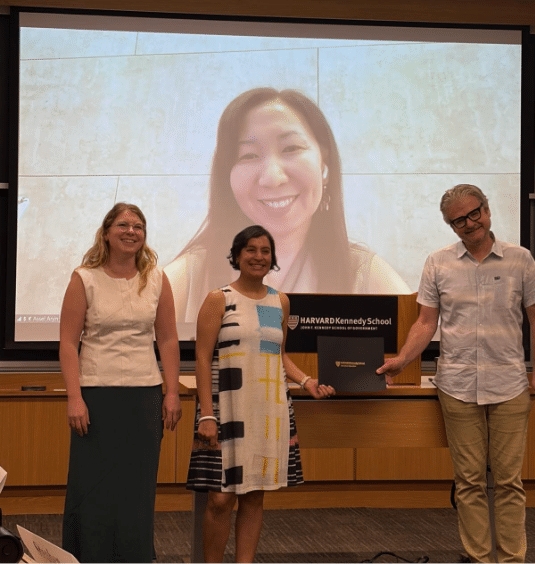
This is a blog series written by the alumni of the Implementing Public Policy Executive Education Program at the Harvard Kennedy School. 33 Participants successfully completed this 5-month hybrid program in September 2026. These are their learning journey stories.
De-risking Private Capital Investment in Addressing Energy Access Gaps in Rural Communities in Ethiopia
Guest blog by Stephen Kansuk, IPP ’26
With over 15 years of development work focused on Africa, I have been confronted with complex development challenges, especially those related to public policy implementation. While the organization I work for is arguably one of the leading international development organizations, equipped with excellent tools to address complex development challenges across Africa, we are still frequently confronted with systemic implementation challenges. These challenges can often be frustrating.
For this reason, I enrolled in the Harvard Kennedy School Executive Education Program on Implementing Public Policy (IPP) to better understand what the real challenge might be and the available tools to deconstruct this challenge.
At the beginning of the course, I thought Matt Andrews, the course director, would simply provide ideas and solutions to my implementation challenge. Instead, he repeatedly emphasized that “policy work is about people, not just about ideas or analysis.” Initially, I thought there was nothing particularly new about this statement. After all, my organization exists to improve the lives of the people we serve across Africa. However, as the course progressed, I realized that I had misunderstood what he meant. The Problem-Driven Iterative Adaptation (PDIA) process fundamentally transformed the way I think about public policy implementation.
One of the most important lessons I learned is that how we construct or deconstruct a policy problem largely determines the results we achieve. During the course, I worked on the implementation challenge: “Limited private capital investment in rural electrification is contributing to persistently low electrification rates in rural communities in Ethiopia.”
A key lesson from the program was the importance of asking the right questions. For example, instead of simply stating, “We need to provide electricity to all rural communities in Ethiopia,” the PDIA approach challenged me to ask why this matters and to whom. Through the fishbone analysis and related PDIA tools, I learned to apply the “Five Whys” technique to explore the deeper causes of the problem.
Asking these questions helped me break down the problem into its underlying causes and identify strategic entry points for action. However, among all the lessons from the course, iteration was perhaps the most significant for me. In my normal line of work, resource constraints often limit opportunities for repeated testing, learning, and adaptation with multiple stakeholders. As a result, there is always a risk of addressing symptoms rather than the real causes of a problem. The PDIA approach demonstrated the importance of continuous learning and adaptation throughout implementation. The fishbone diagram was central to uncovering the root causes of my implementation challenge. It pushed me beyond the energy sector and encouraged me to consider both supply-side and demand-side factors, as well as influences from other sectors.
I revised the fishbone diagram several times with colleagues from both Harvard Kennedy School and my workplace before arriving at the final version as show below.
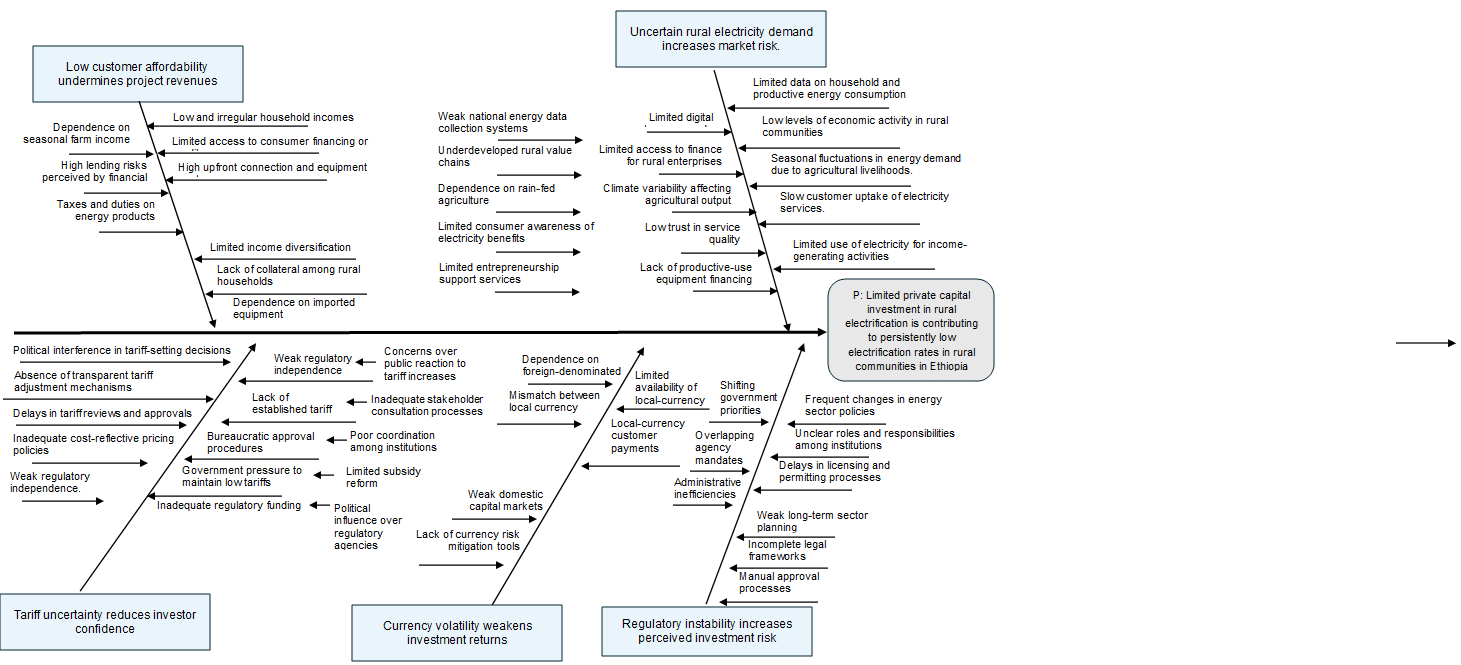
At first glance, the fishbone diagram was overwhelming. Before learning about PDIA, I never imagined that the causes of limited private capital investment in rural electrification could be so extensive and interconnected. Looking at the diagram, I almost concluded that the challenge was impossible to solve. However, Matt often reminded us that recognizing small wins and identifying entry points are critical in addressing complex problems. This insight leads to another important lesson I learned during the IPP program- Leads, Learning, and the Importance of Small Wins. In a busy and resource-constrained donor environment, there is often little incentive to report small wins. Authorizers and donors typically focus on final outcomes and major achievements rather than incremental progress. However, after engaging in discussions with peers and the course instructors, my perspective changed significantly. I now appreciate that in complex public policy challenges, meaningful results often take time to emerge. Progress is frequently achieved through a series of small steps rather than through a single breakthrough. Recognizing and learning from these small wins can help sustain momentum and build confidence among stakeholders.
The course also reinforced the importance of stakeholder engagement. If the implementation challenge is complex, then the stakeholder environment is equally complex. Effective stakeholder engagement cannot be treated as a one-time activity. It requires continuous assessment, adaptation, and reflection. Throughout the course, I learned to repeatedly ask: “Why does this matter, and to whom?
Through the PDIA process, I made important progress in identifying key authorizers and stakeholders both within and outside my organization who will be critical to advancing my implementation challenge. I have already begun engaging some of these external stakeholders to build relationships, understand their interests, and explore areas of collaboration. These early conversations have broadened my support base and helped identify potential opportunities for future action once formal authorization is secured.
Perhaps more importantly, the process helped me recognize that solving the challenge does not require addressing every issue identified in the fishbone diagram simultaneously. Instead, progress can be achieved by identifying feasible entry points, testing solutions, learning from results, and adapting accordingly.
The PDIA approach has fundamentally changed how I think about problem-solving. Today, I spend much more time understanding the problem itself before attempting to identify solutions. I believe these practices will help reduce the likelihood of addressing the wrong problem and improve the effectiveness of implementation efforts.
With the lessons learned from this course, I hope to gradually build support for incorporating PDIA principles into my organization’s project design and implementation processes.
This approach can strengthen authorization for addressing my implementation challenge while also promoting a more adaptive, learning-oriented, and problem-driven culture within the organization. I believe PDIA has significant potential to improve how development programs are designed and implemented, particularly in contexts characterized by complexity and uncertainty.
If I were to offer words of wisdom to fellow PDIA practitioners around the world, they would be these: Your team is your gift. Make use of that gift. Engage team members genuinely and with humility. Recognize and celebrate small wins. Be willing to learn continuously and adapt your approach. Most importantly, remember to care for yourself while addressing complex development challenges. Effective leadership requires personal well-being as much as professional commitment.
As part of my effort to care for myself, I have started taking my golf lessons more seriously.

This course has been a truly transformative learning experience and was worth every moment invested. It was never merely a theoretical academic exercise; rather, it provided practical tools and approaches directly relevant to public policy leadership and implementation.
The PDIA framework has changed the way I understand complex problems, engage stakeholders, and pursue implementation. Most importantly, it has shown me that meaningful progress often begins not with having the right answer, but with asking the right questions.
This is a blog series written by the alumni of the Implementing Public Policy Executive Education Program at the Harvard Kennedy School. 33 Participants successfully completed this 5-month hybrid program in September 2026. These are their learning journey stories.
Strengthening Legislative Oversight for Water Service Delivery in Public Schools in KwaZulu-Natal, South Africa
Guest blog by Dr. Mxolisi R. Mchunu, IPP ’26
One of my most important lessons from the Implementation and Problem-Driven Iterative Adaptation (PDIA) programme is that complex public-sector problems rarely have simple causes or straightforward solutions. My initial instinct was to analyse the problem carefully and identify the appropriate solution. PDIA challenged me to think differently: start somewhere, act, learn, adapt and act again.
The course taught me to distinguish between the problem itself, its causes, potential solutions and my own sphere of influence. Tools such as the fishbone diagram and the Triple-A framework helped me understand the problem more systematically while also forcing me to examine my own authority, acceptance and ability as a change agent.
I also learned that implementation is fundamentally about people. Building relationships, listening to frontline colleagues, communicating effectively, delegating responsibility and gradually building authorization can be as important as having a technically sound solution.
Perhaps most importantly, I learned to become more comfortable with uncertainty. In complex environments, waiting until everything is understood before acting can itself become a barrier to progress.
My implementation challenge focused on recurring water supply disruptions and prolonged water infrastructure failures in public schools in uMkhanyakude District, KwaZulu-Natal.
The problem has significant consequences for learners and educators, including compromised hygiene, unsafe learning environments, disruption of teaching and learning, and increased health risks.
My interest in the problem came from my professional role in legislative oversight. However, I deliberately did not define the problem as a failure of legislative oversight. Rather, I treated the water failures as the public service delivery problem and asked:
How can the KwaZulu-Natal Legislature strengthen its oversight function to improve the timely resolution of water supply disruptions and water infrastructure failures in public schools in uMkhanyakude District?
This distinction became important because it prevented me from assuming the solution before properly understanding the problem.
The process significantly changed my understanding of the problem.
My initial analysis focused largely on infrastructure and service delivery. Through successive iterations of the fishbone analysis, I identified a wider range of contributing factors: unclear accountability, fragmented information, weak coordination, limited technical capacity, procurement and resource constraints, slow response times, weak follow-through and inadequate monitoring.
Fishbone Diagram
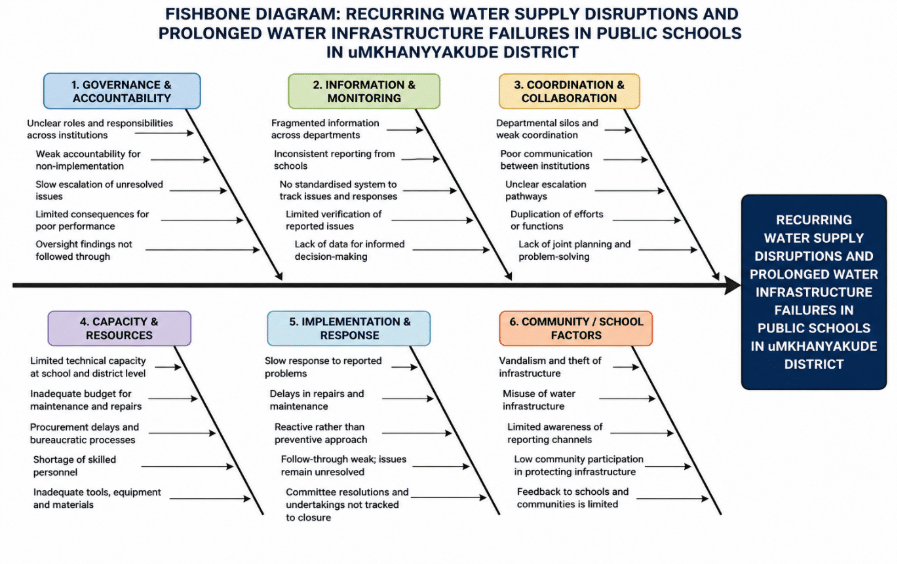
The subsequent iterations helped me see that the persistence of the problem was not only about whether infrastructure existed or whether resources were available. It was also about what happens after a problem is identified and reported: Who is responsible? What is the response? Is the response monitored? Who follows up? What happens when deadlines are missed? How is completion verified?
This insight led me to identify a practical entry point within my change space: the tracking and follow-up of legislative oversight resolutions.
I therefore developed a prototype Legislative Oversight Resolution Tracking System (LORTS). The intention is to record resolutions, identify responsible institutions, monitor deadlines, track responses, verify evidence and ensure that unresolved matters remain visible for further committee action.
Importantly, I do not regard LORTS as a finished solution. It is a small experiment designed to generate learning. Rather than attempting to reform the entire legislative oversight system immediately, I intend to test the approach using a small sample of committee resolutions, gather feedback and refine it through successive iterations.
The process also generated personal insights. I recognised that I sometimes retain too much responsibility because I want to ensure quality. The programme challenged me to delegate more deliberately and create opportunities for colleagues to contribute and take ownership.
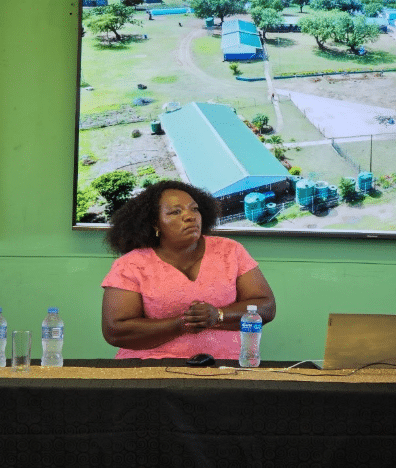

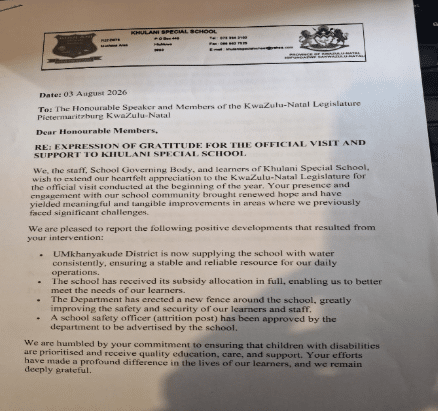
The photographs above capture different stages of the intervention: the Principal of Nkomo Special School briefing the Portfolio Committee and other stakeholders on the work undertaken; a multiparty delegation of Members of the Legislature participating in the oversight process; and a letter from the Principal of Khulani Special School thanking the Legislature for its intervention. Together, they illustrate how a long-standing service-delivery problem can begin to shift when evidence, stakeholder engagement and political oversight are brought together.
The water challenge at these schools had persisted for more than 15 years. Yet, following the Legislature’s intervention and coordinated engagement with the relevant stakeholders, the immediate water problem was resolved within a matter of weeks. This experience provided an important practical lesson for my PDIA journey: the existence of a problem for a long period does not necessarily mean that it requires an elaborate solution. Sometimes the critical issue is finding the right entry point, bringing the right actors together, creating accountability and maintaining follow-through.
The intervention was preceded by extensive preparatory groundwork by my colleagues and myself (Mxolisi Mchunu), who engaged key stakeholders—including the District Department of Education, the local Water Authority, the District Municipality, traditional leadership and local councillors—before briefing the Portfolio Committee. This reflected the PDIA principle of starting with the problem, understanding the system around it, engaging those closest to the problem and using that knowledge to identify practical action.
The Education Portfolio Committee subsequently conducted school oversight visits across uMkhanyakude District. Four special schools were selected as pilot sites to champion inclusive education and strengthen support systems in the district:
- Khulani Special School
- Nkomo Special School
- Sisizakele Special School
- Mpontshini Special School
For me, this experience brought PDIA to life. The process moved from listening, to understanding, to coordinating, to acting, and then to learning from the result. It demonstrated that effective oversight is not simply about identifying problems; it is also about creating the conditions for institutions to respond to them.
“The oversight visit did not begin at the school gate. It began with listening. Extensive preparatory work by Dr Mxolisi Mchunu involved engagement with the District Department of Education, the local Water Authority, the District Municipality, traditional leadership and local councillors before the matter was taken to the Portfolio Committee.”
The Portfolio Committee Chairperson and Team Leader, Hon. D. Mavimbela (Member of the Provincial Legislature).
This was consistent with the PDIA approach of starting with the problem, understanding the system around it and bringing different actors into the problem-solving process.
The Education Portfolio Committee subsequently conducted school oversight visits across uMkhanyakude District. Four special schools were selected as pilot sites to champion inclusive education and strengthen support systems: Khulani Special School, Nkomo Special School, Sisizakele Special School and Mpontshini Special School.
For me, these visits demonstrated an important PDIA lesson: formal oversight is more meaningful when it is grounded in the realities experienced by people at the frontline. The visits provided an opportunity to test what we had learned, listen to schools and communities, challenge our assumptions and identify where practical interventions could begin. This is the essence of an iterative approach—listen, understand, act, learn and adapt.
PDIA will change the way I approach complex problems.
In the future, I am less likely to begin by asking, “What is the correct solution?” Instead, I will ask: “What is the problem, what do we know about it, where is my change space, and what small action can generate useful learning?”
I will also pay greater attention to informal relationships and local knowledge. Formal reports provide important information, but people working directly within a system often understand its practical constraints and opportunities much better.
I will continue to use tools such as the fishbone analysis and Triple-A framework, but more importantly, I will apply the underlying PDIA mindset: iteration rather than perfection, learning rather than assumption, and adaptation rather than rigid implementation.
I am already applying the learning through the continued development of LORTS. My next step is to test the prototype with a small sample of committee resolutions and work with committee researchers and support staff to assess its practicality.
I will use the feedback and evidence generated from this pilot to refine the system and engage committee leadership and other relevant stakeholders. If the experiment demonstrates value, I will use the evidence to build authorization for broader adoption.
More broadly, I intend to apply PDIA to my work in legislative oversight, public finance and institutional development. Many of the challenges I encounter involve multiple institutions, competing priorities and limited resources. PDIA provides a practical framework for navigating this complexity without pretending that a perfect solution can be designed from the outset.
The approach is also influencing how I think about leadership. I am becoming more intentional about delegation, communication, prioritisation and self-care so that I can sustain my contribution over the longer term.
My advice is simple: do not wait for the perfect solution before you act.
Complex problems can be intimidating because they involve many causes, institutions and stakeholders. The temptation is to undertake more analysis, develop a comprehensive plan and seek complete authorization before taking the first step.
My experience has taught me that sometimes the better approach is to start small, act carefully, listen, learn and adapt.
Do not underestimate the value of a small experiment. A modest intervention can generate evidence, reveal hidden constraints, build relationships and create the authorization needed for something bigger.
I would also encourage practitioners to understand their own change space. You may not have formal authority to solve the entire problem, but you may have enough authority, acceptance and ability to influence one part of the system.
Finally, remember that implementation is not a straight line. There will be setbacks, resistance and unexpected discoveries. These should not necessarily be viewed as failures. In a PDIA approach, they are sources of information.
For me, the greatest lesson has been this:
Complex problems are not solved simply by having better answers. They are addressed by creating the conditions in which better answers can emerge through action, learning and adaptation.
My PDIA journey is therefore not ending with this programme. It is continuing with the next iteration.
This is a blog series written by the alumni of the Implementing Public Policy Executive Education Program at the Harvard Kennedy School. 33 Participants successfully completed this 5-month hybrid program in September 2026. These are their learning journey stories.
Building a Path to Land Consolidation in Azerbaijan
Guest blog by Gunay Novruzova, IPP ’26
One of the findings I highlighted in my notebook during the second week of the Implementing Public Policy program concerned how public-policy success is measured. It was mentioned that success can be assessed at two levels: whether an intervention delivers its planned outputs and whether those outputs produce lasting development outcomes. A 2018 study1 examined 416 World Bank projects, 387 of which had data on both measures. Only about 42% performed well in immediate project delivery while also facing relatively low risks to longer-term development outcomes. These figures are difficult to ignore, aren’t they?
As the program progresses, it becomes clearer why apparently successful interventions may fail to produce lasting outcomes. IPP encourages a balance between the natural impulse to move quickly towards solutions and a more deliberate effort to understand the problem first.
This reorientation — from solutions to problems — is the most fundamental shift the course produced. The Problem-Driven Iterative Adaptation (PDIA) approach, fishbone diagnosis, AAA analysis, and the discipline of iteration all reinforce the same insight: time spent understanding a problem is not wasted time.
The people in the room with their different perspectives, questions, and blind spots are not separate from the problem-solving process. Colleagues brought experience from different institutional contexts, questioned assumptions, and demonstrated how collective reflection can improve individual analysis. This is why one message from Matt and Salimah stayed with me: “Your team is your gift.” That was perhaps the most lasting learning of all.
My implementation challenge was:
How do you design an effective policy response to agricultural land fragmentation in Azerbaijan and establish oversight mechanisms that help implementation actors deliver the intended outcomes without having direct operational control?
Land fragmentation is not a single condition. It may refer to agricultural holdings composed of very small parcels, one farm operating several geographically scattered plots, or a single parcel divided among multiple legal or informal rights-holders. Fragmentation may also arise when ownership transfers and inheritance remain unregistered, or when the person cultivating the land differs from its legal owner.
As climate pressures intensify and global food markets become more volatile, fragmented landholdings make it harder to introduce modern technologies, improve production efficiency, and connect farmers to value chains.
Viewed in this way, land consolidation is neither an isolated land-management measure nor a complete solution. It is one possible instrument within a broader policy response. Before selecting the appropriate combination of instruments, however, it is necessary to understand how fragmentation develops and why it persists.
Working through the assignments clarified why land fragmentation persists even when its costs are visible. The fishbone analysis organized the drivers into four connected groups:
- Inheritance and intergenerational transfer: Division among heirs and increasingly complex co-ownership produce smaller parcels, multiple rights-holders, and harder collective decisions.
- Economic risk and attachment to land: Owners may retain underused parcels as security. Family history and fear of permanently losing an asset discourage transfer.
- Institutional sequencing: The post-Soviet land framework initially prioritized land distribution and the protection of newly established private ownership, while legal and institutional mechanisms for voluntary parcel reorganization developed more gradually — leaving limited procedures for parcel exchange, joint investment, and voluntary consolidation.
- Hidden and deferred costs: The costs of fragmentation often remain invisible until land is needed for finance, investment, or a formal transaction requiring clear ownership.
These drivers reinforce one another and allow fragmentation to continue across generations. The fishbone exercise made this system of mutually reinforcing constraints visible.
The fishbone is not a final answer. It is a living diagnostic: you return to it, revise it, and allow new evidence to make it more accurate.
Moving from the broad policy challenge to its practical implementation reveals a closely related issue: consolidation depends on reliable information about who owns and uses each parcel. Land registration makes fragmentation visible and enables it to be addressed, but registration is also shaped by incentives. People often register when a concrete transaction makes formal title necessary rather than in anticipation of a future need.
A related observation emerged from work on non-residential building permits: demand for registration often stayed dormant until another state transaction — a loan, a sale, an inheritance settlement — made formal title indispensable. This suggested that standard prescriptions (digitize, centralize, automate) address only part of the challenge. Processing capacity matters, but so do citizens’ incentives to initiate the process. The connection between formal systems and individual behavior became sharper through the fishbone exercise than through any prior analysis.
Once the problem had been decomposed, the next question was how progress could be supported when implementation responsibilities were distributed across institutions. The exercise clarified that oversight is not only a monitoring problem; it is also an alignment problem. Policies move from text to reality through people, and those people work under different mandates, incentives, and operational constraints.
This alignment challenge becomes visible in routine administrative decisions. A land surveyor determines when a site visit occurs; a registration officer decides whether a file is complete; a clerk identifies the precedent that may resolve a case. Michael Lipsky’s concept of street-level bureaucracy reminds us that citizens experience policy through such frontline judgements. Effective oversight therefore depends not only on performance information but on sustained engagement with the people whose decisions produce results.
Germany’s Flurbereinigung, the Netherlands’ institutional tradition, and experience from other countries show that consolidation is not a quick technical exercise. It requires iterative work, fair treatment of land rights, landowner engagement, and sustained institutional commitment.
Azerbaijan’s cooperation with the Food and Agriculture Organization of the United Nations to develop a National Land Consolidation Strategy, an initial village-level pilot, and the gradual construction of a legislative foundation illustrate what we call capability for policy implementation: not capacity declared before reform begins, but capability accumulated through doing. Pilots test assumptions, institutions learn to coordinate, and legislation gradually becomes specific enough to implement.
The recently adopted State Program in Azerbaijan for 2026–2030 on the development of agricultural production and processing establishes land consolidation as a national priority. The next phase covers 19 villages and approximately 20,000 hectares. International experience therefore provides valuable reference points, while Azerbaijan’s existing pilots and emerging framework provide the basis for developing a context-specific model. The next stage can build on experience already acquired and use implementation to refine that model further.

The photograph shows Khinalig, an ancient high-mountain village in Azerbaijan, surrounded by the demanding landscape of the Greater Caucasus. Known for its pastoral traditions, Khinalig is connected to highland summer pastures and lowland winter pastures by the 200-kilometre migration route. This cultural landscape was inscribed on the UNESCO World Heritage List.
Khinalig is not an example of land consolidation, but its transhumance system offers a useful lesson in coordinated land use. Its dispersed pastures function as a connected system through shared routes, water access, and community rules. This illustrates that addressing fragmentation does not only require merging ownership or creating larger parcels; it should also involve coordinating access, infrastructure, and land use so that separate areas function effectively together.
Three shifts offer a durable approach to implementation.
First, policy work should devote more time to diagnosis before moving towards solutions. PDIA shifts attention from predetermined solutions to binding constraints. Because each constraint may require a different response, every iteration should be adapted to local conditions.
Second, pilot projects should be treated as learning mechanisms rather than scaled-down versions of national programs. They should test assumptions about participation, valuation, coordination, disputes, and infrastructure benefits. Evidence should determine whether an intervention is expanded, redesigned, or discontinued.
Third, policy processes should pay as much attention to implementation actors as to the documents guiding their work. Frontline implementers belong in the learning process because they see where written policy encounters practical constraints. Understanding their mandates, incentives, and operational realities is part of policy design, not a separate matter to be addressed later.
The lasting lesson of IPP is that complex reforms cannot be delivered through plans and formal authority alone. They require careful diagnosis, iterative learning, institutional coordination, and attention to frontline implementation. The program may formally end, but its approach continues shaping how problems are understood, how implementation is supported, and how policy success is assessed throughout a professional journey.
Thank you to everyone who taught, challenged, debated, and shared throughout this program!
It has been one of the most honest professional experiences – not because it gave me answers, but because it gave me better questions and the confidence to stay with them!
This is a blog series written by the alumni of the Implementing Public Policy Executive Education Program at the Harvard Kennedy School. 33 Participants successfully completed this 5-month hybrid program in September 2026. These are their learning journey stories.
Violence prevention against children in Portugal
Guest blog by João Duarte, IPP ’26
When someone says “I don’t know”, I have learned that it can mean one of two things – either that person didn’t do their homework, or he or she is wise enough to realize the little we all actually know. It requires humility, but also a big dose of courage. And that’s how this course started. It makes you realize, or better yet, makes you admit to yourself that most probably the problem you were trying to solve is too complex for you to know it all already.
That was my case.

Violence against children is a multi-sectoral issue, interconnected with pretty much everything, deep within society, cultures, customs that many times start even before a child is born. Bringing a preventive approach to a whole system with decades that was designed to just respond when violence happens is not an easy task.
Any methodology that starts with the problem is obvious. One of Einstein’s most famous quotes is exactly about that. We intrinsically know its importance. But PDIA (Problem Drive Iterative Approach) takes it to a whole new level. It pushes you to dissect the problem incessantly, diligently, almost as an obsession. The more I dug, the more I understood how little I knew about the vastness and complexity of the problem I was trying to solve.
My first feeling was overwhelming. I was flooded with a deep sense of being impostor, maybe even incompetence. How come I don’t know in depth the problem I am trying to address? I have come to realize I know so little about it, and the more I dig, more complexity I find. That’s where the fishbone comes in handy.
You don’t solve a problem by yourself, so you need to frame it in a way that it is important for others to care. Again, one of those details that Matt and Salimah highlighted incessantly, that can completely shape the success of your approach.
So, with a problem well framed and a skeleton of a fish, each bone with a sub-cause of the problem, you start to have a broader view of the pieces of the puzzle. After dozens of tries, there you are looking at your fishbone, proud that you view the problem in full, only to wonder, ok, now I understand it a bit better, but how the hell do I go about it?
When I analyzed the change space of each sub-problem and understood which stakeholders I have most chances to engage in successfully, that was like a revelation.
For so long at my organization we knew we were advocating for the right change, the best public policy within a specific area, backed by solid evidence, yet we were not being listened to. So, we kept shouting and shouting louder, not few times with little success. This analysis gives you a prioritized strategy of engagement. That’s gold.
But the Social Affairs State Secretary or the Health Ministry are crucial to address this problem, how can we not approach them right away? My inner voice, screaming inside my head.
And, as if Matt could listen to my insides crying out in revolt, he would naturally and calmly explain, like he always does, that by building legitimacy and/or increasing authorization with other stakeholder elsewhere, we are building or increasing change space in very same places that we wanted to enter. We just need to be strategic. And nurture in ourselves vast reserves of patience.
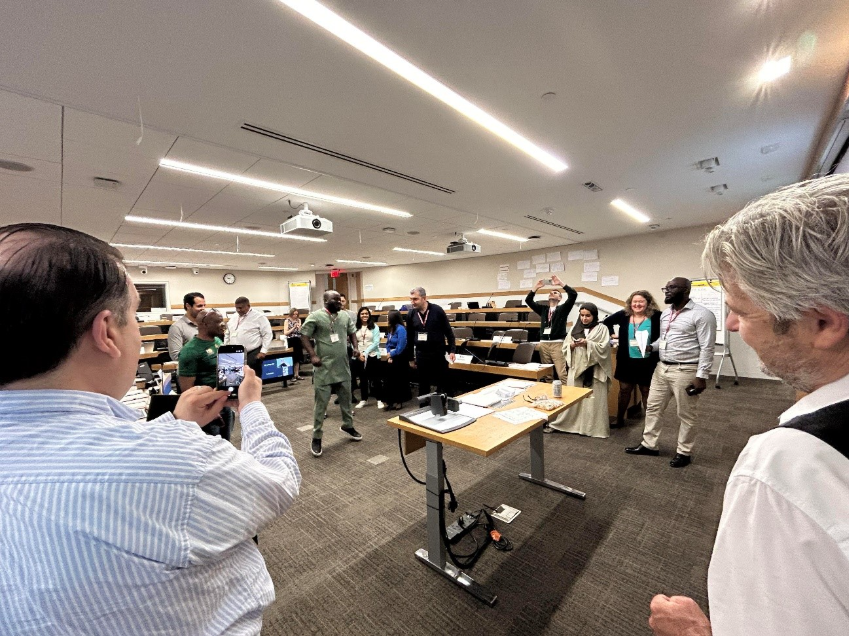
(When you realize that a paper airplanes competition helps you better understand public policy implementation.)
Moving onwards, you finally found the entry points and started to engage, learn more in depth about the problem, expand your authorization, but even with patience, it’s taking forever already… how do you keep up? The answer was as simple as annoying.
Small steps. Really? Our whole lives we were being told about thinking big and here, in public policy, where you change the course of a country, we think small? More or less. Think big, start small. And the small will get slightly bigger, and bigger and if you build legitimacy with the functionality (sorry for the PDIA jargon), you open up a whole new world of opportunities to actually solve the problem.
And with small steps, comes small wins. And small wins fuel motivation because it gives you a heightened sense of progress.
Once I heard that the way to eat an elephant is by cutting it into pieces. Well, PDIA teaches you pretty much that. My sense of frustration by the hindered progress, by the not moving the needle, dissipated. Well, not fully, but I started to get, week by week, a sense of moving forward, of achievement. That’s another perk of PDIA.
Small steps are tied with learning, or at least should be, because only by understanding the problem can you solve it. So small steps can mean having a brief call with a child protection system specialist. Ring that mid-level social security officer that deeply knows the system. Or go on a field visit to a foster care, and talk to the specialists feeling all the ripple effects of public policies in the front lines, daily. And in doing so you not only learn about the granularities of the problem you are addressing but you also increase your authorization. You co-create with people within the system. You create an army of allies.
Organizations that don’t learn stagnate and die, so building an organization that uses learning as a KPI seems obvious right? PDIA takes that very seriously, with learning logs (can be just an excel sheet), simple but effective approaches that I am already using with my team.
The last extremely useful perspective of PDIA is about authorization. You do nothing by yourself. Either you are leading and organization, in the middle of it or you need to engage with peers at the same level in other entities, you need legitimacy to move things forward. By understanding (and pushing) the authorization space you have within your organization, and by engaging with other organizations to expand it too, that’s going to be key in what you are going to achieve. That was a big lesson and made me understand my authorization space within my organization, but upwards and downwards, and how can I push it, slowly, to be more effective at what I do.
This course is about public policy, but it could be about anything, really. It’s so obvious that is annoying, I have to say. It’s so obvious, so well supported by grounded evidence, that it’s disruptive. Above all it connects a lot of pieces that were missing, at least in my mental puzzle.
If master Yoda taught public policy implementation, this might have been what he taught.
This is a blog series written by the alumni of the Implementing Public Policy Executive Education Program at the Harvard Kennedy School. 33 Participants successfully completed this 5-month hybrid program in September 2026. These are their learning journey stories.
Connecting higher education with the labor market in Uzbekistan
Guest blog by Sardor Jakbarov, IPP ’26
When I started the Implementing Public Policy (IPP) program, my problem seemed relatively clear: how can we better connect higher education with a changing labor market and help graduates transition successfully into employment?
Uzbekistan has already made important progress in this area. According to the Graduates Quality Index published by our Agency, 83% of 249,432 graduates from the 2025 graduating cohort were employed, with an average time to employment of 2 months and 27 days. These are encouraging results. At the same time, employment rates alone cannot tell us everything about how well higher education responds to employers’ changing needs.
Working in higher education quality assurance, I initially approached the issue mainly through educational programs and employment outcomes. My logic was straightforward: if universities better understand what employers need, they can continue improving their programs and graduate preparation.
During IPP, however, my understanding of the problem became broader. I realized that the question is not only what universities teach, but also how universities and employers interact, exchange information, and turn that information into decisions.
One of the first steps was to deconstruct the problem rather than jump directly to a solution. My fishbone analysis identified eight interconnected causes, ranging from stakeholder coordination and employer engagement to feedback mechanisms, Career Centers, governance, incentives, and shared responsibility for graduate employment outcomes.
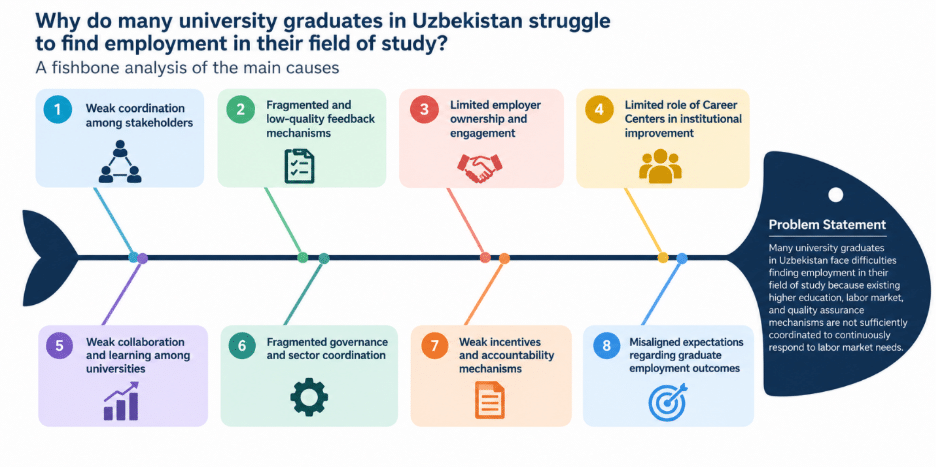
The fishbone helped me see the problem as a system of interconnected factors rather than a single curriculum or skills problem. But PDIA also taught me that a diagram is only a starting point. The assumptions behind it need to be tested through action.
One of the most important lessons I learned from PDIA was not to jump too quickly from a problem to a large solution. Instead, we began by testing our assumptions through small actions.
We started with a pilot employer survey in two universities. During the pilot, compiling reliable employer contact lists proved more challenging than expected. This highlighted the practical importance of maintaining active and up-to-date employer networks.
This small experiment became an important turning point for me.
Formal mechanisms for cooperation already existed. Universities had Career Centers, organized internships, and worked with employers. The pilot encouraged us to look beyond the existence of these structures and ask a different question:
How can these relationships become more continuous, systematic, and useful for improving education?
We decided to continue the experiment and launched the National Employer Survey, initially focusing on employers of university graduates.
Scaling up became an implementation challenge of its own.
We wanted to use telephone interviews, but introducing this approach required not only a sound methodology but also authorization. I engaged experts from the World Bank, UNESCO, and professional survey and research organizations. Their recommendations helped us improve the approach and, equally importantly, build additional credibility for the proposed method.
We eventually mobilized more than 150 volunteers to conduct telephone interviews with employers across the country.
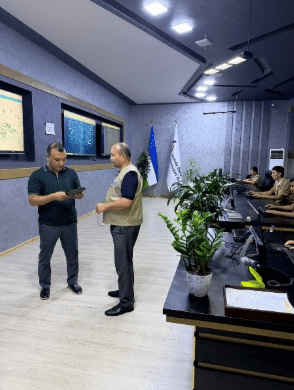
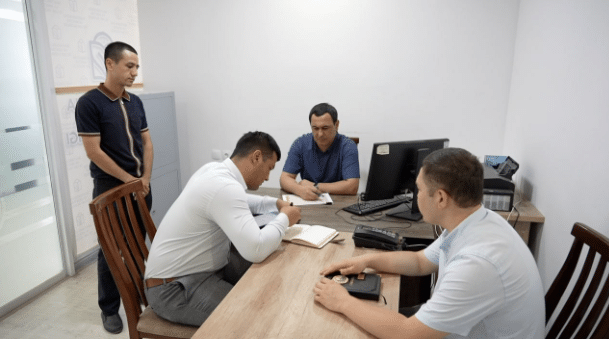
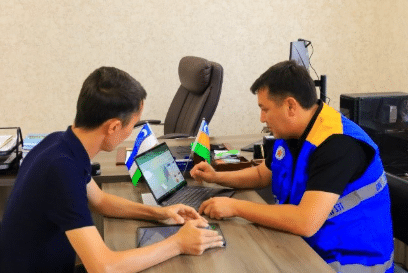
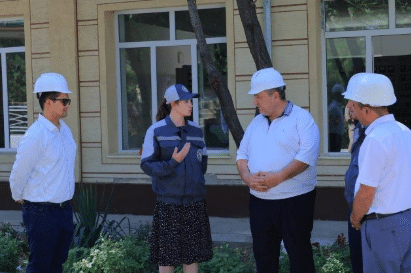
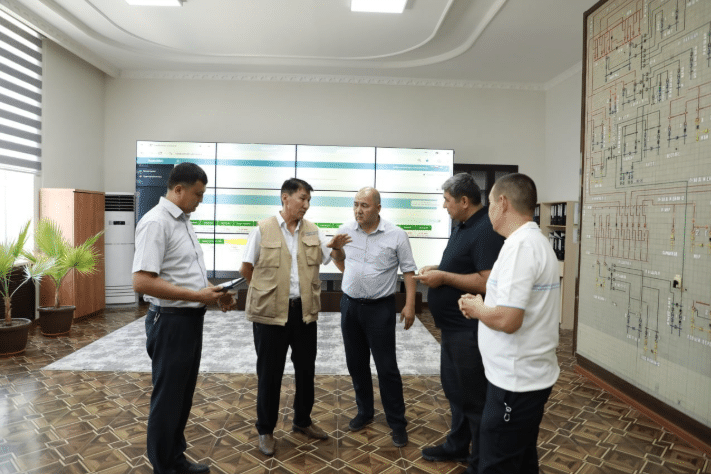
The preliminary results illustrate the scale of the effort. We made 13,412 attempts to contact employers and completed 2,988 successful interviews — 22.3% of all attempts. Employer contact lists were provided for 158 of 170 universities, and at least one successful interview was completed for 155 universities.
But these numbers taught me something else.
We started the survey to learn about the relationship between higher education and the labor market. Yet the practical experience of reaching employers, maintaining contact information, explaining the purpose of the survey, and encouraging meaningful participation became another source of learning.
For me, this demonstrated an important PDIA principle: sometimes the process of collecting evidence teaches you as much as the evidence itself.
The preliminary findings provided a more nuanced picture than I had expected.
Among the 2,988 employers interviewed, 52.9% reported an ongoing relationship or cooperation with the relevant university. Another 18.2% reported engagement through internships or practical placements without an ongoing relationship, while 26.7% reported no ongoing relationship.
These findings suggest considerable opportunity to make university–employer engagement even more continuous and systematic.
Importantly, the employers in the survey were not simply commenting on higher education in general. They were evaluating specific graduates whose work they knew directly.
This reinforced the importance of looking beyond formal cooperation mechanisms and understanding how employer engagement works in practice and how feedback can be translated into institutional improvement.
Perhaps the most interesting finding was one I did not expect.
I thought the survey might reveal a clear problem with the overall quality of graduate preparation. Instead, employers generally evaluated graduates positively.
For example, 93.3% rated graduates’ performance of practical work tasks as good or very good/excellent, while 86.6% gave these ratings to graduates’ overall readiness for professional work.
In addition, 76.7% of the graduates assessed were working mainly in a field related to their university qualification, with another 13.4% working in a partly related field.
These were encouraging findings, but they also reminded me of an important implementation lesson: we should not approach a problem with predetermined conclusions.
At the same time, employers identified areas where further improvement would be valuable. When asked what universities should improve first, 40.8% selected more practical skills training, 28.3% selected strengthening graduates’ ability to apply theoretical knowledge to real work tasks, and 21.6% selected stronger professional knowledge.
There is an important lesson here.
An employer can be satisfied with a particular graduate while still seeing opportunities to strengthen the system that prepared that graduate.
This is why complex policy problems should rarely be understood through a single indicator.
Another important part of my IPP journey was deciding to go into the field myself.
I visited three regions of Uzbekistan and conducted face-to-face interviews with employers.
These visits changed how I think about data.
A table can tell you what is happening. A conversation can often help explain why.
The field visits showed me that meaningful employer participation requires clear communication about how their feedback will be used. They also highlighted the importance of maintaining current employer networks and building trust with respondents.
We therefore began using television and other media not simply to publicize the National Employer Survey, but also to explain its purpose and why employer participation matters.
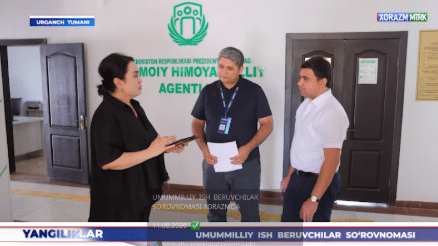
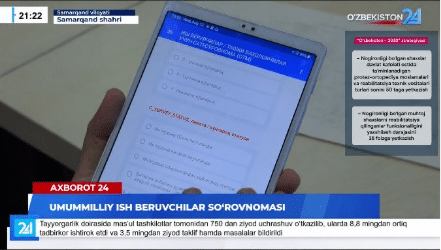
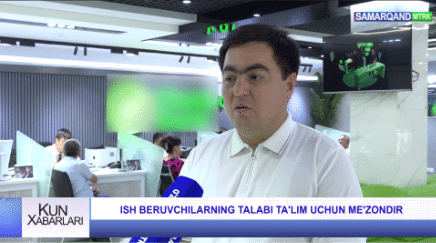



This taught me that communication is not always a supporting activity in implementation. Sometimes communication is part of implementation itself.
Another finding made me think about the problem dynamically.
When employers were asked which competencies would become most important over the next 3–5 years, the leading categories included modern digital technologies and the ability to use artificial intelligence and digital assistants at work. Employers also highlighted the ability to learn new technologies quickly, creativity, and specialized software.
When hiring graduates, they emphasized professional knowledge, digital skills and specialized software, and the ability to work with modern equipment. Among transferable competencies, responsibility and discipline, teamwork, and communication stood out.
This points to a broader lesson.
Labor-market alignment is not something an education system can “solve” once. Even when current employment outcomes are encouraging, technology, occupations, and employer expectations continue to evolve.
The challenge is therefore to build the capacity to listen continuously, learn continuously, and adapt continuously.
At the beginning of IPP, I was asking:
How can we better align graduate preparation with labor-market needs?
Today, my question is different:
How can we create a sustainable mechanism through which employers and educational institutions interact regularly, feedback is translated into decisions, and the system adapts as labor-market needs change?
We have completed the first phase of the National Employer Survey and moved into analysis. The next phase will focus on employers of vocational college graduates.
The opportunity now is to connect different sources of evidence. Administrative data such as the Graduates Quality Index can tell us about employment outcomes and the transition from graduation to work. Employer surveys can add another perspective: how graduates perform in the workplace, which competencies employers value, and how those needs are changing.
Together, these tools can help move us from simply measuring outcomes toward continuous learning and improvement.
Before IPP, I often thought about implementation as moving from a problem toward a solution.
Now I see it as:
Problem → small action → feedback → learning → new relationships → adaptation → next action.
I also think differently about progress. Previously, my main question was: What did we accomplish?
Now I add two more:
What did we learn? And what new relationships or opportunities did this action create?
My understanding of leadership has changed as well. A leader does not always need to arrive with the solution. Sometimes the role is to connect people, build authorization, create space for experimentation, go into the field, listen carefully to evidence, and be willing to revise the original hypothesis.
Our experience in Uzbekistan has given me one lesson that I believe may be useful elsewhere:
Do not build a feedback mechanism simply to collect data. Build it so that every iteration helps you understand the problem better, strengthen relationships among the actors, and improve the next action.
Our National Employer Survey began as a way to better understand the relationship between graduate preparation and labor-market needs. Along the way, it became something more: an opportunity to strengthen dialogue between those who educate graduates and those who employ them.
My main takeaway from IPP is therefore simple:
Do not fall in love with your original explanation of the problem. Fall in love with the process of learning about it.
Sometimes the most valuable result of implementation is not proving that your original assumption was correct. It is finding evidence, relationships, and experience that allow you to ask a better question — and take a better next step.
Note: Survey findings presented in this blog are preliminary. Final calculations may vary by 1–3 percentage points.
This is a blog series written by the alumni of the Implementing Public Policy Executive Education Program at the Harvard Kennedy School. 33 Participants successfully completed this 5-month hybrid program in September 2026. These are their learning journey stories.
Reducing Violent Crime and Addressing Homelessness in Albuquerque, New Mexico
Guest blog by Raul Bujanda, IPP ’26
One of the biggest lessons I learned from the Implementing Public Policy program is that understanding a problem is very different from being able to solve it. In public safety, we are used to identifying a problem, developing a plan, assigning resources, and expecting results. That approach works when the problem is fairly clear and the solution is known. It becomes much harder when the problem involves human behavior, politics, limited resources, different agencies, and competing expectations from the community.
The PDIA process forced me to look at the problem differently. Instead of immediately asking, “What is the solution?” I learned to spend more time asking why the problem exists and what is keeping us from making progress.
Another important lesson was the value of breaking large problems into smaller pieces. Violent crime, homelessness, behavioral health, addiction, repeat offenders, and public disorder are connected, but they cannot be solved through one initiative. Trying to solve everything at once can actually make implementation harder. Smaller interventions give us an opportunity to learn what works, what does not, and what needs to change before expanding an approach.
My implementation challenge focused on reducing violent crime and improving public safety in Albuquerque while developing a realistic and humane approach to homelessness, behavioral health, and visible disorder.
As Executive Director of Public Safety for the City of Albuquerque, I work across the Albuquerque Police Department, Albuquerque Fire Rescue, Albuquerque Community Safety, and the Office of Police Reform. I quickly realized that many of the challenges we face do not belong to one department.
A person experiencing homelessness may interact with police, firefighters, emergency medical personnel, community safety responders, hospitals, treatment providers, courts, and nonprofit organizations, sometimes repeatedly. At the same time, neighborhoods and businesses expect the City to address crime and disorder and keep public spaces safe.
The problem was not simply a lack of effort. A major part of the problem was coordination. Each organization could be doing its job while the overall system was still not producing the outcome we wanted.
The fishbone exercise was probably one of the most useful parts of the course for me because it forced me to move beyond the symptoms of the problem.
Our analysis identified several contributing areas: coordination and governance, the justice system, homelessness and behavioral health, staffing and resources, data and technology, and community and environmental conditions.
That helped me see that what initially looked like a crime problem was also an implementation and coordination problem.
For example, police can arrest a repeat offender, but the long-term outcome may depend on prosecutors, courts, treatment providers, housing availability, or other organizations outside the police department. Similarly, Albuquerque Community Safety can connect someone experiencing homelessness with services, but if appropriate treatment or housing is unavailable, that individual may return to the same location and the same circumstances.
The Triple-A analysis also helped me think differently about what I could realistically influence. I had authority to bring APD, AFR, ACS, and the Office of Police Reform together, but authority alone did not guarantee results. We also needed acceptance from employees, community partners, elected officials, businesses, service providers, and other stakeholders. Finally, we needed the ability, including staffing, technology, data, services, and operational capacity, to actually carry out what we were asking people to do.
Our early iterations reinforced this. We began looking at specific locations and operational problems rather than discussing homelessness or crime only at the citywide level. One example involved examining conditions around Robinson Park and bringing APD and ACS together to better understand what was happening and what each department could realistically contribute.
That experience led to another important lesson. We needed clearer short-term objectives. Saying we want to “reduce homelessness” is not an operational objective. Asking what we can change at a specific location over the next 24 hours, week, or month creates something we can act on and measure.
That thinking has carried into our broader approach to problem locations. Instead of simply moving people or increasing enforcement temporarily, we are looking at the entire environment: crime, repeat calls for service, behavioral health needs, outreach, property conditions, businesses, and the physical environment. We can then bring the appropriate departments and outside partners together, assign responsibility, measure results, and adjust.
The process also showed me how much we still do not know. My earlier analysis identified uncertainty around long-term coordination, political and organizational support, staffing, technology, data sharing, and our ability to adapt quickly. I no longer see those unknowns as a reason not to act. They are reasons to start small, learn, and adjust.
The biggest change for me is resisting the urge to immediately develop a large solution.
My background in law enforcement taught me to assess a problem, establish objectives, develop a plan, and execute it. I still believe strongly in accountability and execution. PDIA does not replace those principles. It adds another step before them.
I now spend more time decomposing the problem and asking what we actually know, what we assume, and what we still need to learn.
I also think more about whether we have enough authority, acceptance, and ability to implement an idea before launching it. A good idea without those three things can become another plan that looks good on paper but never produces sustainable results.
I am already using the approach in Albuquerque.
We are bringing departments together more consistently, focusing on specific problems and locations, and asking what measurable change we expect from the resources we deploy. I want our teams to become comfortable testing an approach, evaluating the results, and changing direction when the evidence tells us something is not working.
That requires a different leadership mindset. Changing a strategy should not automatically be viewed as failure. If we learn quickly and use that information to improve the next iteration, the process is working.
I also want to continue breaking down the silos between public safety agencies and our external partners. Police, fire, community safety, prosecutors, courts, behavioral health providers, housing organizations, businesses, and community groups all see different parts of the same problem. Bringing those perspectives together gives us a better chance of understanding what is actually happening.
My advice is simple: do not wait for the perfect plan.
Public sector leaders are often expected to have answers. Sometimes the better approach is admitting that we do not yet know enough and creating a process that helps us learn.
Start with the problem. Break it down. Talk to the people closest to it. Look at the data, but also understand what is happening on the ground. Identify what you can control and where you need partners. Try something small enough that you can see whether it works. Measure it. Learn from it. Then adjust.
I would also encourage practitioners not to underestimate relationships. Many implementation problems cross organizational boundaries. Authority can get people into a room, but relationships and trust are what keep them working together when things become difficult.
Finally, stay focused on outcomes rather than activity. In government, it is easy to measure how many meetings we held, how many people we contacted, how many calls we answered, or how many operations we conducted. Those numbers matter, but they are not the final measure of success.
The better question is whether conditions actually changed for the people and communities we serve.
That is probably the most important lesson I will take from this program. Complex problems will not be solved by one leader, one department, or one plan. Progress comes from understanding the problem, taking action, learning from what happens, and being willing to adjust until we begin producing better results.
This is a blog series written by the alumni of the Implementing Public Policy Executive Education Program at the Harvard Kennedy School. 33 Participants successfully completed this 5-month hybrid program in September 2026. These are their learning journey stories.
Implementing Healthy Meals in Abu Dhabi Workplaces
Guest blog by Nouf Albadi, IPP ’26
When I started the Implementing Public Policy program, I came with a challenge that sounded simple: How can we improve access to healthy food in Abu Dhabi workplaces?
As a public health nutritionist, I naturally looked at the challenge first from a technical perspective. We know what healthier food should look like. We can develop nutrition standards, guidelines, and policies. But throughout this course, I learned that having a technically strong policy does not mean that it will be successfully implemented.
Implementation is about people. It is about understanding the problem, building authority, creating acceptance, strengthening ability, communicating effectively, and continuously learning and adapting.
That has been one of my biggest lessons from this journey.
Many employees in Abu Dhabi spend a large part of their day at work. With long working hours, meetings, busy schedules, and easy access to food delivery applications, the workplace becomes an important environment where daily food habits are formed.
When healthy choices are difficult to find, while less healthy options are convenient and easily available, people may repeatedly choose what is easiest.
Over time, these small daily choices matter.
Obesity and related noncommunicable diseases are important public health concerns in Abu Dhabi. For me, this means that improving health cannot depend only on telling people to “eat healthier.” We also need to look at the environment around them.
My implementation challenge therefore became broader than simply introducing healthy meals. It became:
How can we successfully implement the Healthy Meals at Workplaces Policy across Abu Dhabi by creating stakeholder ownership and acceptance while coordinating implementation across multiple government entities?
This change in the way I defined the challenge was itself part of my learning during the course.
One of my most important learnings was how to break down a complex problem.
At work, we sometimes face a large problem and immediately start thinking about the final solution. The course taught me to slow this process down. Instead of asking, “How do we solve everything?”, I learned to ask what is actually causing the problem and which parts of it we can realistically influence.
Developing and repeatedly reviewing my fishbone diagram helped me do this.
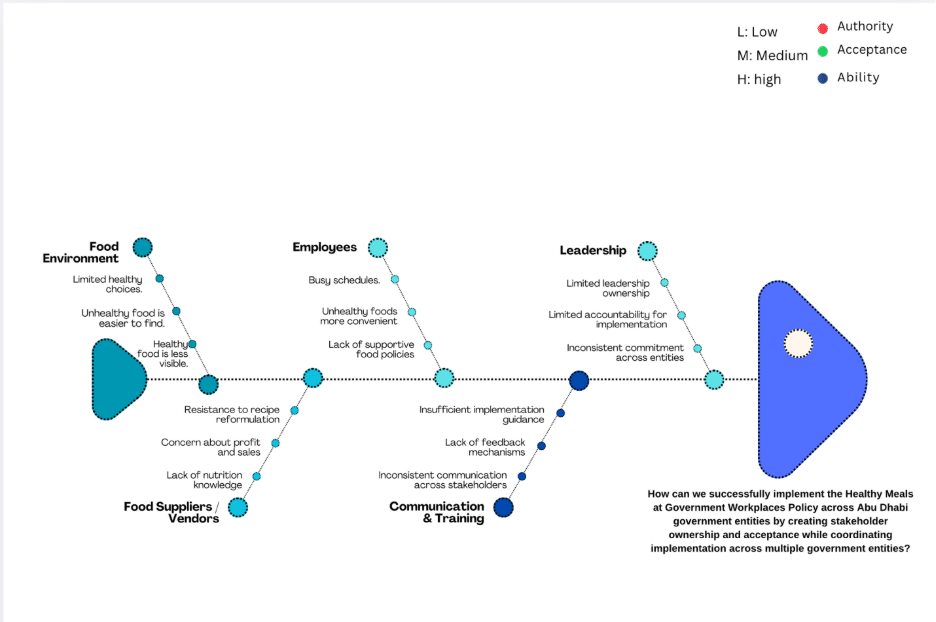
My fishbone identified several interconnected causes: the food environment, employees, food suppliers and vendors, communication and training, and leadership. Under these were smaller issues such as limited healthy choices, unhealthy food being more convenient, supplier concerns about sales, limited nutrition knowledge, insufficient implementation guidance, inconsistent communication, and limited leadership ownership.
Seeing the challenge this way helped me understand something important: there was no single cause and therefore there could not be a single solution.
The Authority, Acceptance and Ability framework helped me go one level deeper. A solution might technically work, but do we have the authority to implement it? Do the stakeholders accept it? Do they have the ability and resources to implement it?
This changed how I approached the problem.
My biggest progress was not only in the policy itself. It was in how I approached implementation.
At the beginning, I was approaching the challenge mainly as a nutritionist. As the course progressed, I started looking at it more as an implementation problem.
For example, I realized that the people authorizing a project do not always need or understand all the technical details that I work with every day. If I present a problem as extremely complicated, with many technical barriers and requirements, I may unintentionally make the solution appear impossible.
Instead, I learned to break the challenge into smaller and more understandable pieces and communicate what matters to each audience.
This connected strongly with the 4P leadership framework. I learned that Projection matters: rather than presenting the initiative only as a policy that organizations must comply with, I can frame it around improving employee health, wellbeing, and productivity. I also learned the importance of People: listening to government entities and food suppliers, understanding their concerns, and developing practical solutions together rather than only explaining technical requirements.
Another important lesson was learning how to communicate upward to authorizers.
In a government environment, information moves through different levels. I learned that communication needs to be simple enough for senior decision-makers to quickly understand the issue, while still providing the evidence and technical information they may need. In one of my assignments, I reflected that executive summaries can be useful, but important information can sometimes be lost as a message moves through an organizational hierarchy. I therefore started thinking more carefully about how to communicate the main message while keeping supporting evidence available.
I also learned that progress is not always a final result.
During my journey, I started looking at learning and leads as indicators of progress. In June, I learned that a strong policy alone was not enough and that authority, ability and acceptance all influenced implementation. In July, I identified technical limitations and expanded discussions with other partners. In August, I learned how multiple levels of authorization could slow implementation. By September, one of my main lessons was how important it is to maintain momentum while waiting for decisions.
This helped me appreciate that implementation is rarely a straight line.
How will this change the way I tackle problems in the future? Before jumping to a solution, I will first ask:
What part of this problem is actually within my authority? What can I influence? Who else has authority? Do the people involved accept the proposed change? And do they have the ability to implement it?
This sounds simple, but it changes how I work.
Instead of trying to solve a large problem at once, I can break it into smaller components, identify where I have space to act, test a small intervention, learn from it, and then decide what to do next.
I also learned not to depend only on formal authority. Throughout the course, I saw that authorization can grow through trust, communication, relationships, and demonstrating progress. My own reflection was that authorization is not simply receiving formal approval; it is also about building support throughout implementation.
This is particularly important when working across several government entities where no single person controls every part of implementation.
I am already applying these lessons to my work.
I am communicating more intentionally with stakeholders instead of focusing only on technical requirements. I am trying to understand their concerns before proposing solutions. I am also thinking more carefully about how I communicate progress to management and authorizers.
Most importantly, I am trying to make implementation a shared responsibility rather than the responsibility of one person.
The course also made me think differently about delegation and sustainability. A program should not depend entirely on one individual. Knowledge, capability, and ownership need to be shared so that implementation can continue even when people or leadership change.
This became very real during the course when changes in leadership meant that relationships with authorizers sometimes needed to be rebuilt. Our peer-learning discussions reinforced that implementation progress is not always linear and that changes in leadership and priorities can affect progress. What we can control is how we respond: rebuilding relationships, listening, adapting, and finding small opportunities to continue moving forward.
If I could share one lesson with other public policy practitioners, it would be:
Do not wait until you have the perfect solution to start implementing. Break the problem into smaller pieces, understand where you have authority and where you need others, take one practical step, learn from it, and keep adapting.
As technical professionals, we can sometimes become very focused on creating the perfect policy, guideline, or solution. But implementation happens through people.
Listen to the people who will implement the policy. Understand the people affected by it. Communicate differently with technical teams, managers, and senior leaders. Build relationships before you need them. And do not underestimate small progress.
For my own challenge, the ultimate goal remains simple: make the healthy choice easier for employees.
But my understanding of how to reach that goal has completely changed.
A healthier workplace will not be created by a nutrition guideline alone. It requires leadership ownership, capable suppliers, supportive food environments, informed employees, good communication, and coordination across organizations.
That is what implementation means to me now.
This is a blog series written by the alumni of the Implementing Public Policy Executive Education Program at the Harvard Kennedy School. 33 Participants successfully completed this 5-month hybrid program in September 2026. These are their learning journey stories.
The Deficit Show: We Keep Watching, but Don’t Act
Written by Matt Andrews
The third in a series of blog posts by Matt Andrews on U.S. federal debt and the capabilities needed for fiscal governance.
Note: all images were generated using ChatGPT.
In the previous post, I asked why the federal debt struggles to become a problem we act on together as a nation. I focused on Marshall Ganz’s familiar questions, Why this? Why us? Why now?
Unfortunately, I suggested that each question runs into a different difficulty:
- Why this? Reducing the deficit sounds appealing until it becomes a choice about a particular tax or program. People can picture the higher tax bill they might receive or the service they might lose. They can also picture what they would rather protect: retirement benefits, healthcare, defense, schools or infrastructure. General agreement that borrowing should fall does not tell us which of those commitments to change.
- Why us? Responsibility is easy to place elsewhere. Politicians can blame another party or an earlier administration. Citizens can blame politicians while opposing changes to their own taxes or benefits. These accounts may each contain some truth, but they can leave everyone waiting for somebody else to act.
- Why now? Action brings visible costs to people living and voting today. Continued borrowing postpones part of the bill. Its costs arrive gradually, through interest payments and reduced room for future choices, often in places that do not immediately look like part of the federal budget. There is nearly always a reason to say that this is the wrong moment to make a difficult change.
In sum, the US debt situation sets us up with a fundamental tension. We can all see it, and have strong feelings about it. Sometimes its hard to look away. But looking and doing are two different things.
A Reality TV Show?
In reflecting on this, I have come to liken the situation to a reality television series, The Deficit Show.

Imagine it showing a family struggling with its finances. Each episode, an expert sits them down and explains that their debts are growing faster than their income. The bills arrive. Family members argue about who spent the money, who failed to earn enough and who ought to give something up. Viewers take sides. Then comes the episode that promises to change everything. Someone announces a tough new budget. Someone else storms out. A cupboard is cleared, a subscription cancelled, perhaps a prized possession sold. It makes compelling television. We can see the conflict and the sacrifice. At the end of the episode, everyone says the family has finally faced its problem.
The next season opens with another stack of bills.
The comparison is uncomfortable because it captures something about how most Americans—including political leaders—seem to engage with the reality of federal finances. A debt-ceiling confrontation or a public spending cut commands attention. It offers characters, conflict and a moment that looks decisive. The less dramatic question—whether the government’s recurring commitments and revenues are coming into balance—receives far less attention. Different viewers applaud different interventions. When the annual accounts arrive, the underlying problem is still there.
Where are we in the show?
So where are we in the story? To start answering, let’s look at the most recent completed fiscal year, asking how much the federal government spent beyond its income, and what has happened to bills from prior seasons. If we titled the episode based on such data, we might call it, How exceptional borrowing has become a new normal.
The current episode’s title derives from what I see in the figure below, which shows the federal deficit as a share of GDP since 1990:
- In the latest completed episode—fiscal year 2025—the government collected about $5.23 trillion and spent about $7.01 trillion.
- It borrowed the $1.78 trillion difference—approximately 5.8% of overall U.S. GDP.
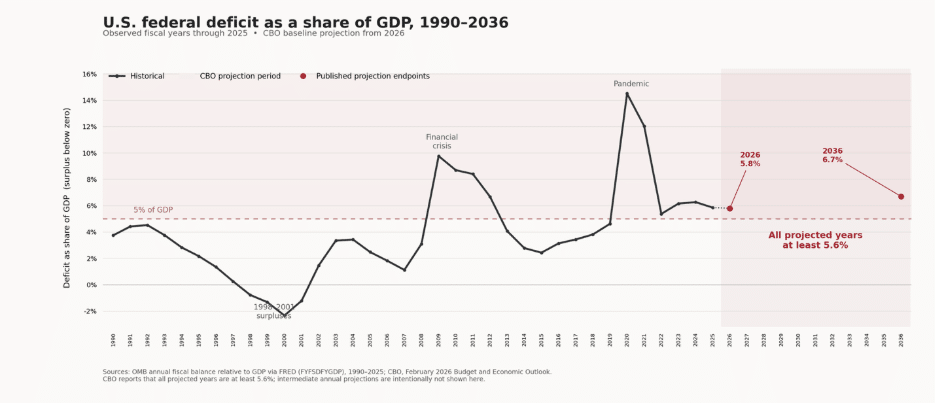
Those numbers are difficult to picture, so let’s widen the camera and allow a more textured comparison:
- First, consider that the entire construction industry in the United States contributed roughly 4.4% of GDP, and the information industry (including tech) contributed about 5.5% of GDP. That means that the federal government borrowed more in one year than the construction and tech industries added (separately) to the economy.
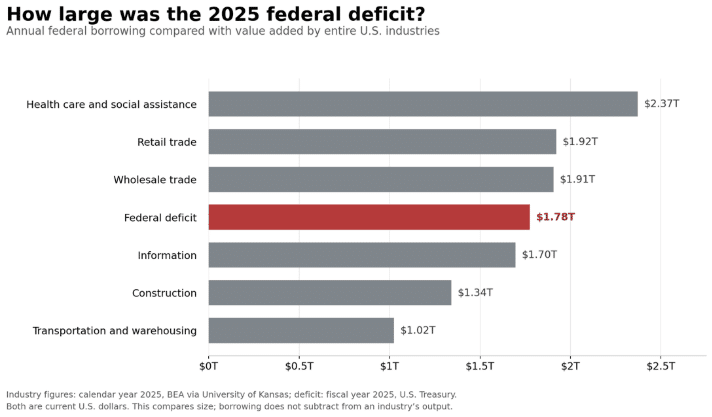
- Looking further afield, we can compare this to other countries. In an IMF-based ranking of national GDP for 2025, only 15 countries produced more in the entire year than the U.S. federal government borrowed in the same year. The US deficit was nearly as large as South Korea’s economy and larger than the annual output of Turkey, Indonesia, the Netherlands and Saudi Arabia. Note that I’m not saying the deficit was equal to these countries’ deficits; the deficit was equal to the size of the countries’ economies.
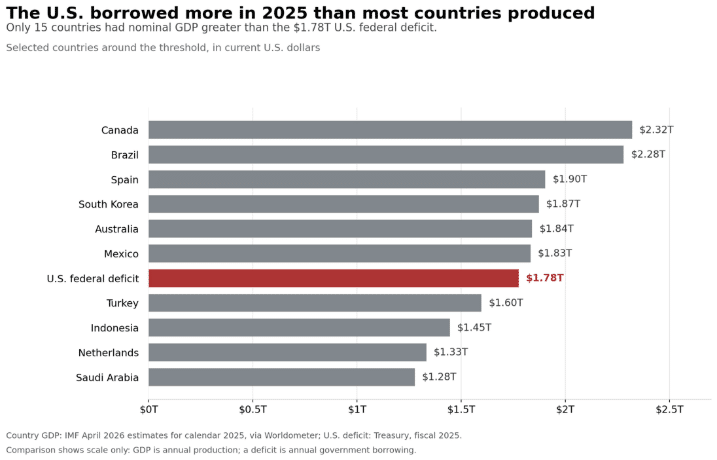
It is also useful to reflect on how the current instalment of this deficit show compares with past seasons, especially recognizing that the US has seen deficits above 5% before. This happened in prior seasons that were characterized by dramatic events, however, with the deficit jumping above 5% during the financial crisis in 2009 and again during the pandemic in 2020 (for instance).
But the plot seems to have changed since 2020. The Covid emergency has passed, but borrowing continues as a norm and not an exception. We see this in that the deficit exceeded 5% of GDP in all six fiscal years from 2020 through 2025. This happened in just five years between 1947 and 2019.
The advance preview of future seasons offers little reassurance. The Congressional Budget Office (CBO) projects deficits of at least 5.6% of GDP every year from 2026 through 2036.
If that forecast holds, the run of deficits above 5% of GDP will last 17 consecutive years. Future decisions could change the projection. But CBO is not assuming a decade of recession to produce these figures: it expects unemployment to remain below 5% throughout the period. Borrowing at a level once associated with emergencies has become the expected result under ordinary conditions.
These figures would make a startling reveal at the end of any television episode. Yet we have seen so many reveals that another large number may hold our attention only until the next scene. We tend to be more captivated by the tension of conflict.
Episodes that captivate us
Two recent episodes had all the ingredients needed for great viewing: recognizable characters, high stakes, public confrontation and a moment that looked decisive. Different viewers cheered at different points. The test, though, came after the cameras moved on. What changed in the accounts?
The showdown
In 2023, the deficit story became a suspense episode. The United States had reached its debt ceiling. The Treasury used temporary measures to keep paying the government’s bills, while President Biden and House Speaker Kevin McCarthy faced a deadline. Each meeting brought another round of cameras and commentary. Would they make a deal? Would the United States default?
The confrontation made compelling television. Biden and McCarthy disagreed over whether spending cuts should be a condition of raising the debt ceiling. Viewers could follow the arguments, count the days, and choose a side. It was harder to see that the debt ceiling concerned payment of obligations already incurred. Avoiding default would keep the family paying its bills; it would not, by itself, balance spending and income.
The negotiations produced the Fiscal Responsibility Act. It suspended the debt ceiling and capped some discretionary spending for two years. The Congressional Budget Office estimated that the agreement would reduce projected deficits by about $1.5 trillion over 2024–2033, relative to its earlier baseline. This was a real change in the expected borrowing path. It was also a ten-year estimate, not a plan to balance the annual budget.
Then came the familiar reality-TV ending: the confrontation was resolved, the principal characters claimed their victories, and attention moved on. The quieter question—what did the deal actually do to the family’s finances?—received much less attention than the fight itself.
When the next annual accounts arrived, the fiscal year 2024 deficit was about $1.8 trillion, roughly $138 billion higher than in 2023. That increase does not mean the agreement failed: the deficit might have been larger without it. It does mean the deal addressed only part of the imbalance. We watched the showdown closely. We paid less attention to the result. The family was still spending far more than it brought in.
The chainsaw
The next season gave the show a prop. In February 2025, Elon Musk walked onto a conference stage holding a chainsaw given to him by Argentina’s President Javier Milei. The crowd cheered. Here was a promise to cut government that could be understood in a single image.
The scenes that followed were just as vivid. The Trump administration moved to dismantle parts of the federal government, like the U.S. Agency for International Development. Foreign aid contracts were terminated; employees cleared their desks. To some, this looked like overdue action against wasteful spending. To others, including aid workers and organizations whose programs stopped, it was deeply alarming. People watched the same episode and saw either a government finally willing to make cuts or one destroying work it did not understand.
The conflict held our attention on news sites. But the question for this series is what happened to the deficit. A cut can be enormous for the people who depend on a program and still be small relative to the federal budget.
Reuters examined spending at agencies affected during the early DOGE period and found about $19 billion less spending—roughly 0.5% of total federal outlays over the comparison period. When the fiscal year 2025 accounts arrived, the deficit was still high—at $1.78 trillion—the current 5.8% of GDP.
The debt-ceiling showdown and the chainsaw drew different audiences and different reactions. Both involved decisions with real effects. Yet in each case, the most watchable question was who would win the confrontation? The less watchable question came afterward: Did recurring revenue and spending move into a relationship the country can sustain?
Reality television gives us a new conflict each episode. Fiscal governance requires us to keep looking when the drama is over.
The bill arriving between episodes
While we watch the confrontations, another part of the story advances with little drama. Every year, the interest bill arrives. It is the cost of borrowing undertaken in earlier episodes, and it must be paid alongside everything the government wants to do now.
In 2025, federal net interest cost $970 billion—about $2.66 billion a day. That exceeded the $917 billion spent on the national defense budget function. Interest claimed 18.5 cents of every dollar the federal government collected.
| Fiscal year | Net interest | Interest per $1 of federal revenue |
| 2015 | About $223 billion | 6.9¢ |
| 2025 | About $970 billion | 18.5¢ |
This is more than four times the annual interest bill of a decade earlier, in current dollars. The share of revenue going to interest has grown from about seven cents to more than eighteen cents per dollar. Those are two views of the same pressure: the bill has grown, and paying it takes a much larger portion of what the government collects.
This is money raised today to pay for yesterday’s borrowing. An interest payment does not renew a road, support a new discovery or prepare a community for the next disaster. Congress can still choose to fund those things, but it must do so while meeting the interest bill. If revenue does not cover both, the government has to borrow again, adding to the bills future budgets will face.
The scene is easy to miss because nothing visibly closes when an interest payment is made. There is no showdown, no chainsaw and no crowd to cheer or protest. The payment simply goes out. Yet each year it leaves less of today’s revenue available for tomorrow’s needs.
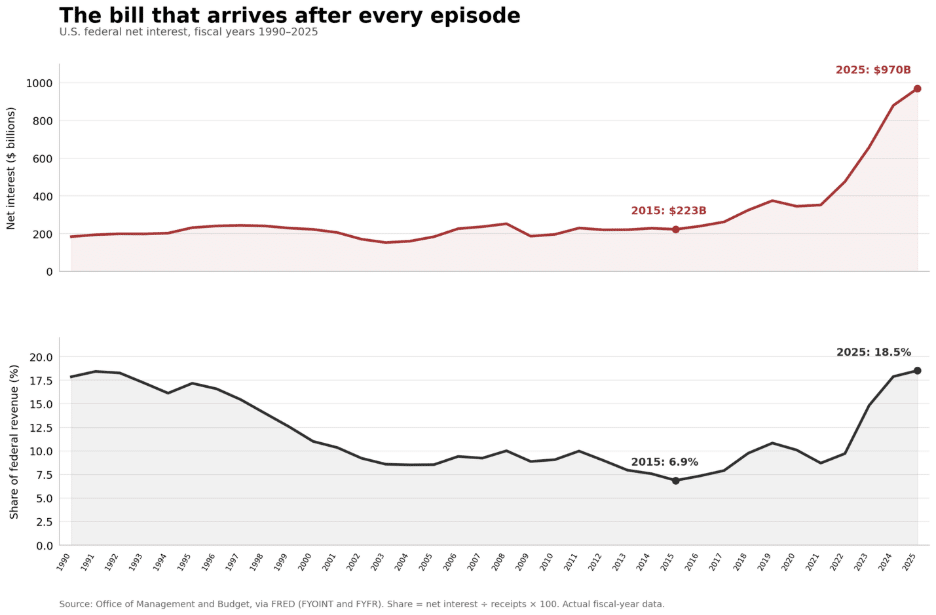
Where the Deficit Show now leaves us
The showdowns have subsided in our ongoing Deficit Show, and the chainsaw scene is long gone. But the country’s accounts are still open, and the latest figures tell us where the story stands. In 2025, the federal government borrowed roughly one quarter of what it spent, paid more in net interest than it spent on national defense, spent about $805 billion more than it collected (before paying interest), and incurred debt exceeding 5% of US GDP.
The current episode sits uncomfortably in the overall series: The federal government deficit has exceeded this 5% level of GDP in all six years since 2020—having surpassed the level only five times between 1947 and 2019. The Congressional Budget Office expects deficits above 5% of GDP every year through 2036. What was exceptional is now normal.
These are the realities that remain after the dramatic scenes we all watch on live TV, and that we will have to pay attention to at some point. Yet the attention is still lacking, ostensibly because the show offers other entertainment: follow the confrontation, cheer or condemn the intervention, then wait for the next shocking figure.
We know how to be an audience. We have been less willing to ask what it would take to change the family’s finances. That is the unsettling thing about The Deficit Show. We keep watching, but do not act. Every year we watch becomes part of the next year’s bill.
In the next post, I will look at recent experience in other countries where similar shows have unfolded. Their experiences cannot tell us exactly what will happen in America. They can, however, show what happens when fiscal room narrows without any treatment—and why it matters to make choices to change while those choices still remain.
This is the third in a series of posts examining the United States federal debt through the lenses of governance and state capability. To read more in this series, see Post 1 (A $40 Trillion Puzzle: Why Has the United States Failed to Address Its Federal Debt?) and Post 2 (Everyone Says the Debt Is a Problem. So Why Is It Not a Priority?).
A Gold Ring Cannot Fix a Hospital: Two Stories of Incentivizing the Wrong Problem
Guest blog by Prarthna Dayal
A gold ring to encourage women to deliver in public hospitals.
Yes. The Government of Tamil Nadu, a state in India has announced exactly that. The states’ new Thaimaman Thanga Mothiram Thittam scheme will provide a one-gram gold ring to babies born in government hospitals, aiming to encourage families to choose public facilities – in a state where 99.7% of births already happen in health facilities. The scheme has an annual allocation of ₹755.83 crore (USD 78.8 million).
The problem that the Tamil Nadu government is solving for is a steady drift away from government hospitals which are free, towards private ones, where care can cost 6-8 times more.
There is nothing inherently wrong with using incentives in public policy. The problem comes when an incentive is used to solve a problem whose causes lie elsewhere.
If families are willing to pay many times more for a private delivery, what are they paying for? Perceived differences in quality, cleanliness, responsiveness, waiting times, privacy, dignity, availability of staff and medicines, or simply trust in the care they receive. A gold ring resolves none of these deficiencies in public hospitals.
The instinct to hand someone a benefit or a subsidy rather than fix what’s broken underneath, is pervasive in how we often approach development. It has appeal to both politicians and the public. There are many examples of this from across countries in Asia and Africa where cash transfers to women to deliver in facilities led to increased utilisation but did not address the fundamental quality issues plaguing these facilities. There is a powerful attraction to policies that are immediate, visible and tangible. The gold ring is only the latest version of the same reflex. The alternative—reforming a public health system—is much harder.
That’s why it was heartening to see the Government of India’s Parliamentary Standing Committee on Health and Family Welfare recently released Report on Affordability and Accessibility of Healthcare Facilities in the Public and Private Sector making a strong case for exactly this harder path: systematic investment in public-sector infrastructure to strengthen the capacity of Community Health Centres, District Hospitals and state-run medical colleges to deliver dependable emergency obstetric and paediatric care. If we want people to choose public hospitals, we have to make public hospitals work.
But money alone doesn’t translate into better functioning services. Public hospitals are notoriously resistant to reform – across high-income, low-and middle-income contexts alike – even when reforms offer economic incentives, like hospital autonomy or pay-for-performance.
I looked at this conundrum recently – of why economic incentives built into reforms don’t always translate into action? Specifically, why public hospitals in a resource-constraint setting were not interested in engaging with a strategic purchasing reform which would provide an additional source of revenue to improve their functioning?
What surprised me was public hospital leaders either claiming they had sufficient funds or blaming junior contractual staff for non-performance and engagement with the scheme. This response was striking given how chronically underfunded public hospitals are known to be. Either longstanding resource constraints had become normalised, or that hospital leaders were consciously distancing themselves from the additional revenue.
The real explanation for their disinterest in the extra money lay not in the incentive itself, but in how existing institutional relationships, structures and patterns of behaviour in the public sector determined whether that incentive was seen as worth pursuing at all.
First, existing resource shortages – understaffing, poor infrastructure, unreliable electricity – combined with what were considered tedious processes, made lodging claims genuinely challenging. Doing it required initiative and experimentation – to align hospital systems to obtain required information and complete the paperwork – that were not in tune with how hospital leaders were used to working. They were used to following routine administrative procedures to execute budgets, not being entrepreneurial or investing additional effort to generate revenue.
Second, there was a risk attached to getting the money and no incentive to take the risk of using it, and in fact every incentive not to. They operated in an institutional environment marked by low trust and punitive means of oversight. This intersected with an absence of a performance management system that recognised their utilisation of funds to improve services, making risk avoidance a rational choice. As one government official put it, “Everyone is scared of scrutiny….and zero penalty for not doing anything but potential penalty for doing something.” There was an absence of incentives for public hospital leaders linked to hospital improvement.
Third, externally contracted staff and parallel implementation structures – set up presumably to work around an under-resourced bureaucracy – instead enabled everyone with real authority to disown responsibility by being able to lay blame elsewhere, often on the contractual staff with no power to change anything.
Inaction, in other words wasn’t a failure of individual motivation. It was a socially embedded disposition produced and reinforced by fragmented governance arrangements and weak accountability, misaligned incentives, challenging processes, resource and capacity constraints, and institutionalised patterns of behaviour.
This points to a deeper pattern in policymaking: reforms are too often designed on simplistic economic assumptions — that economic incentives carry a fixed, self-evident value and people respond predictably to them, regardless of context.
Health systems are social systems. Reforms have to work through existing institutions, organizational cultures, relationships, and power structures. They have to be understood and acted upon by the people expected to implement them.
These learnings could help inform countries like India as they embark on investing in their public hospitals. Below are a few suggestions:
- Integrate new initiatives with existing programmes and structures rather than simply adding another layer – so that responsibility is aligned with authority.
- Involve the people actually delivering services in defining problems and designing solutions – to build real ownership.
- Create monitoring systems that generate feedback and learning—and genuine incentives for improvement – simply identify failure and assign blame.
- Be willing to adapt when policies do not work as intended.
This is slower, harder work – it demands long-term commitment and a willingness to address the root of a problem, not a glittery gift wrap around it.
A gold ring might attract attention. A functioning public health system is harder to gift.