

Using PDIA to Address Confidentiality Risks in Papua New Guinea
Guest blog by Elly Toimbo, Joyce Maru, Rose Walen, Renat Muruket, Delwyn Dau and Dellah Maiak
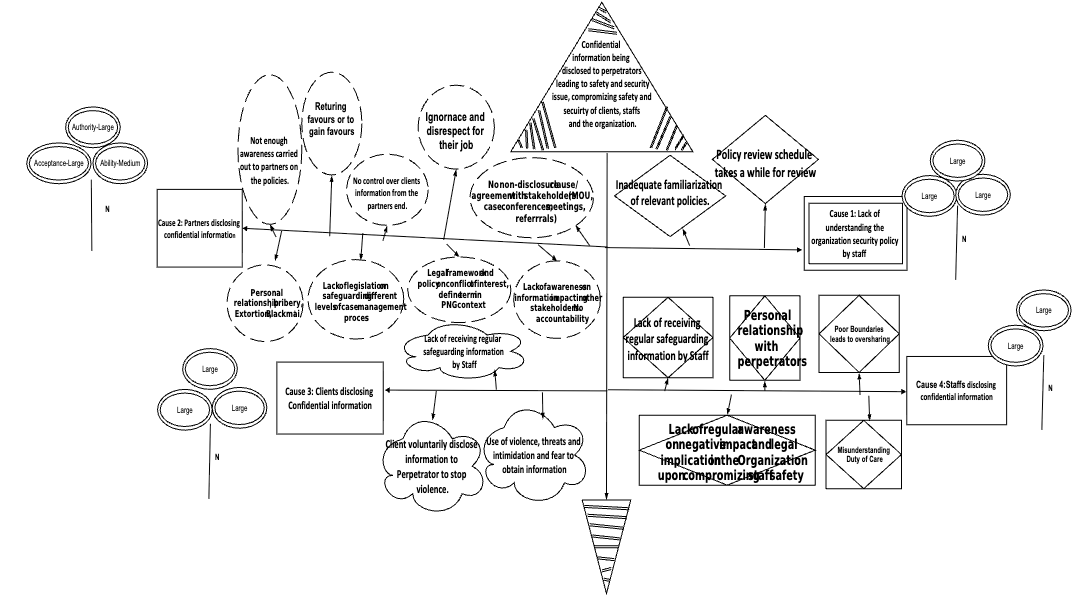
We addressed the issue of confidential information being disclosed to perpetrators, which created serious risks. This breach compromised client trust, organizational integrity, and compliance with policy, while also endangering the safety and security of clients, staff, and the organization.
Confidentiality breaches are complex, with multiple interacting causes. Through PDIA, we learned that breaking down the problem, testing small solutions, and adapting iteratively not only reduced risks but also strengthened staff ownership and organizational culture. Each attempt was a win, building capacity and trust.
To address the issue of confidential information being disclosed, we used tools such as the fishbone diagram, triple AAA analysis, iteration worksheet, and check-in tool to identify gaps and missing links. Practical actions included:
- Policy reminders: Reading one clause from the HR and security policies during morning staff security meetings, emphasizing the importance of confidentiality and consequences of breaches. Staff appreciated the reminders, shared supporting statements, and reflected on past incidents.
- Safe House engagement: Shared the approach with the Safe House Manager, who implemented daily policy clause readings with staff and clients. This sparked discussions and even led to incident reporting, showing increased awareness.
- Addressing related issues: Policy reminders also resolved other project concerns, such as staff cancelling overlapping leave requests after being reminded of leave procedures.
- Building relationships: Collaboration with the Safe House Manager strengthened relationships and reinforced shared responsibility for preventing breaches.
- Authorization and leadership support: The CEO endorsed the steps and recommended expanding them to all project meetings, tailoring clauses to specific groups, and posting the code of conduct and policies visibly in conference rooms.
Applying PDIA showed that small, practical steps—like daily policy reminders— can spark dialogue, build ownership, and strengthen organizational culture. Progress was achieved not only in reducing confidentiality risks but also in improving relationships, accountability, and trust across the organization.
PDIA Key Learnings
- Personal growth & teamwork: Complex problems require collaboration with partners, authorizers, and diverse perspectives. A guiding constitution strengthened team commitment and ownership.
- Problem analysis & skills: Learned to break down issues into root causes and sub-causes, sharpened reflection and decision-making, and ensured evidence-based solutions.
- Addressing complexity: Recognized that sensitive or unknown problems demand adaptive thinking, collective effort, and iterative approaches.
- Contributing factors & adaptability: Mapped interacting causes, adjusted when solutions fell short, and embraced adaptive management.
- PDIA mindset: Progress is iterative—every attempt builds capacity, learning, and legitimacy.
- Techniques & tools: Applied Fishbone diagrams, “5 Whys,” iterative adaptation cycles, authorizing environments, and diffusion strategies to scale local solutions
Applying the PDIA approach will definitely change the way we tackle work across staff management, logistics, case management, administration, finance, and HR. While these areas are challenging, PDIA tools help reduce overthinking, stress, and anxiety by providing a structured way to address problems:
- Focus on root causes: Begin with the real problem rather than jumping to solutions.
- Iterative mindset: Test small steps, learn, and adapt continuously.
- Evidence-based decisions: Ensure solutions truly fit the causes and context.
- Shared ownership: Engage staff and partners actively in problem analysis and solutions
This approach reshapes how we see and address problems in the future. We sincerely thank TVI and Harvard for making this course available. its structure and delivery provided an in-depth understanding of why many developing countries face persistent challenges, and showed that PDIA is a practical, effective way to solve them.
What will remain unchanged?
- Commitment to confidentiality: Protecting sensitive information remains a core principle.
- Policy framework: Organizational policies and compliance standards continue to guide practice.
- Ethical standards: Survivor-centred and trauma-informed values stay constant
Reflection on our Journey
Our journey with PDIA has been self-transformational, especially in our role as middle managers. Working in humanitarian contexts is complex — we face challenges not only in helping survivors seek safety, protection, and justice, but also in managing internal staff issues.
Using PDIA tools, we were able to address day-to-day challenges more effectively. For example, when staff were applying for more than two days of annual leave per month against policy, we used a simple step: reading the HR policy clause during staff meetings. This clarified misunderstandings, and staff began applying for leave correctly.
PDIA also helped us tackle personal problems. By constructing and deconstructing issues and using tools like the fishbone diagram, we identified causes and sub-causes. One staff member discovered why she was overspending and withdrawing from savings, and is now working on addressing those sub-causes.
This experience showed us that PDIA is not only for organizational challenges but also for personal growth. Sharing these tools with our admin team and staff can help them solve financial and relationship problems, and we plan to train others using the same module.
Words of Wisdom for Fellow PDIA Practitioners
- Celebrate small wins: Each incremental step builds momentum. Don’t underestimate the power of modest victories in shifting systems.
- Foster shared ownership: Sustainable change comes when teams, communities, and authorizers feel the solution belongs to them.
This blog was written by participants who completed a 12-week PDIA for PNG online learning program from August – November 2025. 44 participants successfully completed this program.