

Continuing Professional Development in Saudi Arabia’s Sports Sector
Guest blog by Mazna AlMarzooqi, IPP ’25
When I began the Implementing Public Policy (IPP) course, I expected tools, frameworks, and case studies. What I gained went far beyond that: I learned how to reframe problems, work iteratively, and see “progress” not as final results but as a series of learnings and leads that build momentum.
Three insights stood out:
- Problem-driven iteration matters. Big policy challenges rarely yield to a single reform or blueprint. Breaking them down into smaller, actionable problems allowed me to generate traction where before I felt stuck.
- Learning and relationships are progress. Unlike conventional reporting, which emphasizes outputs and deadlines, I saw the value of treating learning (what we discover) and leads (who we engage) as legitimate indicators of forward motion.
- Adaptive leadership is essential. Implementation is less about rigid plans and more about navigating uncertainty, distributing leadership, and building trust through delegation and communication.
The course gave me not just theory, but also a practical, repeatable approach for navigating complex systems.

My challenge centered on the lack of a coordinated, enforceable national framework for Continuing Professional Development (CPD) in the Saudi sports sector. This problem affects coaches, referees, and sports professionals who face inconsistent standards, weak incentives for lifelong learning, and limited recognition for training. The absence of national standards undermines professionalization and slows the sector’s growth.
Using the PDIA lens, I reframed this as not a single “policy gap,” but a systemic challenge made up of interlocking causes, which my fishbone diagram illustrates:
- Policy Gaps – No national CPD policy or occupational standards.
- Lack of Accreditation – No system to regulate or license CPD providers.
- Institutional Fragmentation – Unclear roles between federations, providers, and the Ministry.
- Limited Quality Assurance – No common benchmarks for curricula or trainer qualifications.
- Low Incentives – CPD not mandatory for career advancement.
- Monitoring Gaps – No system for tracking participation or measuring impact.
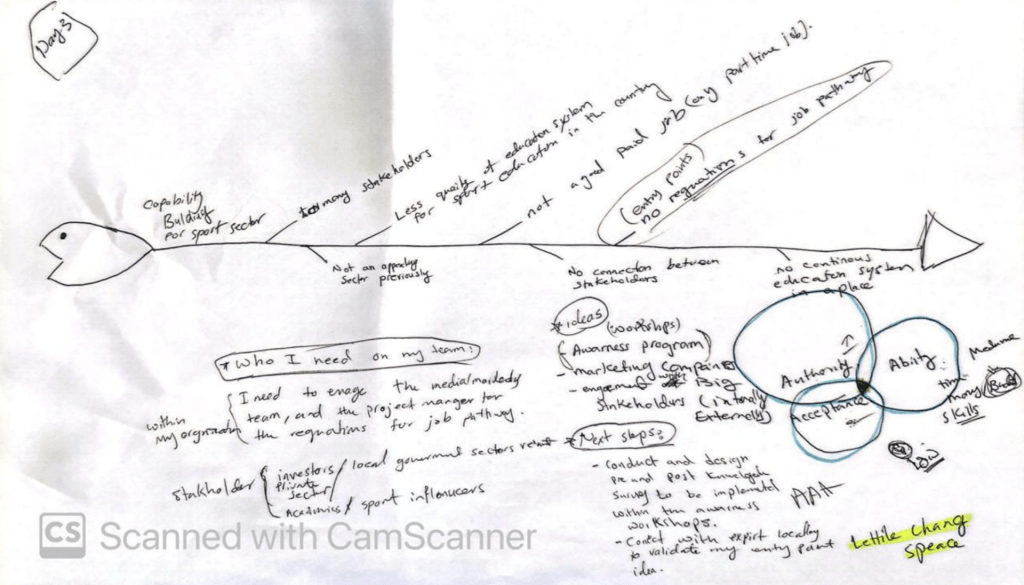
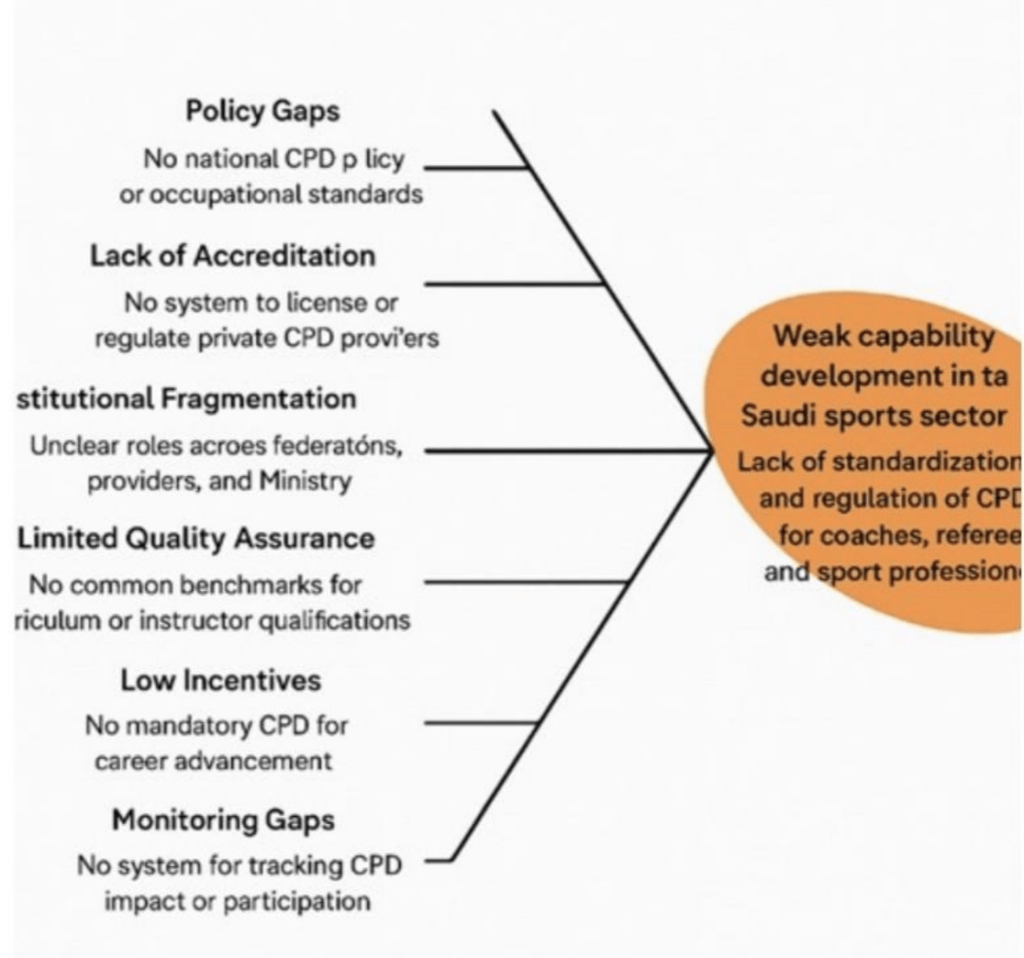
This analysis allowed me to move from frustration to a clearer map of where to intervene.
Progress came through iterations, small experiments that generated both learning and authorization.
- Iteration 2: Mapped institutional roles and discovered fragmentation was a bigger barrier than expected. Began conversations with stakeholders to clarify responsibilities.
- Iteration 3: Drafted a competency framework with technical experts, benchmarking international best practices. Learned that federations wanted flexibility, not one-size-fits-all.
- Iteration 4: Secured agreement from three federations to pilot the framework. Learned that institutional readiness varied significantly.
- Iteration 5: Launched pilots and gathered participant feedback. Built a coalition of federation “champions” willing to advocate for the framework.
- Iteration 6: Introduced a monitoring template, collected structured data, and initiated discussions on how CPD completion might be better connected to career pathways.
The insight I gained is that progress is not linear. It requires persistence, reflection, and building coalitions step by step. The fishbone helped me stay grounded in the systemic nature of the challenge, while iterations helped me test real pathways for reform.
This approach has already transformed my mindset. In the past, I leaned toward big solutions and comprehensive plans. Now, I see the value in starting small, experimenting, and scaling what works.
In the future, I will:
- Begin with problem deconstruction rather than solution statements.
- Treat learning and connections as progress to celebrate, not distractions.
- Use iteration cycles to build adaptive capacity, especially in complex systems where uncertainty is high.
- See “failure” as useful feedback, not a setback.
This approach helps avoid paralysis and creates momentum, even in environments where political and institutional barriers exist.
I am already applying IPP lessons in my daily work. For example:
- When delegating, I now focus on clarity of scope, accountability, and trust.
- In time management, I block space for strategic reflection and avoid being consumed only by urgent requests.
- In stakeholder engagement, I now map not only positions but also authorizers, connectors, and potential resistors.
Looking ahead, I will use PDIA to design and implement reforms across the sports sector, from talent development to governance. I also see value in sharing these methods with colleagues, so adaptive problem-solving becomes part of the institutional culture.

Words of Wisdom to Share with Fellow PDIA Practitioners
- Progress is not always visible, but it is always happening if you are learning and building relationships.
- Do not underestimate the power of a conversation with a stakeholder, a simple mapping exercise, or a single pilot session. These are not “small wins”, they are the building blocks of transformation.
- Finally, embrace humility. Complex problems resist quick fixes. The courage to say “we don’t know yet, but we are learning” is itself a mark of leadership.
The IPP journey has been a leadership transformation. Working on building a national CPD framework for the Saudi sports sector has given me a clearer pathway, stronger tools, and a coalition of partners committed to capacity building.
As a policy leader, I have learned that impact does not come from arriving with ready-made answers, but from listening deeply, engaging diverse voices, and enabling collective problem solving. Leadership in this context means creating the conditions where better solutions can emerge, adapt, and thrive.
Moving forward, I will continue to apply these lessons — listening before acting, experimenting before scaling, and empowering others to share ownership of the change. This is how capacity building will become not just a policy aspiration, but a lived reality in the sports sector.
Ultimately, true leadership in public policy is measured not by the plans we announce, but by the sustainable systems and real impact we help create. And this is the journey I am committed to leading.
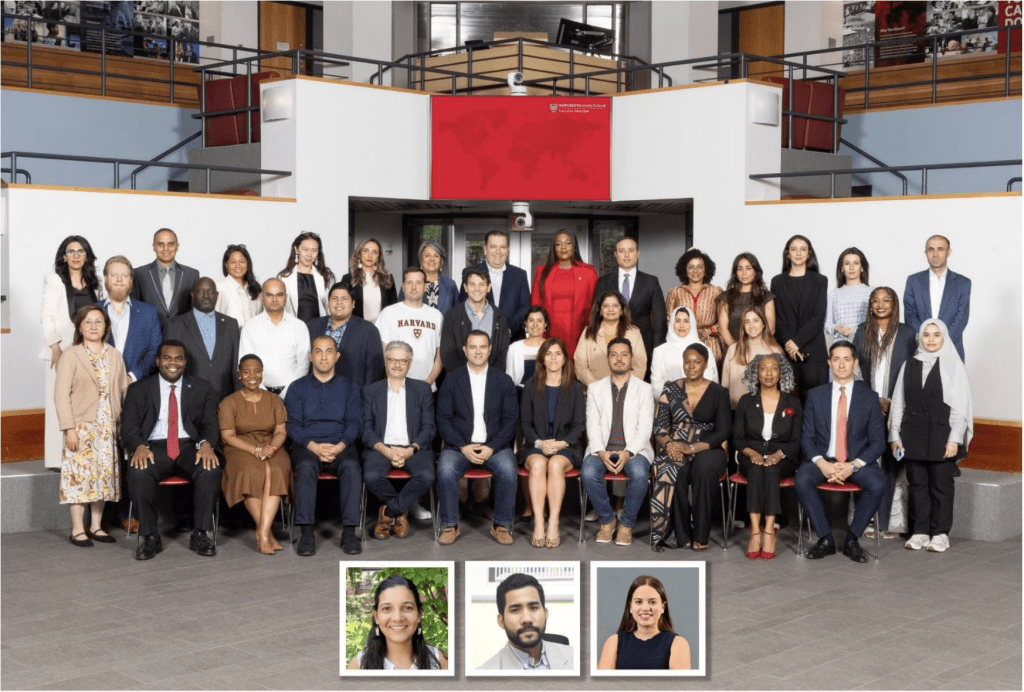
This is a blog series written by the alumni of the Implementing Public Policy Executive Education Program at the Harvard Kennedy School. 36 Participants successfully completed this 5-month hybrid program in September 2025. These are their learning journey stories.