
Reducing Regional Inequality in Azerbaijan: Tackling Income and Employment Gaps Beyond Baku
Guest blog by Shamil Shirinov, IPP ’25
When I first joined the IPP course, I thought policy implementation was mostly about having the right plan and making sure it was executed properly. That’s how I had always seen things in practice: deadlines, budgets, checklists. But over time, I came to realize that implementing public policy is less about following a fixed script and more about ruling uncertainty, learning as you go and building coalitions of people who care enough to keep pushing forward.
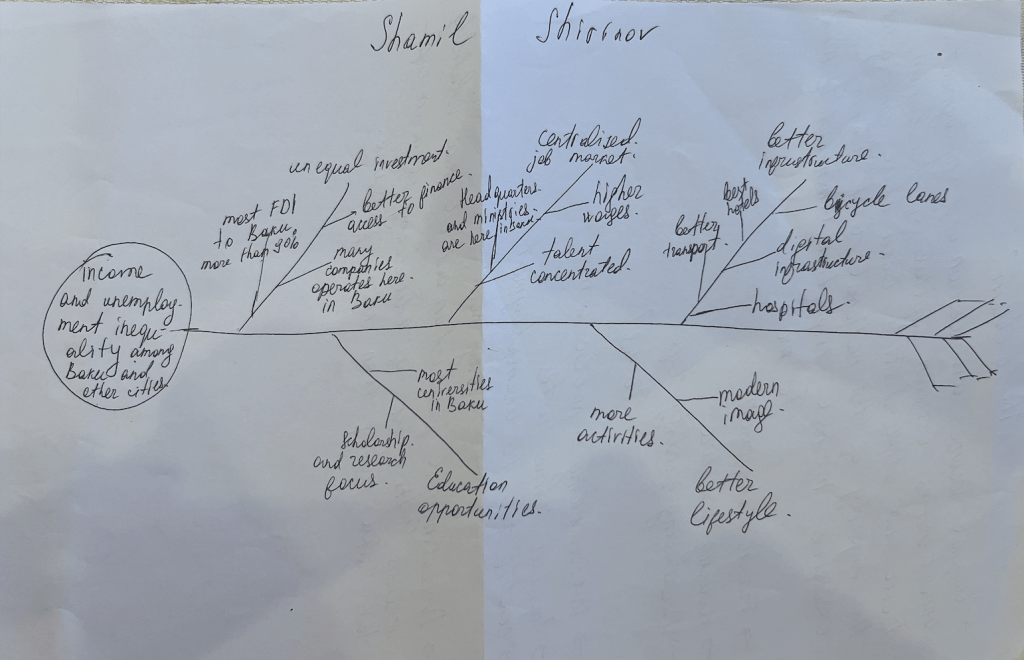
The challenge I chose to work on was deeply personal to me: the gap in income and employment opportunities between Baku, the capital of Azerbaijan, and the rest of the country. I have seen this inequality all my life. For decades, wealth has been concentrated in the capital, while regional programs are repeated again and again with little change in outcomes. At first, the problem felt overwhelming, too broad and too entrenched to touch. But using the PDIA tools — especially the fishbone diagram — helped me see that the roots of the problem went beyond economics. They stretched into weak coordination among ministries, unreliable data, rigid planning practices and limited empowerment at the local level.
As I worked through the course, my approach began to shift. I stopped expecting a single big fix and started looking for smaller entry points. I noticed how much of implementation is really about people – about how trust is built slowly, through small steps, conversations and the way responsibility is shared. Delegation, for example, was something I had underestimated. I saw how often tasks were handed out without clarity, leaving people waiting for approvals rather than acting with ownership. Introducing simple habits like short, regular check-ins changed the tone of teamwork from dependency to collaboration.
Time also took on new meaning for me. At first, my days were dictated by external deadlines and formal reporting, leaving me rushing from one task to the next. But when I began to prioritize time for reflection and focus on work that felt truly meaningful, I felt more effective and less exhausted. Even in policy, where urgency often dominates, I learned that making space for thought can actually speed up progress.
Perhaps the most surprising discovery was that progress doesn’t always look like a finished product. A pilot project that failed to deliver the intended results turned into a breakthrough once I reframed it as a learning opportunity. Sharing what didn’t work, instead of hiding it, actually built more trust and brought new people into the conversation. Over time, I could trace how authorization expanded step by step: first deputy-level officials, then regional colleagues and eventually senior ministries. Each stage added legitimacy, even as challenges of alignment remained.
I no longer see policy work as a race to finish a plan. I see it as a journey of learning. I want to keep breaking down big problems into smaller parts, testing ideas, treating communication as central and empowering others to act. Already, I’ve begun sending out short “lessons and leads” updates to colleagues and authorizers, inviting regional voices into the work, and pushing for stronger data systems. None of these are dramatic shifts, but together they are changing how the challenge is seen and how people engage with it.
If I could leave one piece of advice for others walking this path, it would be: don’t wait for certainty. Start with what you know, take a small step, learn and adjust. Progress is not only about building roads or delivering reports – sometimes it’s about a new ally, a new insight, or the courage to admit, “That didn’t work, but now we understand more.”
This course gave me more than tools. It gave me a mindset – one that embraces complexity, values trust and keeps moving forward, one small but meaningful step at a time.
This is a blog series written by the alumni of the Implementing Public Policy Executive Education Program at the Harvard Kennedy School. 36 Participants successfully completed this 5-month hybrid program in September 2025. These are their learning journey stories.