
Championing Social Public Partnership Frameworks in Africa
Guest blog by Carolyn Kandusi, IPP ’25
When I joined Harvard Kennedy School’s Implementing Public Policy (IPP) program, my goal was clear: sharpen my policy acumen before fully launching Policy Innovation Lab Africa (PIL-A). As a social sector leader who has spent years building solutions, mobilizing capital, and driving social sector impact, I knew that moving into the public policy space required more than vision—it required legitimacy, frameworks, and the discipline to engage with government systems at their own pace. I thought IPP would simply provide me with the technical tools to support that ambition.
However, what I discovered was something far more profound. IPP became therapy—the kind that interrupts old habits of rushing from idea to solution, forcing you to slow down, interrogate assumptions, and see the deeper architecture of problems. It taught me that leadership in policy innovation is not just about fixing what is broken; it is about learning to construct and deconstruct problems, to hold the complexity without rushing to tidy answers. That shift has been transformative, not only professionally but personally.
Beyond the theoretical frameworks, the most profound lessons emerged from the people around me. The cohort itself proved to be an invaluable classroom, a dynamic space where role-playing sessions helped me refine strategies for my policy challenge. From late-night collaborations to peer feedback, I connected with a diverse community of practitioners, each bringing wisdom from across the globe. They underscored that policy is not merely about ideas or institutions, but fundamentally about people: the authorizers, implementers, partners, and the intricate networks of trust that drive systems forward. Witnessing their journeys and, in turn, offering my skills and experience, was among the most enriching aspects of the program.
This context has sharpened the problem I am committed to solving: how can African governments and the social sector transition from fragmented, ad hoc engagements to structured, co-created partnerships that enable innovations to scale sustainably through public systems? For me, this is not just a technical problem—it is a relational one. It is about building trust, aligning incentives, and equipping both sides with tools to co-own solutions. The Social-Public Partnership Framework (SPPF), which I am now developing through Policy Innovation Lab Africa, is rooted in this conviction. The IPP’s Problem-Driven Iterative Adaptation (PDIA) model is providing me with both the methodology and mindset to turn that conviction into practice.
As a social entrepreneur, I lived by the motto: every problem is capital—move fast, innovate, and solve. IPP turned that speedometer down. I learned that in public policy, rushing often means fixing symptoms while ignoring root causes.
The discipline of constructing and then deconstructing problems was a game-changer. It reminded me that sometimes the best leadership is to pause, ask more profound questions, and resist the itch to “just fix it.”
Another gem was the power of frameworks. The 4Ps (Projection, People, Process, Perception) became my anchor. They’ve given me a way to balance my visionary brain with systems thinking.
And perhaps my most important lesson? Remembering that behind every office and institution are real human beings with emotions, motivations, and fears. Policy isn’t just paperwork; it’s people-work. Stephen Covey’s wisdom—seek first to understand, then to be understood—now sits at the heart of my leadership.
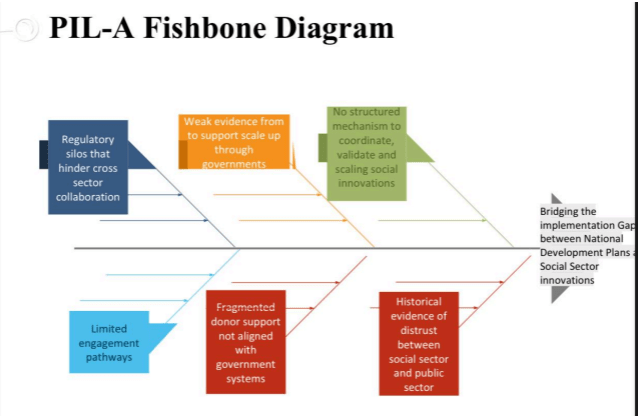
In my problem construction and deconstruction through the fishbone, I realized my challenge wasn’t just about “government buy-in.” There were deeper causes: weak institutional processes, capacity gaps at mid-levels, trust deficits, and misaligned incentives.
That analysis helped me reframe the problem. The real issue isn’t that governments are unwilling, but that systems and relationships are underdeveloped. Once I saw that, everything shifted. I started designing more realistic pathways for the Policy Innovation Lab Africa, ones that map actors across layers—from ministers to implementers—and create multiple entry points.
Before IPP, I ran on adrenaline: see problem → design solution → launch. Now, I work like a detective. I slow down, trace causes, test assumptions, and embrace iteration. This doesn’t mean I’ve lost my entrepreneurial spark. It means I’ve added a new gear. Instead of only sprinting, I can also pace myself for marathons—the kind of stamina that influences work demands.
Already, I’m embedding these lessons into PIL-A’s Social-Public Partnership Framework. Actor mapping, root-cause analysis, and the 4Ps are shaping how we design pilots with governments.
On a personal level, I’ve noticed the “therapy effect.” I don’t just rush into solutions for professional challenges—I also apply problem construction in my personal life. It’s teaching me patience and emotional intelligence in ways I never expected.
If I can leave you with a few reminders, they’d be these:
- Fall in love with the problem, not the solution. Digging deep is the real superpower.
- Never forget that policies are made and implemented by people. Kindness and emotional intelligence are as essential as data and frameworks.
- Think beyond authorizers. Real change happens when the ecosystem at all levels is engaged.
- Don’t be afraid of the messy middle. It’s in the iterations, the reframings, and the unexpected alliances that breakthroughs happen.
IPP has been the therapy I didn’t know I needed. It has taught me to slow down, deconstruct before I construct, and treat policy not as a race to solutions but as a dance with complexity and humanity. As I build the Policy Innovation Lab Africa, I’m grateful to carry these lessons into a future where the social and public sectors co-create, not just coexist.
This is a blog series written by the alumni of the Implementing Public Policy Executive Education Program at the Harvard Kennedy School. 36 Participants successfully completed this 5-month hybrid program in September 2025. These are their learning journey stories.